
If you’re struggling to build quality media lists, you’re definitely not alone. 57% of PR professionals say that building and nurturing media relations is the most time-consuming part of their job
Having recently launched a new startup myself, I know all too well the struggle of having a ground-breaking product but struggling to get the word out about it, especially before your SEO efforts start to kick in.
So before you drop five figures on a press directory that turns out to be a journalist graveyard with a 53% bounce rate (yes, I’ve been there), let me share the ones that have actually delivered value for me over the years.
TL;DR: I’ve found that JournoFinder is the best media database because it’s continually updated and verified, so you don’t waste time on pitches that never get read. The fact that it costs 75% less than most other options is just a bonus.
But there’s a time and place for other platforms depending on your specific needs, budget, and team size. So, here’s a deep dive into my top 6 media databases for 2026.
1. JournoFinder: Best Overall Media Database
JournoFinder first caught my attention because it promised something revolutionary: real-time journalist data pulled directly from current news articles.
Instead of maintaining a static database that goes stale, JournoFinder continuously crawls over 50 million news articles to identify who’s actually writing about specific topics right now. When I search for “fintech startups,” I’m not getting a list of journalists who covered fintech three years ago; I’m seeing reporters who published relevant stories this week.

What really sold me was the email verification system. Every contact gets automatically checked for deliverability before you export your media list. During my first campaign using JournoFinder, I achieved an 89% delivery rate compared to the 47% I was getting with my old approach. That’s not just better metrics… that’s the difference between landing coverage and having your pitch disappear into the void.
The AI-powered JournoRequest alerts are another game-changer. Instead of manually checking HARO, Qwoted, Featured, and other platforms daily, I get targeted notifications when journalists are looking for sources in my expertise areas. Last month, one of these alerts led to a feature in TechCrunch that drove more traffic than our entire previous quarter.

The final thing that made it a no-brainer for me was JournoFinder’s 7-day free trial. They’re so confident in their database, they let you access it for free before you commit. You don’t even have to have an awkward sales call first – just sign up from their website.
Pros:
- Real-time data from current news articles
- Automatic email verification and bounce detection
- AI-filtered journalist request alerts
- Bulk URL upload for extracting author contacts
- Significantly more affordable than enterprise alternatives
- 7-day free trial with no long-term commitment
Cons:
- Not the largest database (but quality matters too)
- No built-in email sending capabilities
- Newer platform with fewer integrations than established competitors
Pricing: Starting at $189/month or $99/month with an annual plan, making it by far the most affordable option. 7-day free trial available without a sales call.
Best for: Small to medium businesses, agencies, and anyone who needs accurate data without the enterprise price tag. Perfect for teams that prioritize data quality over database size.
2. MillionPodcasts: Best Outreach Podcast Database

Plenty of traditional databases now bolt on a few podcasts, but the coverage is thin and the contact data thinner. That works for the odd guest spot, but if podcast placements are a real part of your campaigns, you’ll want a specialist. MillionPodcasts is a podcast contact database built specifically for outreach, and that focus is the whole point.
It indexes shows from every major hosting platform and pairs each one with verified host, producer, and booker contacts. These are sourced from public podcast pages and host bios the way a publicist would do it by hand, then SMTP-verified, refreshed continuously, and GDPR-compliant rather than scraped. The depth of search is where it earns its spot. You can filter by host, location, language, beat, audience size, and latest episode date, then narrow by whether a show accepts guests or carries sponsors, and even by listener demographics like persona, income, age, and gender skew. From one query you get a pitch-ready shortlist, save it, and export to CSV or Excel for your CRM or mail-merge tool.
Pros:
- Podcast-specific contact database
- Verified host, producer, and booker emails
- SMTP-verified and GDPR-compliant, not scraped
- Deep filters for host, beat, and audience size
- Listener demographics for sponsorship targeting
Cons:
- Limited to podcasts only
- Listener demographics are estimates, not exact
- Fewer monitoring and reporting features
- Newer than established competitors
Pricing: Free trial no card required, starts at $19/month or yearly with 40% off.
Best for: PR and comms teams building podcast media lists, marketers sourcing sponsorship-fit shows, and podcasters booking guests.
3. Rephonic: Best Podcast Media Database
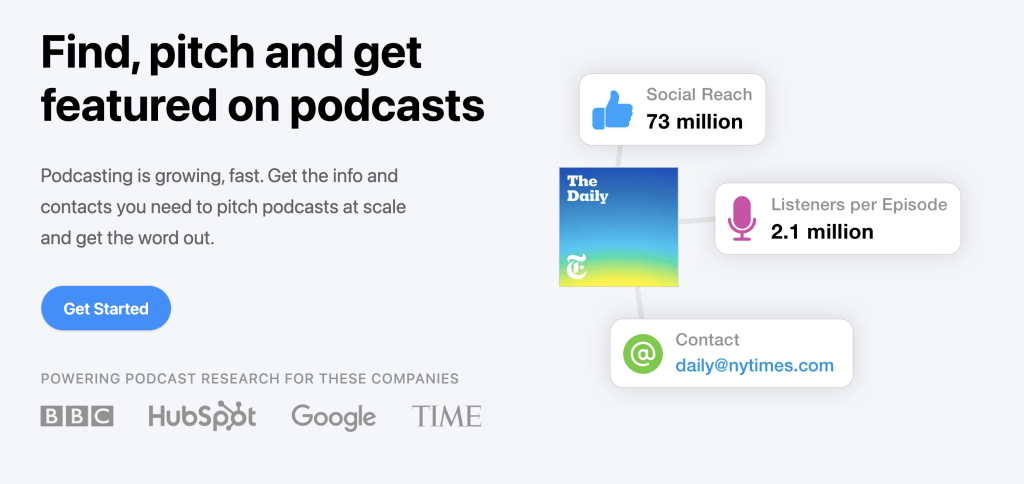
While many traditional media databases now include podcasts, their coverage is often limited in both the number of shows indexed and the depth of data. That might work for occasional podcast outreach, but PR teams often find they need a specialist tool. Rephonic is the most comprehensive podcast media database for PR teams looking to book high-impact guest appearances for clients.
Rephonic has more than 3 million shows in its database, with a search tool, advanced search filters, and hundreds of data points per podcast. Rephonic saves PR teams a huge amount of time when finding and qualifying relevant opportunities. Each show includes details such as estimated listener numbers, contact information, and audience demographics, while built-in outreach tools help streamline pitching and reply management. Another plus is that it’s relatively affordable compared with many other PR software platforms.
Pros:
- Huge podcast database with 3m+ shows
- Rich podcast data and contacts
- Podcast monitoring across episode titles, show notes, and transcripts
- Built-in outreach tool for sending pitches and managing replies
- Strong team collaboration features
Cons:
- Some advanced features are limited to higher-tier plans
- Listener numbers are estimates and best used for comparison, not absolute accuracy
- Reporting and ROI tracking are somewhat limited
- Limited to podcasts only
Pricing: Starts at $99/month or $990/year, with a 7-day free trial.
Best for: Data-driven PR teams that want to identify and pitch high-impact podcasts for their clients.
4. Cision: Best for Enterprise-Level PR
Now, I’ll be honest – Cision isn’t my first recommendation for most businesses, but there are scenarios where its massive scale makes perfect sense. When I worked with a Fortune 500 client on a global product launch, Cision’s comprehensive approach proved invaluable.
Cision has been in the PR game for over a century, and it shows in their database depth (but also their UI). With over one million journalist contacts spanning 190 countries, they’re the undisputed heavyweight champion of media databases. Their integration with PR Newswire means you can research, pitch, and distribute press releases all within one ecosystem.

Cision’s advanced filtering options are genuinely impressive. You can segment journalists by circulation numbers, audience demographics, and even past coverage sentiment. During our campaign, we identified tier-one reporters who had written positively about our competitors – intel that proved crucial for our messaging strategy.
However, let’s talk about the elephant in the room: cost. Cision typically starts around $7,000 annually and can easily climb into five figures with add-ons. That’s enterprise-level investment for enterprise-level results.
Pros:
- Massive global database with extensive coverage
- Integrated press release distribution via PR Newswire
- Comprehensive media monitoring and analytics
- Advanced filtering and segmentation options
- Strong customer support and training resources
- Established relationships with major media outlets
Cons:
- Expensive; no transparent pricing
- Interface feels outdated and can be overwhelming
- Requires long-term contracts and setup fees
- Overkill for small to medium businesses
Pricing: Custom pricing typically starts around $7,000+ annually, with add-on costs for premium features and press releases
Best for: Large corporations, international campaigns, and organizations that need comprehensive media monitoring alongside their database needs.
5. Muck Rack: Best for Modern PR Teams
Muck Rack represents the new generation of PR tools, and honestly, it’s probably the platform I’d choose if budget weren’t a factor. Their approach to combining journalist databases with modern collaboration features creates something special for PR teams.
What really makes Muck Rack one of the best media databases is its focus on the social media age of journalism. Instead of just providing email addresses, they offer comprehensive journalist profiles including Twitter activity, recent articles, and even beat changes. I’ve found this context invaluable for personalizing pitches. Knowing that a journalist just tweeted about struggling with work-life balance helped me frame a story about our company’s four-day work week experiment.

The platform’s search functionality uses natural language processing, so you can enter long-tail searches like “journalists who cover sustainability in fashion” to find the specific contacts you need.
And for PR teams, Muck Rack’s collaboration features are super helpful. If you’ve ever been in the embarrassing situation where multiple team members pitch the same journalist with different angles, you’ll know what I mean.
Pros:
- Modern, intuitive interface that’s actually enjoyable to use
- Comprehensive journalist social media profiles and activity
- Excellent team collaboration and pitch tracking features
- Sophisticated search with natural language processing
- Automated coverage tracking and analytics
- Strong mobile app for on-the-go PR work
Cons:
- Premium pricing that puts it out of reach for smaller teams
- No free trial
- Database size smaller than enterprise competitors
- Some users report occasional data lag
- Can be overwhelming for solo practitioners
Pricing: Plans start around $5,000 annually for basic access, with team features pushing costs significantly higher.
Best for: Mid-sized agencies, collaborative PR teams, and organizations that prioritize modern workflows over database size.
6. Meltwater: Best for Comprehensive Media Monitoring
While I wouldn’t recommend Meltwater for its media database alone, it has proved invaluable for its social listening and media intelligence features that go far beyond traditional PR metrics.
Meltwater’s analytics capabilities are enterprise-grade. You can track share of voice against competitors, analyze geographical sentiment variations, and even predict trending topics based on social media patterns. For brands operating in multiple markets, these insights become crucial for timing and targeting campaigns.

However, I’ve found Meltwater’s journalist database to be less current and complete than specialized platforms. Their strength is breadth of monitoring rather than depth of journalist contacts. The platform is also notably expensive and complex to implement.
Pros:
- Comprehensive social listening and sentiment analysis
- Advanced analytics and competitive intelligence
- Global coverage with local market insights
- Predictive trending topic analysis
- Excellent crisis monitoring capabilities
Cons:
- Very expensive with complex pricing structure
- Journalist database less current than specialized competitors
- Steep learning curve and lengthy implementation
- Can be overwhelming for simple PR needs
Pricing: Custom pricing typically ranging from $7,000-$10,000+ annually depending on features and regions covered.
Best for: Brands needing extensive media monitoring, crisis management capabilities, and competitive intelligence alongside basic PR database functions.
7. Agility PR: Best Value for Mid-Market
If you like the sound of Meltwater but can’t afford it, Agility PR might be the next-best option.
Their database, while smaller than enterprise competitors, focuses on quality over quantity. I’ve found their contact accuracy to be quite reliable, though you won’t find as many niche or international contacts as with larger, dedicated platforms like JournoFinder.
What makes Agility PR a viable alternative to Meltwater is its media monitoring and social listening features that give a better all-round picture of brand sentiment.

Agility’s integrated email outreach with AI translation and detailed custom reports allow you to manage and track your whole campaign in one place. You can see which journalists are opening your pitches, which outlets are providing the most valuable coverage, and how your efforts translate into website traffic and leads.
Managed PR services are also available, and although I have never used these myself, I have heard good things about their support.
Pros:
- Excellent customer service and account management
- Built-in email outreach and tracking capabilities
- Reasonable pricing for feature set provided
- Solid reporting and ROI tracking
Cons:
- Smaller database compared to dedicated platforms
- Fewer advanced features than premium competitors
- Integration options somewhat limited
- No transparent pricing
Pricing: Approximately $3,000 annually for full-feature access, making it one of the more affordable comprehensive solutions.
Best for: Growing businesses and mid-sized companies that need reliable PR tools without enterprise complexity or costs.
8. Prowly: Best for Startups and Modern Workflows
Prowly (what a name!) represents the newest generation of PR platforms. Its features are similar to Muck Rack: media database, CRM, emails and press releases, media monitoring, reporting.
One standout feature of Prowly is the newsroom hosting. Instead of just helping you find journalists, Prowly helps you create a branded media center where reporters can access press releases, high-resolution images, and executive bios.

Refreshingly, Prowly is upfront about its pricing and plans. Starting at $369/month (or $258/month with an annual plan), you get access to the media database and basic email tools. For follow-up emails, you’ll need to upgrade to the next tier.
I have also found some of the limits on their plans to be quite restrictive. You can store and export a limited number of contacts, and only personalize 10 out of the 1,000 emails included in the basic plan. And if you’ve done any amount of digital PR outreach, you’ll know that personalization is everything.
Personally, I prefer to use JournoFinder as a specialist media database, supported by a separate email outreach tool that does everything I need it to.
Pros:
- Modern, visually appealing interface
- Built-in newsroom hosting and brand management
- Flexible monthly billing options
- Strong CRM and marketing tool integrations
- Startup-friendly pricing and features
Cons:
- Smaller journalist database than established competitors
- Limited advanced search capabilities
- Newer platform with fewer proven case studies
- Basic plan limits can be frustrating
Pricing: Starting at $369/month ($258/month paid annually)
Best for: Startups, design-conscious brands, and companies that prioritize modern workflows over database size.
Media Database Comparison at a Glance
| Feature | Standout | Pricing | Database Size |
| JournoFinder | Real-time data | $99/month | 1M+ contacts |
| MillionPodcasts | Podcast data | starts $19/month | 2.7M+ contacts |
| Cision | Global reach | Custom ($7,000+/year) | 1.4M+ contacts |
| Muck Rack | Team collaboration | Custom ($5,000+/year) | 500K+ contacts |
| Meltwater | Social listening | Custom ($6,000+/year) | 700K+ contacts |
| Agility PR | Customer service | Custom ($3,000/year) | 300K+ contacts |
| Prowly | Modern UI | $258/month | 200K+ contacts |
How to Choose the Right Media Database for Your Digital PR
After years of testing these platforms across different campaigns and budgets, I’ve identified several key factors that should influence your choice of media database. The key is understanding that no single platform excels at everything – success comes from aligning features with your actual requirements.
Start with budget reality checks. I’ve seen too many small businesses stretch their budgets for enterprise platforms they’ll never fully utilize. If you’re spending more than 5% of your annual marketing budget on a media database, you’re probably overpaying. Consider the different features you need, and work out whether you can get individual specialized tools cheaper.
Prioritize data freshness over database size. A common mistake is assuming bigger databases automatically deliver better results. It’s far more important to have up-to-date information. Fresh data from 1,000 active journalists beats stale contacts from 10,000 former reporters.
Test search functionality with your specific keywords. Each platform’s search algorithm works differently, and some excel at finding journalists for niche topics while others favor broad categories. Before committing, run searches for your industry-specific terms and evaluate result relevance. If you’re stuck with a demo rather than a free trial, you can request for certain searches to be included.
Consider integration requirements early. If your team uses specific CRM or marketing automation tools, verify compatibility before signing contracts. I learned this lesson painfully when a client’s expensive Cision subscription couldn’t integrate with their existing workflows, forcing manual data exports for every campaign.
Factor in learning curve costs. Complex platforms like Meltwater might offer impressive features, but if your team spends weeks learning the interface, you’re losing valuable campaign time. Sometimes the simpler tool that your team can use immediately delivers better ROI than the feature-rich platform that sits unused.
My Final Take on Media Databases
Although SEO is still my main source of long-term traffic, I can’t deny the effectiveness of a well-placed PR campaign. After testing all of these platforms across dozens of campaigns, I keep returning to a simple truth: the best media database is the one that has the journalists actually covering your niche.
For this purpose, JournoFinder comes out on top. Its real-time data approach solves the fundamental problem that plagues traditional databases: outdated information. When I can achieve 89% email delivery rates at $99 monthly versus 50% rates at $700 monthly, the choice becomes obvious.
That said, context matters enormously. Enterprise teams managing global campaigns may genuinely need Cision’s comprehensive coverage and monitoring capabilities. Collaborative agencies might find Muck Rack’s team features worth the premium pricing. The key is honest assessment of your actual requirements versus aspirational feature lists. Plus, there are a few types of PR, you can even go down the route of being featured in podcasts, then I would suggest checking out MillionPodcasts.
My advice? Start with a platform that matches your current needs and budget, but choose one that’s innovating for the future rather than being held back by a legacy system.
Frequently Asked Questions
What is the difference between a media database and a press release distribution service?
Media databases help you find and contact journalists directly, while distribution services send your press release to multiple outlets simultaneously. Media databases enable targeted, personalized outreach, whereas distribution services offer broad but less targeted reach.
Can small businesses afford professional media databases?
Yes, affordable options like JournoFinder start at $99 monthly, making professional databases accessible to small businesses. The key is choosing platforms that match your scale rather than paying for enterprise features you won’t use.
What’s the best free alternative to paid media databases?
While no free option matches paid databases’ comprehensiveness, Google News searches, Twitter journalist lists, and outlet websites can provide basic contact information. You can also use HARO and other alternatives to access journalist requests as they arise. However, free methods require significantly more time and offer lower accuracy rates.
How do I verify journalist contact information before sending pitches?
Use platforms with built-in verification like JournoFinder, or employ third-party email verification tools. Additionally, check journalists’ recent articles and social media activity to confirm they’re still active on relevant beats before pitching.
Which media database has the most international coverage?
Cision offers the most extensive international coverage with contacts across 190 countries, making it ideal for global campaigns.
Share:
About the Author


