
The Keyword Golden Ratio: Hidden SEO KW Research for Ranking Faster
|

Written by
James Oliver
Ever wondered why some new websites can rank quickly while others struggle for months?
The Keyword Golden Ratio (KGR) might be the secret weapon you’re missing. This powerful yet underutilized keyword research method helps new websites find low-competition opportunities that can rank in days, not months.
Well, we’ll be going over:
- What is the Keyword Golden Ratio and why does it work so effectively?
- How do you calculate and find KGR keywords for your website?
- What are the potential benefits and limitations of this approach?
Let’s dive in!
What is the Keyword Golden Ratio?
The Keyword Golden Ratio (KGR) is a data-driven keyword research methodology developed by Doug Cunnington of Niche Site Project. This approach helps identify low-competition keywords that new or low-authority websites can rank for quickly—often within days of publishing content.
Unlike traditional keyword research that focuses primarily on search volume, KGR examines the relationship between search volume and the number of competing pages with the exact keyword in their title tags. This ratio reveals “golden” keyword opportunities that are underserved in Google’s search results.
The beauty of KGR lies in its simplicity and effectiveness. By targeting these specific keywords, website owners can potentially generate organic traffic much faster than with conventional keyword strategies.
How the Keyword Golden Ratio Works
At its core, KGR works by identifying keywords that have:
- Relatively low monthly search volume (under 250 searches)
- Few competing pages with the exact phrase in their title tags
- A mathematical relationship between these two factors that meets specific criteria
The approach is built on a straightforward premise: when there aren’t many pages specifically optimized for a search term (as indicated by “allintitle:” results), Google has fewer strong options to display in search results—creating an opportunity for new content to rank quickly.
The KGR Formula
The Keyword Golden Ratio formula is:
KGR = Number of Google “allintitle:” results ÷ Monthly search volume
Where:
- “Allintitle:” results show how many pages have the exact keyword in their title tag
- Monthly search volume is the estimated number of monthly searches for that keyword
KGR Interpretation
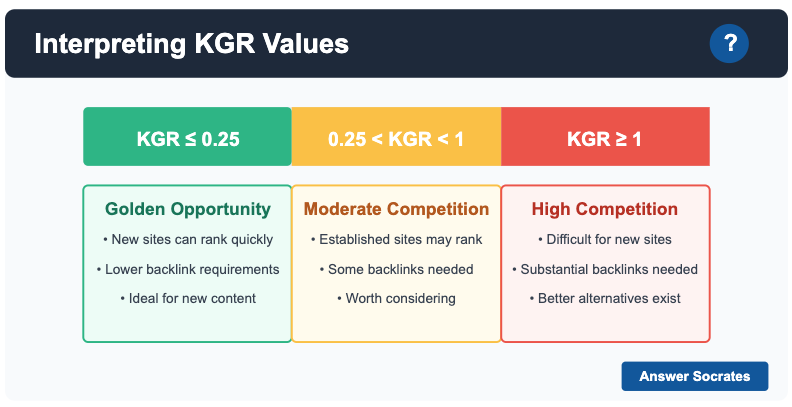
To qualify as a “golden ratio” keyword:
- The monthly search volume must be less than 250
- The KGR value should be less than or equal to 0.25
For example, if a keyword has 30 “allintitle:” results and a monthly search volume of 170:
KGR = 30 ÷ 170 = 0.18
With a KGR of 0.18, this keyword would qualify as a golden opportunity.
Finding KGR Keywords: Step-by-Step Process
Finding KGR-compliant keywords involves a systematic approach. Here’s how to do it:
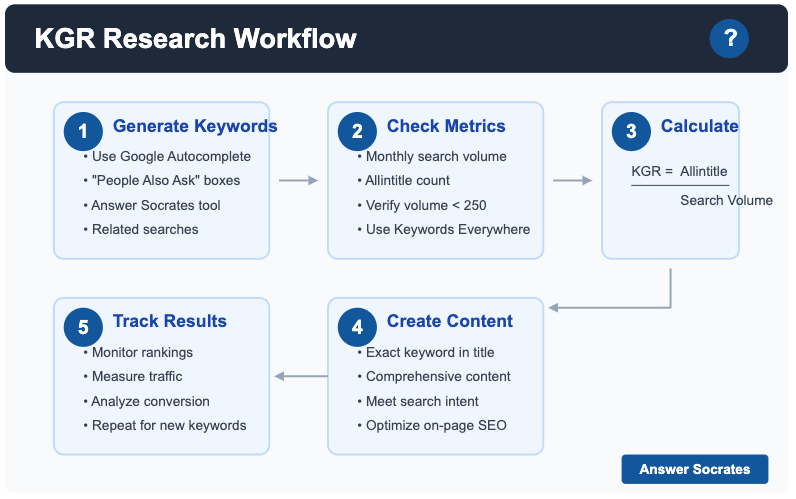
1. Generate Long-Tail Keyword Ideas
Start by brainstorming potential long-tail keywords in your niche. These are typically 3-5 word phrases that are specific and have clear search intent. You can generate these through:
- Google Autocomplete suggestions
- “People Also Ask” boxes
- Related searches at the bottom of search results
- Keyword research tools like Answer Socrates, Ubersuggest, or Ahrefs
2. Check Search Volume
For each keyword candidate, determine its monthly search volume. This can be done using:
- Google Keyword Planner (free but requires an active Google Ads account)
- Keywords Everywhere’s paid browser extension (or any of these alternatives)
- SEMrush or Ahrefs (paid tools)
Remember, KGR focuses on keywords with less than 250 monthly searches, so eliminate keywords exceeding this threshold.
3. Determine “Allintitle:” Count
To find how many pages have your exact keyword in their title:
- Go to Google
- Type “allintitle:” followed by your keyword (without quotation marks)
- Record the number of results
For example: allintitle: best running shoes for flat feet
4. Calculate and Evaluate KGR
Divide the “allintitle:” count by the monthly search volume to calculate the KGR.
- If KGR ≤ 0.25: This is a golden opportunity keyword
- If 0.25 < KGR < 1: Competition is moderate; ranking may take longer
- If KGR ≥ 1: Competition is high relative to search volume
5. Organize Your KGR Keywords
Create a spreadsheet to track and prioritize your KGR keywords. Include columns for:
- Keyword
- Monthly search volume
- Allintitle count
- KGR value
- Search intent
- Content status
Tools That Streamline KGR Research
While KGR can be calculated manually, several tools can automate and simplify the process:
Answer Socrates
Answer Socrates is particularly effective for KGR research because it:
- Automatically generates hundreds of keyword ideas from Google autocomplete and “People Also Ask” questions
- Can be filtered for low-competition keywords
- Provides a user-friendly interface for exploring keywords by topic
- Offers recursive keyword discovery to find deeper niche opportunities
Other Helpful Tools
- Allintitle.co – Provides real-time “allintitle:” data without Google’s API limits
- Keyword Atlas – Specifically designed for automating alphabet soup and KGR research
- Keywords Everywhere – Shows search volume directly in Google search results
- KWFinder – Offers accurate search volume data with an intuitive interface
Benefits of KGR
The KGR method offers several potential advantages according to its proponents:
- Potentially Faster Rankings: By targeting keywords with low competition relative to search volume, new sites might see rankings more quickly
- Reduced Backlink Dependency: Content targeting KGR keywords may rank with minimal or no backlinks
- Clear Methodology: Provides a straightforward, data-driven approach
- Budget-Friendly: Can be implemented with free tools
- Targeted Content: Focuses on specific user queries with clear intent
Limitations and Considerations
When evaluating KGR as a strategy, consider these limitations:
- Low Traffic Volume: Individual KGR keywords generate modest traffic
- Scalability Challenges: Finding hundreds of KGR keywords can be time-consuming
- Search Volume Inaccuracy: Keyword tools often provide imprecise data
- Allintitle Limitations: Doesn’t account for semantic variations or SERP features
- May Not Work in All Niches: Highly competitive industries might have fewer KGR opportunities
- Limited Empirical Evidence: While there are anecdotal success stories, comprehensive studies of KGR effectiveness are limited
The KGR Controversy
It’s worth noting that KGR has been the subject of debate in SEO communities. Income School, a popular blogging education platform, has both promoted and criticized aspects of KGR in their content. Some critics argue that:
- The method oversimplifies Google’s ranking factors
- “Allintitle:” is an imperfect competition metric
- Low-volume keywords may not justify the creation effort
- The formula doesn’t account for user engagement metrics
However, supporters maintain that KGR provides a useful framework for beginners to find winnable keyword opportunities.
Advanced KGR Strategies
Combining KGR with Topic Clusters
Create topic clusters by:
- Identifying a broader topic with commercial potential
- Finding multiple KGR keywords related to that topic
- Creating a pillar page targeting the main topic
- Publishing cluster content targeting individual KGR keywords
- Interlinking all related content
This approach builds topical authority while leveraging the quick-ranking potential of KGR.
KGR for Affiliate Content
KGR may work particularly well for affiliate content:
- Target buying-intent KGR keywords (containing “best,” “review,” “vs,” etc.)
- Focus on specific product variations or use cases
- Create detailed comparison content for highly specific queries
KGR Content Optimization
To maximize KGR effectiveness:
- Use the exact keyword in your title tag and H1 heading
- Create comprehensive content (1,200+ words) that thoroughly addresses the query
- Include relevant images, tables, and bullet points
- Add schema markup where appropriate
- Ensure optimal page speed and mobile experience
Conclusion: Is KGR Right for Your SEO Strategy?
The Keyword Golden Ratio offers an interesting approach for new websites looking to gain traction in organic search. By focusing on underserved keywords with mathematical precision, KGR provides a potential pathway to early rankings and traffic.
While not a complete SEO strategy on its own, KGR can serve as a starting point for new sites and a complementary tactic for established ones. The method’s emphasis on low-competition opportunities aligns with the concept of targeting specific user needs.
As with any SEO technique, success depends on consistent implementation, quality content creation, and adapting to changes in search algorithms. Consider KGR as one tool in your broader SEO toolkit, and test its effectiveness for your specific niche and circumstances.
Whether you’re launching a new site or looking to expand an existing one, the Keyword Golden Ratio offers a data-driven approach that may be worth exploring as part of your overall content strategy.
Common Questions About KGR
Q: Does KGR still work with Google’s AI and semantic search capabilities?
A: This is debated among SEO practitioners. While Google better understands semantically related terms, the competition metric of “allintitle:” remains relevant because it shows pages specifically optimized for that exact query. However, you should also consider semantically related keywords in your content.
Q: Should I only target KGR keywords?
A: Most proponents recommend using KGR as part of a balanced SEO strategy. Use KGR keywords to gain initial traction and rankings, then gradually target higher-volume keywords as your site builds authority.
Q: How many KGR keywords should I target?
A: For a new site, some recommend aiming for 20-30 KGR-optimized articles before expanding to higher-competition keywords. This provides a foundation of potentially ranking content and initial traffic.
Q: What if I can’t find KGR keywords in my niche?
A: Some niches may have fewer opportunities than others. Try:
- Expanding your seed keyword list
- Looking at more specific sub-niches
- Exploring question-based keywords
- Considering related topics that complement your main niche
Share:
About the Author
