
I’ve been in SEO for over seven years, and Semrush was my go-to tool for a long time.
It’s a strong platform, but with the pricing starting at $139.95/month, it often feels like paying a lot, for more than you actually need.
The best Semrush alternative is Answer Socrates because it’s a simple and affordable keyword research tool that helps you discover real user questions and cluster them for your content.
These days, I use Answer Socrates to uncover trending, question-based topics alongside Ahrefs for data on SERPs, competitors, and backlinks.
But since no single tool works for everyone, I’ve pulled together eight of the best alternatives to help you find the right balance of features and cost.
Semrush Alternatives Overview
| Tool | Best For | Free Plan Details | Starting Price |
| Answer Socrates | Comprehensive keyword research & clustering | 3 searches/day, 1 recursive, 1 CSV, 1,500 clustering credits | $15/mo |
| Keywords Everywhere | Cheap keyword data in-browser | Extension free, volume data needs credits | $84/year (about $7/mo) |
| Ahrefs | Enterprise SEO & backlink analysis | Ahrefs Webmaster Tools (limited) | $129/mo |
| Moz Pro | Beginner SEO with DA/PA metrics | 3 searches/day | $49/mo |
| SE Ranking | Rank tracking & client reporting | 14-day free trial | $65/mo |
| Mangools | Beginner-friendly SEO tools | 5 searches/day, 15 keyword results, 5 competitor keywords | $31.85/mo |
| Ubersuggest | Budget-friendly all-rounder | 3 searches/day | $12/mo |
| Serpstat | Affordable all-in-one with rank tracking & competitor analysis | 7-day free trial | $69/mo |
| SEO Scout | Content optimization & A/B testing | Free trial | $49/mo |
1. Answer Socrates: Best for Keyword Research and Clustering
Answer Socrates is the best free alternative to Semrush if your main focus is keyword research and discovery, clustering, and content strategy. It pulls from Google Autosuggest, People Also Ask, Google Trends, and recursive search to find hundreds of real questions your customers are searching for, then groups them into topical clusters.
This makes it much faster to plan articles, build topical maps, and avoid keyword cannibalization.
Pros
- Pulls from multiple Google data sources (Suggest, PAA, Trends)
- Recursive search uncovers “next step” questions people ask
- AI-powered clustering groups keywords into content hubs instantly
- CSV exports include volume, CPC, and competition data – even on free plan
- Includes extras: title generators, statistic finder, trending topics tool
Cons
- Limited to Google data only (no Bing, YouTube, etc.)
- No backlink analysis or SERP tracking
- Clusters may still need occasional manual refinement
Semrush vs Answer Socrates
Semrush is an all-in-one suite: keyword data, backlink audits, rank tracking, local SEO, PPC, and more. That breadth is valuable for agencies, but is expensive overkill for many users.
Answer Socrates focuses on the part of Semrush most content marketers use daily: keyword research.
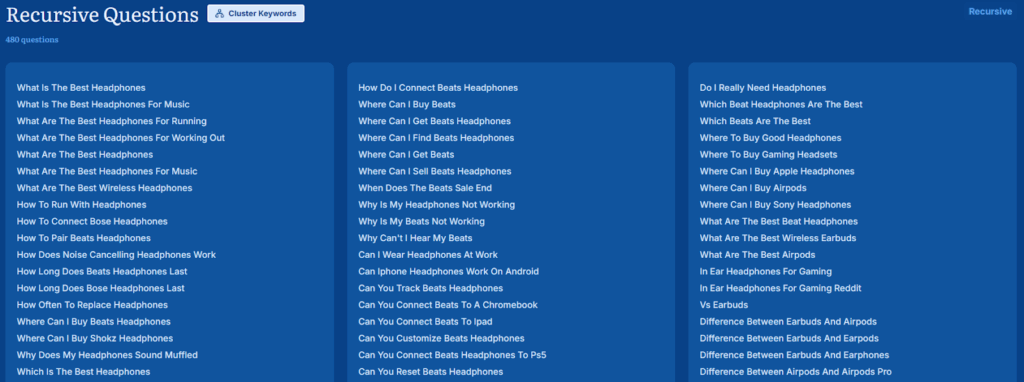
A single search query generates hundreds (often thousands) of real questions that people are asking about your topic. Each one is automatically labelled as BOFU/MOFU/TOFU so you can easily target your content according to buyer journey.

Answer Socrates’ unique recursive search feature digs up the topics people search for AFTER your main keyword.
This often uncovers hundreds of ideas that Semrush misses.
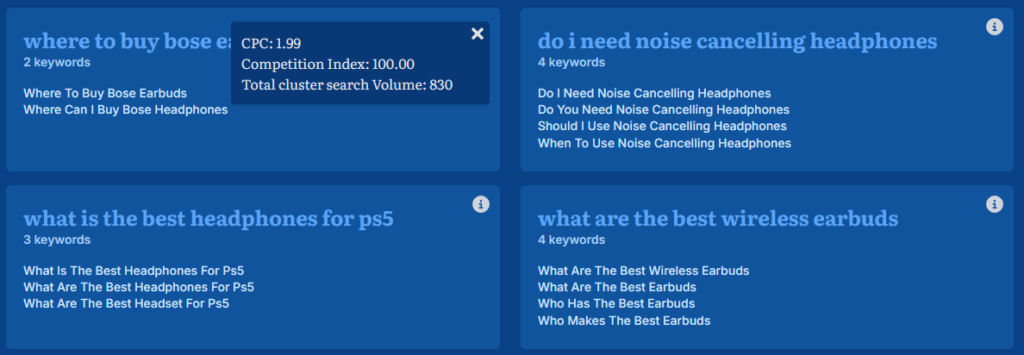
Then you can cluster your keywords into semantically-related topics, ready to use in your content plan.
Each cluster displays metrics on CPC, competition, and search volume – and you can download a CSV to view this data for individual keywords, too.
All of these features are available on Answer Socrates’ free plan, with 3 daily searches and 1,500 monthly clustering credits.
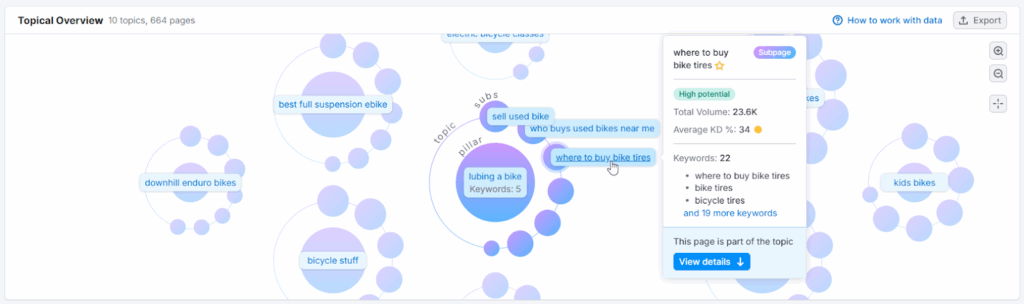
Semrush also does keyword clustering as part of its Keyword Strategy Builder. But although the interactive results look good, I find it difficult to get meaningful data from them.
If you need other features like backlink analysis and rank tracking, you can pair Answer Socrates with a lighter specialist tool and still spend a fraction of a single Semrush subscription.
Pricing
- Free ($0/month): 3 searches/day, 1 recursive, 1 CSV, 1,500 clustering credits
- Lite ($15/month): 100 searches, 30 recursive, 3,000 clustering credits, unlimited CSVs, SEO metrics
- Seneca ($29/month): 500 searches, 100 recursive, 12,000 clustering credits
- Aurelius ($49/month): Unlimited searches, 500 recursive, 40,000 clustering credits
Try Answer Socrates for free and see how many keywords you’ve been missing with your current tool.
2. Keywords Everywhere – Best for Cheap Keyword Data
Keywords Everywhere replaces one thing Semrush does, and does it for about 5% of the price.

There’s no site audit, no rank tracking, no PPC module. What you get is search volume, CPC, competition and 12-month trend data appearing wherever you’re already looking, across Google, YouTube, Amazon, Bing, eBay, Etsy, and more. For a lot of people that’s the only Semrush screen they open in a given week.
Pros
- Volume and CPC on 20+ Integrations
- Historical search volume back to 2004
- MCP server pulls data into AI tools
Cons
- No rank tracking or site audits
- Credits burn fast on widget-heavy searches
- Annual billing only, no monthly option
Semrush vs Keywords Everywhere
Semrush is a platform you log into. Keywords Everywhere is a layer on top of the browsing you already do. That difference decides which one suits you far more than any feature table will.
Semrush gives you the full picture: keyword database, backlink index, position tracking, technical audits, competitor traffic, ads data. If you report to clients, you need most of that.
Keywords Everywhere gives you numbers in context. You search something, the volume is there. You open a competitor’s page, the traffic estimate is there. Nothing to set up, no project to configure.
Pricing
Annual billing only. Bronze $84/year (about $7/month) for 100,000 credits and 1 seat. Silver $168/year ($14/month) for 400,000 credits and 3 seats. Gold $480/year ($40/month) for 2 million credits and 10 seats. Platinum $1,440/year ($120/month) for 8 million credits and 20 seats. Credits expire after a year.
The cheapest honest way to stop paying Semrush if all you ever used it for was checking volume. Pair it with something that handles discovery and you’ve replaced most of a $139 subscription for $7.
3. Ahrefs: Best Top-Tier SEO Tool
Ahrefs is arguably the main competitor to Semrush – it’s a well-established all-in-one SEO tool with similar pricing.
Pros
- Industry-leading backlink data with fresh updates
- Huge keyword index (28.7 billion keywords)
- Accurate traffic & click metrics beyond search volume
- Robust site audit & SERP analysis tools
Cons
- Expensive starting point
- Strict usage and export limits
- Learning curve for new users
Semrush vs Ahrefs
Both Semrush and Ahrefs have giant databases of keywords and backlinks. Semrush wins slightly on keyword volumes, while Ahrefs has a larger backlink database.
But what really makes a difference is Ahrefs’ in-house data center. Having invested in its own hardware, Ahrefs can crawl the web faster and keep its results more up-to-date than Semrush.
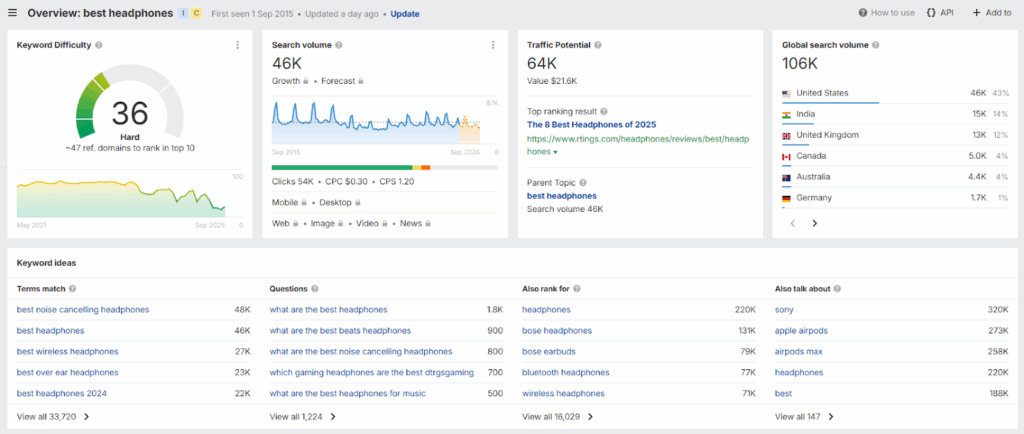
Semrush has various add-ons for local SEO, social media, and content. Ahrefs, on the other hand, is more focused on SEO essentials: backlinks, keywords, and SERPs.
If you need a broader marketing suite (and have the marketing budget to pay the extra fees), Semrush is probably the best choice. But for data freshness and backlinks, Ahrefs is stronger.
Pricing
- Lite ($129/mo): 5 projects, 750 keywords, 100k crawl credits
- Standard ($249/mo): 20 projects, 2,000 keywords, 500k crawl credits
- Advanced ($449/mo): 50 projects, 5,000 keywords, 1.5M crawl credits
- Enterprise ($1,499/mo): API, SSO, unlimited projects
I, personally, use Ahrefs most days for a broad range of SEO tasks. But when it comes to keyword research and clustering, Answer Socrates is my go-to tool.
4. Moz Pro: Best for Authority Metrics
Moz has long been seen as the entry point for beginner SEOs. Its trademark Domain Authority (DA) and Page Authority (PA) scores are widely referenced across the industry.
Pros
- Clean, beginner-friendly interface
- DA/PA metrics are industry benchmarks
- Keyword Explorer & Link Explorer included
- Strong learning resources and community support
Cons
- Smaller keyword & backlink database than Semrush/Ahrefs
- Limited free searches (3/day in Keyword Explorer)
- Updates roll out slower than competitors
Semrush vs Moz
Moz is less data-rich than Semrush or Ahrefs, but much easier to use and understand. This, along with its more affordable entry price, makes it suitable for smaller teams with less advanced SEO requirements and lighter usage.
If you need simple keyword tracking, authority metrics, and competitor insights, Moz Pro is a great place to start. It even includes an on-page content optimizer – something that Semrush charges extra for.
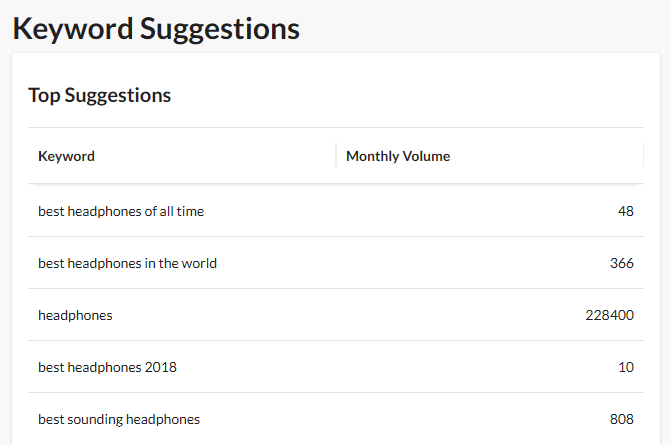
Some of the keyword recommendations are questionable, so apply your own common sense when deciding which ones are worth targeting.
For local Businesses, Moz Local is an affordable add-on starting at $16/month. You can also try many of Moz’s tools for free, which is helpful for getting a feel for how they work and deliver your data.
Pricing
- Free: 3 searches/day
- Starter ($49/mo): 1 site, 75 keyword queries
- Standard ($99/mo): 3 sites, 150 queries
- Medium ($179/mo): 10 sites, 5,000 queries
- Large ($299/mo): 25 sites, 15,000 queries
5. SE Ranking: Best for Smaller Agencies
SE Ranking is a flexible all-in-one SEO platform that punches above its price point. It offers rank tracking, keyword research, site audits, and white-label reporting, making it popular with consultants and small agencies.
Pros
- Accurate, flexible rank tracking with historical data
- Site audits with actionable technical fixes
- White-label reports for client-facing work
- More affordable than Semrush
Cons
- Keyword database smaller than premium players
- Slightly less intuitive UI for beginners
- Complaints about customer support
Semrush vs SE Ranking
While Semrush is stronger for global keyword data and PPC integrations, SE Ranking covers the core SEO stack for around half the price.
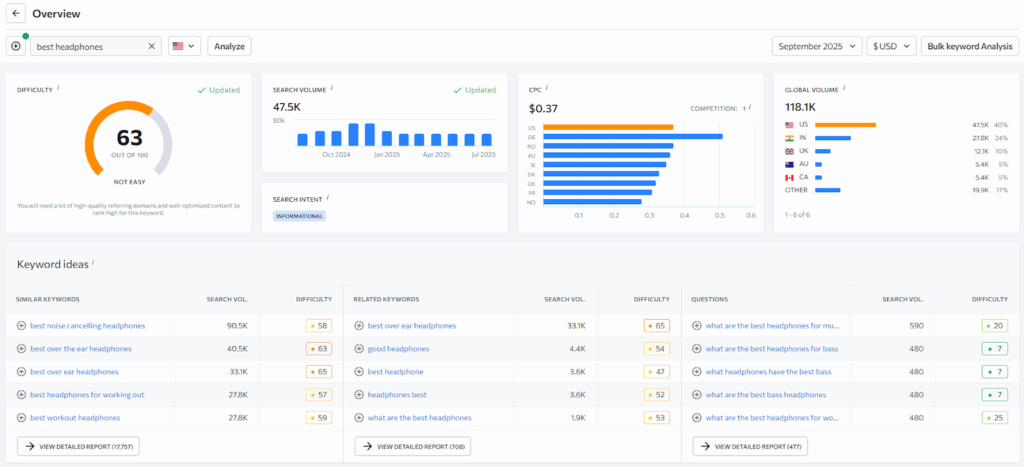
Agencies that need to manage rank tracking and deliver branded reports can do so for $169/month with the Pro plan + agency pack. This makes SE Ranking a cost-effective alternative to Semrush’s Agency plan.
However, for non-agency users, other tools offer better value than SE Ranking.
Pricing
- Essential ($65/mo): Rank tracking, basic research, site audit
- Pro ($119/mo): SERP analysis, AI results tracking, white-label reporting (with agency pack for +$50/mo)
- Business ($259/mo): Higher limits, longer search history, ChatGPT research
6. Mangools: Best for SEO Beginners
Mangools is a bundle of five lightweight SEO tools (KWFinder, SERPWatcher, LinkMiner, SERPChecker, and SiteProfiler). Its clean design makes it one of the easiest toolkits to learn, which is why it’s popular among bloggers and first-time SEOs.
Pros
- Very beginner-friendly interface
- Clear keyword difficulty scores in KWFinder
- Includes rank tracking and backlink checks
- Affordable entry-level pricing
Cons
- Some limits are restrictive
- Smaller keyword and backlink databases than Semrush or Ahrefs
- Lacks advanced outreach, PPC, and enterprise features
Semrush vs Mangools
Semrush is an all-in-one suite that covers every SEO and marketing function, but that breadth makes it expensive and often overwhelming. Mangools, on the other hand, strips SEO back to the core essentials: keyword research, SERP validation, backlink checks, and rank tracking.
If you’re starting out, Mangools feels approachable in a way that Semrush doesn’t. The trade-off is scale – once you’re running multiple sites or need enterprise-level data, Mangools’ limited databases will hold you back.
One thing you may find restrictive on the Basic tier is the limit of 200 keywords per search. Many keyword searches have thousands of potential keywords, so you feel like you’re missing a lot of important data with Mangools.
Answer Socrates, in contrast, does not limit the number of keywords uncovered per search – even on its free plan.
Pricing
- Free: 5 searches/day, 15 keyword results, 5 competitor keywords
- Basic ($31.85/mo): 100 lookups/day, 200 results/search, 25 competitor keywords
- Premium ($44.85/mo): 500 lookups/day, unlimited suggestions, 700 tracked keywords, 3 seats
- Agency ($83.85/mo): 1,200 lookups/day, 5 seats, expanded SERP & backlink data
7. Ubersuggest: Best Budget-Friendly All-Rounder
Ubersuggest markets itself as an affordable Semrush-lite. It offers keyword ideas, audits, backlink data, and rank tracking – but in practice, the datasets are shallower and the free plan is heavily restricted.
Pros
- Low-cost entry, including lifetime deal options
- Clean interface, easy to navigate
- Includes keyword suggestions, audits, and rank tracking
Cons
- Aggressive upselling in the interface
- Keyword database less reliable than Semrush or Ahrefs
- Limited export and reporting options
- Free plan less useful for keywords than Answer Socrates
Semrush vs Ubersuggest
Ubersuggest is a very budget-friendly SEO starter tool – fine if you want to check keyword ideas or run quick site audits without breaking the bank.
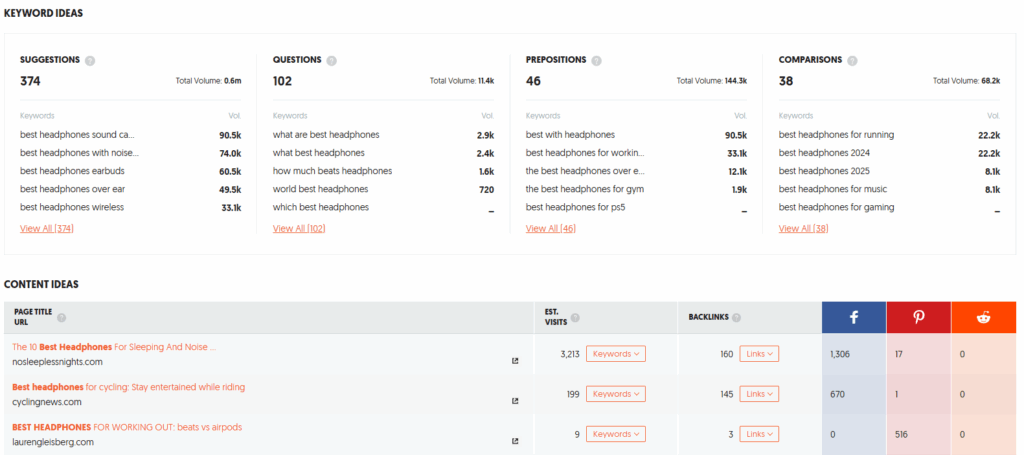
But its keyword database is small (344 keyword ideas in one of my comparisons, compared to 1053 from Answer Socrates and tens of thousands from Semrush). It does a lot of things to a basic standard, but nothing exceptionally well.
If you’re serious about building long-term SEO campaigns, Ubersuggest will feel limiting fast. But if your budget is tight, it’s a stepping stone to more robust tools.
Pricing
- Free: 3 searches/day
- Individual ($12/mo): 1 domain, 150 tracked keywords, 20k suggestions
- Business ($20/mo): 7 domains, 150 keywords/domain, 50k suggestions, 2 seats
- Enterprise ($40/mo): 15 domains, 300 keywords/project, 100k suggestions, 5 seats
- Lifetime Plans: From $120
8. Serpstat: Best Mid-Range Suite
Serpstat combines keyword research, site audits, backlink analysis, clustering, and rank tracking into one package that’s about half the price of Semrush.
Pros
- Full SEO toolkit with keyword clustering built in
- Rank tracking and competitor analysis included
- API and batch features for scaling
- Cheaper than Semrush or Ahrefs
Cons
- Interface feels dated
- Keyword difficulty metrics less precise than competitors
- Not as data-rich as premium tools
Semrush vs Serpstat
Semrush offers broader databases, PPC research, and polished reporting dashboards. Serpstat narrows its scope to SEO and does it affordably.
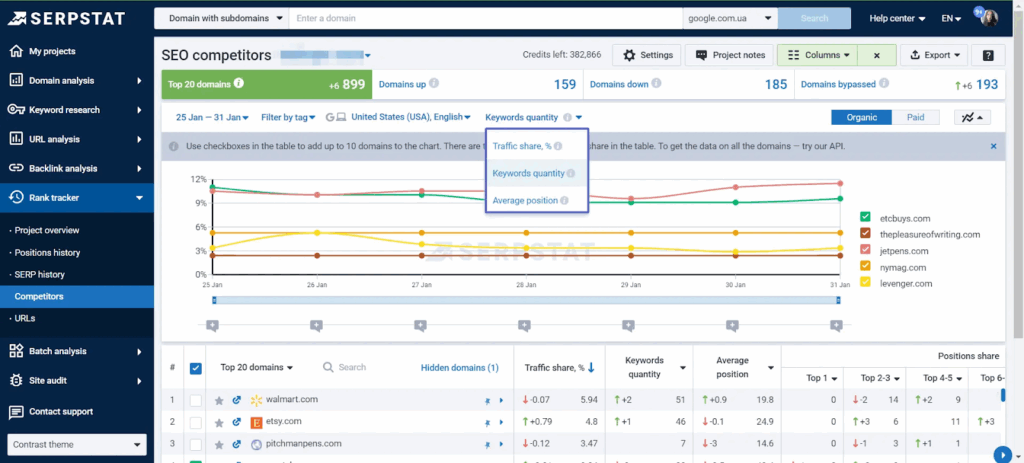
For agencies or freelancers who want an all-in-one SEO tool without enterprise pricing, Serpstat is an attractive middle ground.
It won’t replace Semrush’s sheer scale, but if you combine Serpstat with a specialized content planning tool like Answer Socrates, you’ll cover most workflows at less than half the price.
One caveat: the 100 searches/day limit on the Individual plan sounds like a lot, but since this covers keywords, sites, and link analysis, it’s easy to burn through them quickly.
Pricing
- Individual ($69/mo): 5 projects, 100 daily searches, 10k position checks
- Team ($129/mo): Unlimited projects, 500 daily searches, 50k position checks, API access
- Agency ($499/mo): 5,000 daily searches, 500k position checks, 1.5M page audits, white-label reports
9. SEO Scout: Best for Content Optimization
SEO Scout focuses on on-page SEO and content refinement, making it a useful complement to keyword tools like Answer Socrates. It helps you improve existing articles with keyword optimizaion, title/meta A/B testing, and internal link analysis.
Pros
- Keyword grouping by theme for topical relevance
- Content scoring tools to optimize published posts
- Meta title & description A/B testing
- Internal linking analysis on par with specialist tools
Cons
- No backlink or off-page SEO features
- Smaller user base and fewer integrations than major suites
- Limited rank tracking compared to Semrush
Semrush vs SEO Scout
Semrush bundles dozens of features together, but its content optimization modules (like the SEO Writing Assistant) are limited.
SEO Scout goes deeper in this area, helping you improve what you’ve already published. For content teams that want to squeeze more performance out of existing assets, SEO Scout is a sharper and cheaper tool.
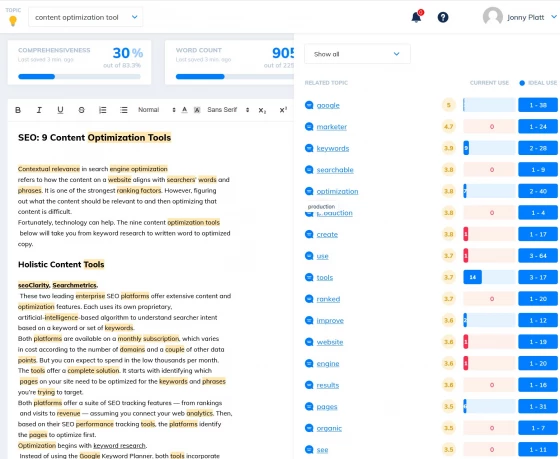
It won’t replace Semrush’s breadth – there’s no backlink database, PPC insights, or competitive traffic analysis. But if you already use another tool for discovery and ranking, SEO Scout fills the optimization gap nicely.
Pricing
- Starter ($49/mo): 10 optimized articles/month, basic content tools
- Business ($99/mo): 30 optimized articles/month, deeper reporting, multi-user
- Agency ($199/mo): Expanded usage, multi-client support, white-label reports
Final Verdict: The Best Semrush Alternative
Here’s the quick rundown of my top Semrush alternatives in 2026:
- Answer Socrates (Best for Keywords & Content Planning): Keyword discovery, clustering, AI helpers, and trend tools – all starting free, with paid plans starting under $20.
- Ahrefs (Best Premium Alternative): Strongest backlink index and competitor research; ideal for large companies and agencies.
- SE Ranking (Best for Agencies on a Budget): Affordable rank tracking, audits, and white-label reporting.
- Mangools (Best for Beginners): A clean, intuitive toolkit for bloggers and first-time SEOs.
If you’re a solo SEO, blogger, or content marketer, Answer Socrates gives you everything you need to research and plan content at a very affordable price.
Mangools, SE Ranking, and Serpstat are all good options if you need a full SEO tool at a lower price than Semrush – but you may have to compromise on data depth and features.
Ahrefs remains the most robust Semrush alternative for serious data and link insights, but comes with a similar price tag.
FAQs: Semrush Alternatives
Is Semrush really worth paying for?
Yes, if you need a full marketing suite (SEO, PPC, content, and competitive research) in one place. But if your focus is only on SEO or keyword research, you’ll find cheaper tools that specialize and often perform better in their area.
Is there a free Semrush alternative?
Yes. Answer Socrates is a free Semrush alternative for keyword and question research. The free plan pulls thousands of real questions people ask on Google and AI tools like ChatGPT, clusters them, and exports the data. It has the most generous free plan out of all the SEO tools and a very competative paid plan starting at $15 a month, well below Semrush. Google Keyword Planner and Search Console are free too, but narrower in use cases.
Which paid tools are better than Semrush?
For backlink analysis, Ahrefs is the stronger choice. For rank tracking and client reporting, SE Ranking is more cost-effective. For affordable all-in-one coverage, Serpstat is a solid middle ground.
Is Answer Socrates better than Semrush?
For keyword research, topical mapping, and content ideation – yes. Answer Socrates is faster, simpler, and far cheaper. But if you need backlinks, technical audits, or multi-channel marketing tools, you’ll still need a broader suite like Semrush or Ahrefs.
What’s the cheapest way to replace Semrush?
Build your own toolkit: combine Answer Socrates (keyword research) with SE Ranking (rank tracking and reporting). Together, they cost less than a single Semrush subscription while covering most workflows.
Share:
About the Author

