
The Alphabet Soup Method: A Powerful SEO Keyword Research Technique
|

Written by
James Oliver
Ever wondered how to find those hidden keywords that your competitors are missing?
The Alphabet Soup Method is one of the most effective yet underutilized keyword research techniques in SEO. It helps you discover valuable long-tail keywords directly from Google’s autocomplete suggestions—the same queries real people are searching for.
Well, we’ll be going over:
- What exactly is the Alphabet Soup Method and why is it so effective?
- How can you implement this technique in your SEO strategy today?
- What tools can save you hours of tedious work while maximizing your results?
Let’s dive in!
What is the Alphabet Soup Method?
The Alphabet Soup Method is a keyword research technique that leverages Google’s autocomplete feature to uncover valuable long-tail keywords. This approach involves typing a seed keyword into Google’s search bar, followed by each letter of the alphabet (hence the name “Alphabet Soup”), to reveal a wide range of search suggestions.
For example, if your seed keyword is “coffee,” you would search for:
- “coffee a” (to see suggestions like “coffee aeropress” or “coffee and anxiety”)
- “coffee b” (for “coffee beans” or “coffee brands”)
- And so on through the entire alphabet

These autocomplete suggestions are incredibly valuable because they represent actual search queries that users are typing into Google. This means you’re getting direct insight into the language and questions your target audience is using.
Why SEO Experts Love the Alphabet Soup Method
The Alphabet Soup Method has gained significant popularity in the SEO community, particularly among bloggers and content creators for several key reasons:
- It’s completely free – You don’t need expensive keyword research tools to get started
- It reveals user intent – These are actual phrases people are searching for
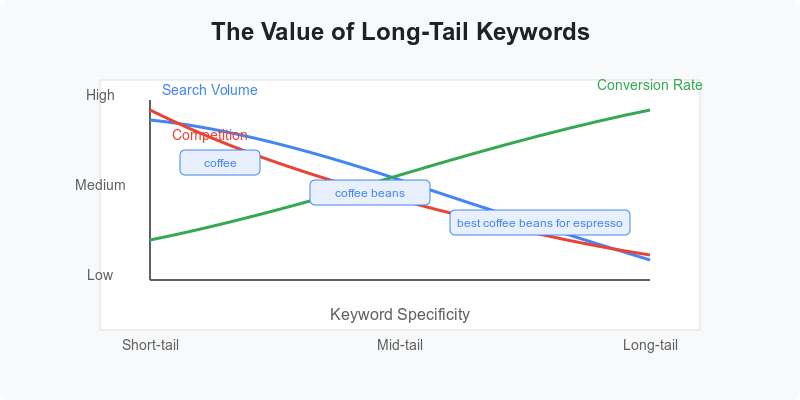
- Uncovers long-tail keywords – These typically have lower competition and higher conversion rates
- Finds question-based keywords – Perfect for creating FAQ content and featured snippets
- Helps identify content gaps – Discover topics your competitors haven’t covered
Long-Tail Keywords: The Hidden Treasure
Long-tail keywords—those longer, more specific phrases—often make up about 70% of all search traffic. While they individually have lower search volume, they collectively represent a massive opportunity.
The beauty of the Alphabet Soup Method is its effectiveness at uncovering these valuable long-tail keywords that might be missed by traditional keyword research methods.
How to Use the Alphabet Soup Method: Step-by-Step
Let’s break down how to implement this technique effectively:

1. Start with a Seed Keyword
Begin with a broad topic or keyword related to your niche. This will be your foundation for discovering more specific phrases.
2. Add Letters and Symbols
Type your seed keyword followed by a space and a letter of the alphabet (a through z). You can also try:
- Adding letters before your keyword
- Using numbers (0-9)
- Including symbols like “$” or “?”
- Adding prepositions (“for,” “with,” “without”)
3. Record the Results
As Google displays its autocomplete suggestions, record the most relevant ones. These are all potential keywords for your content strategy.
4. Analyze for Search Intent
Group your findings by search intent:
- Informational (how to, what is, guide to)
- Navigational (brand names, specific websites)
- Commercial (reviews, comparisons, best)
- Transactional (buy, discount, deals)
5. Evaluate Competition and Volume
While the Alphabet Soup Method doesn’t provide metrics like search volume, you can gauge competition by:
- Checking the number of results for each keyword
- Looking at the authority of ranking sites
- Using supplementary tools for more detailed metrics
The Manual Process: Effective but Time-Consuming
While the Alphabet Soup Method is incredibly valuable, doing it manually has significant drawbacks:
- It’s extremely time-consuming – Working through 26 letters for multiple seed keywords can take hours
- Easy to miss variations – There are thousands of possible combinations
- Difficult to organize – Managing spreadsheets of keywords becomes unwieldy
- No metrics included – You’ll need additional tools to evaluate volume and difficulty
- Repetitive and tedious – Leading to researcher fatigue and missed opportunities
This is where specialized tools come into play, dramatically improving efficiency while maintaining the method’s effectiveness.
Tools That Automate the Alphabet Soup Method
Fortunately, several tools have been developed to automate this process, saving you countless hours while expanding your keyword discovery potential.
Answer Socrates: The Ultimate Alphabet Soup Automation Tool
AnswerSocrates.com stands out as perhaps the most powerful tool for automating the Alphabet Soup Method.

This tool takes the concept to a new level by:
- Instantly generating hundreds of keyword suggestions from Google autocomplete
- Incorporating “People Also Ask” questions to expand your content ideas
- Offering recursive keyword research to uncover deeper semantic relationships
- Clustering related terms to help organize your content strategy
- Providing a generous free plan with premium features for power users
It effectively turns a process that would take hours into one that takes seconds, while actually improving the quality and breadth of keywords discovered.
Other Helpful Tools
While AnswerSocrates is particularly effective, several other tools can assist with alphabet soup-style keyword research:
- Keyword Atlas – Specifically designed to automate the Alphabet Soup Method with various permutations
- Ubersuggest – Built around autocomplete scraping with both free and paid options
- Allintitle.co Free KW Explorer – A real-time tool that pulls keywords from multiple sources
- Keywords Everywhere – A browser extension that can export related queries in bulk
Advanced Techniques for Power Users
Once you’ve mastered the basics, try these advanced approaches:
Recursive Keyword Research
Instead of stopping at the first level of suggestions, use the suggestions themselves as new seed keywords. This “recursion” can uncover deeper, more specific keyword opportunities.
For example, if “coffee beans” appears as a suggestion for “coffee b,” use “coffee beans” as a new seed keyword to find even more specific phrases like “coffee beans for espresso.”
We are the only SEO tool to do this! Read the guide on recursive searches here.
Competitor Gap Analysis
Use the Alphabet Soup Method to analyze what keywords your competitors are missing:
- Identify your top competitors
- Run alphabet soup research for your main topics
- Cross-reference the results with competitor content
- Focus on valuable keywords they’ve missed
Content Clustering Strategy
Group related keywords to develop comprehensive content clusters:
- Use a main keyword as your pillar content
- Group related alphabet soup keywords as supporting content
- Link these pieces together to create topical authority
Putting It All Together: A Practical Workflow
Here’s an efficient workflow combining manual insights with automated tools:
- Brainstorm seed keywords relevant to your niche
- Use AnswerSocrates to quickly generate hundreds of keyword ideas
- Export and organize your findings by search intent and priority
- Supplement with metrics from tools like Ahrefs or SEMrush if available
- Develop a content calendar based on your prioritized keywords
- Create comprehensive content that addresses the specific queries uncovered
- Monitor performance and refine your strategy based on results
Real Results from the Alphabet Soup Method
Many successful bloggers attribute their organic growth to this method. For instance, one niche site owner reported increasing their monthly organic traffic from 500 to over 25,000 visitors in just 8 months by focusing on long-tail keywords discovered through the Alphabet Soup Method.
The key to their success? Targeting low-competition, specific keywords that larger competitors overlooked, then creating highly relevant content that precisely matched search intent.
Conclusion: The Alphabet Soup KW Research
The Alphabet Soup Method remains one of the most effective keyword research techniques available to SEO professionals, bloggers, and content creators. While it can be performed manually, tools like Answer Socrates have revolutionized the process, making it faster and more powerful than ever before.
By incorporating this approach into your regular keyword research workflow, you’ll uncover valuable long-tail keywords that your competitors miss, create more relevant content for your audience, and ultimately drive more targeted organic traffic to your site.
Whether you’re just starting out or you’re a seasoned SEO expert, the Alphabet Soup Method—especially when enhanced with modern tools—should be an essential component of your digital marketing strategy.
FAQs
Q: How often should I perform Alphabet Soup keyword research? A: For active content strategies, running this research monthly helps identify trending topics and seasonal variations.
Q: Can the Alphabet Soup Method work for any niche? A: Yes! Since it’s based on actual user searches, it works for virtually any topic where people are searching online.
Q: How do I determine which keywords to prioritize? A: Focus on keywords that balance relevance to your business, reasonable competition levels, and clear search intent.
Q: Is this method still effective with Google’s AI and semantic search? A: Absolutely. In fact, it’s become more valuable as Google’s understanding of search intent has improved, making long-tail keywords even more important.
Q: Can I use this method for other search engines besides Google? A: Yes! While Google offers the most robust autocomplete data, you can apply the same technique to Bing, YouTube, Amazon, or any platform with autocomplete functionality.
Share:
About the Author
