LLM Brand Tracker
Track your brand mentions in responses from multiple LLMs like OpenAI, Anthropic, Perplexity, Grok and DeepSeek.
Find every ChatGPT and Google AI Overview mention for your domain.
We hold millions of recorded ChatGPT answers and Google AI Overviews. Type your domain and we'll tell you how many of them mention you — in about four seconds, free.
Free with an account · no card · about four seconds
Open LLM Brand Tracker for live scans across all six models
What is an LLM Brand Tracker?
An LLM brand tracker measures how large language models (LLMs), like ChatGPT, Perplexity, Gemini, Claude, Grok, and Copilot, mention, recommend, and describe your brand across AI answers.
Instead of counting blue links like classic SEO rank trackers, it runs controlled prompts, records whether (and how) your brand appears in the generated answer, and turns that into visibility, share-of-voice, and citation metrics you can improve over time.
Basically, when you ask AI a question, it searches a range of often 10-15+ keywords on Google or Bing, and uses those sources to recommend the answer.
If the question is for a product or tool, for example: "what is the best SEO tool?" then the answer LLMs return is often based on the websites it scans for the various keyword it searches.
The answer is partly based on searching the web (the "retrieval" layer), and partly based on the training data the LLM was trained on. Understanding how often your product or brand appears in these answers can help guide you on what you need to improve to get featured.
Why this matters now in the age of AI SEO (or GEO)
LLMs are becoming "answer engines." If buyers ask an AI, "What's the best tool for X?", the model's response shapes consideration instantly.
An LLM brand tracker shows:
- How often you're recommended vs competitors (by model, country, and language)
- What sources the AI cites for (or against) you
- How your messaging is summarized, including any inaccuracies or outdated claims
- Trend lines as models update, and as your brand and entity signals improve
How Answer Socrates' LLM Brand Tracker Works
1
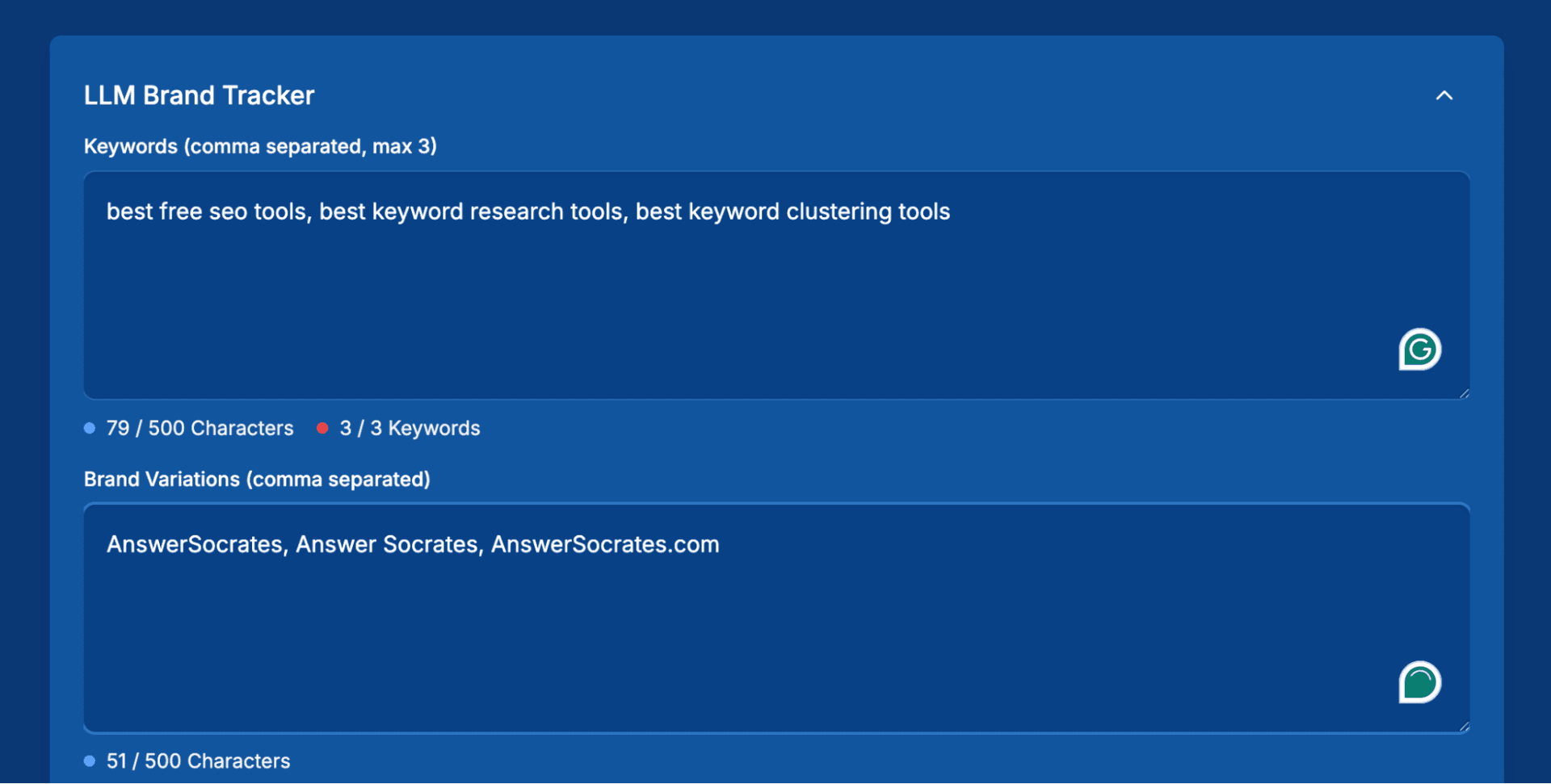
Step 1 — Add your main keywords & brand variants
Tell the tracker how buyers ask for your category, and how your brand can appear.
What you add:
Core prompts: e.g., "best [category] tools," "top alternatives to [competitor]," "what to use for [job-to-be-done]".
Brand variants: official name, product lines, common misspellings/short names.
2
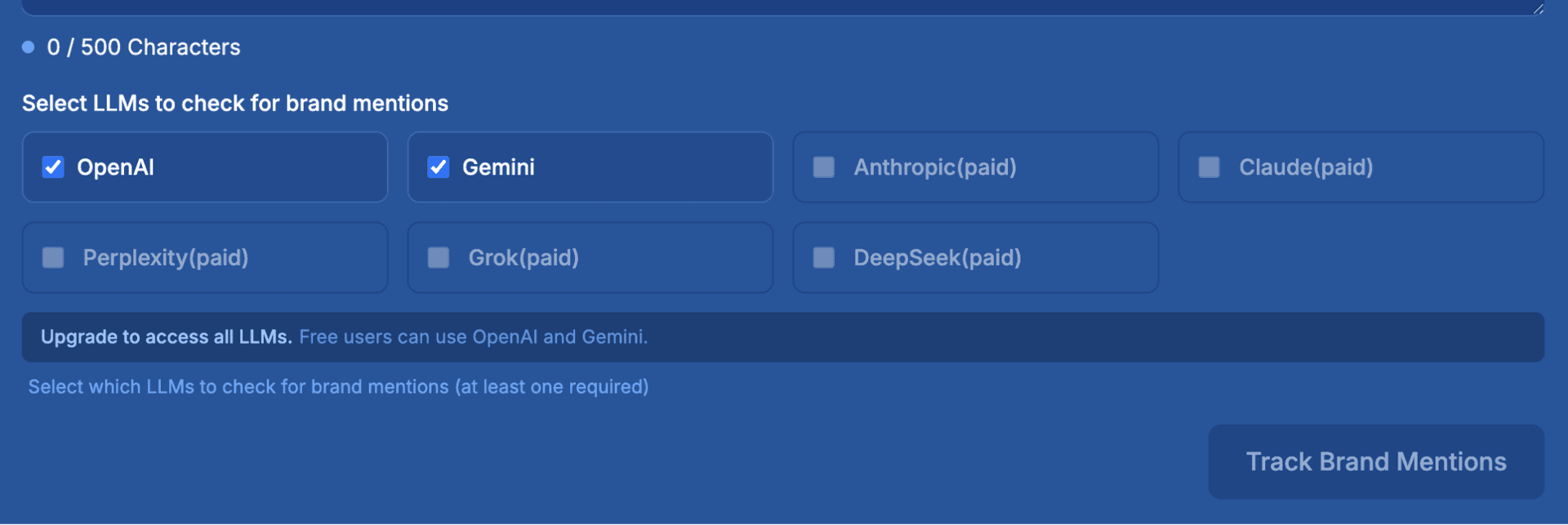
Step 2 — Select models & locales
Choose which LLMs you want to monitor. You can monitor ChatGPT and Gemini for free, but you need a paid plan (starting at just $19/month) to track Grok, Claude, Perplexity, and DeepSeek.
3
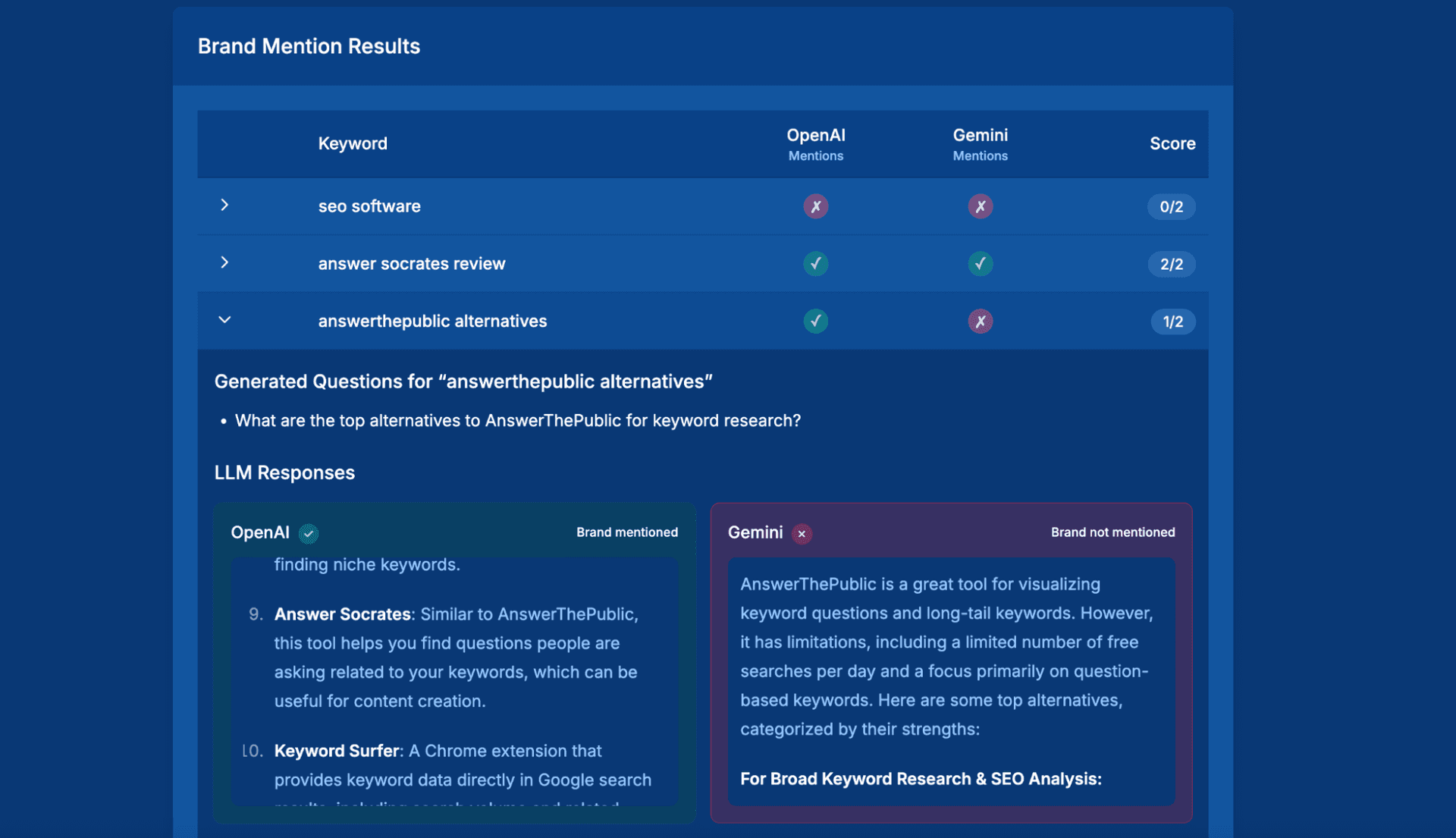
Step 3 — Get visibility, citations, sentiment & missed opportunities
See your visibility score and share of voice %, understand exactly which LLMs recommend you, and the exact output they currently have.
Now you know where you're not featured, you can fix this and win in the AI SEO era.
Track Your AI Visibility Across Every Model
Answer Socrates' LLM Brand Tracker tracks every major LLM to help you understand if you're visible in every AI search model that your customers are searching.
Models currently covered:
ChatGPT (OpenAI) – the most widely adopted general-purpose assistant.
Perplexity – the research-oriented "answer engine" with strong citation data.
Gemini (Google) – powering Google's AI Overviews and Bard successor.
Claude (Anthropic) – known for safe, long-context responses.
DeepSeek – fast-rising open-source model, growing in developer adoption.
Grok (xAI) – integrated across X (Twitter) products.
So you can understand where you're strong, and where you need to improve to be more visible, everywhere.
AI Visibility Metrics We Track
1 - Visibility Score
How prominently your brand appears across answers and models. Weighted by position in the response (headline vs buried mention).
2 - Share of Answers
The % of tested prompts where your brand is recommended. Lets you benchmark against competitors and monitor gains/losses week by week.
3 - Citation Sources
The domains and URLs LLMs use to justify including you. Spot missing references, secure coverage on influential sites, and close the loop with PR/SEO.
Who It's For
An LLM Brand Tracker isn't just for SEOs. Anyone responsible for AI visibility benefits from it:
SEO & Growth Marketers
See if your site/entity optimizations translate into real LLM visibility. Identify which citations you're winning—and where you're being left out.
CMOs & Brand Leaders
Protect brand equity by monitoring how LLMs describe you. Spot inaccuracies, outdated messaging, or missed mentions before they spread.
Product Marketing Managers
Validate whether positioning sticks. Check if models frame your product correctly in comparisons, and fix gaps in docs, PR, and review coverage.
Partnership & Affiliate Managers
Find which partners and publishers LLMs cite most often. Double down on those channels to strengthen AI-driven visibility loops.
Agencies & Consultants
Prove ROI by reporting client presence in LLM answers alongside SEO and PR metrics.
Frequently Asked Questions
An LLM brand visibility tracker runs questions as prompts through large language models (like ChatGPT, Perplexity, Gemini, Claude) to measure if and how your brand is recommended. Instead of tracking Google rankings, it shows you if your brand appears in AI responses and the sources cited, as well as the sentiment used to describe your brand.