ChatGPT + Answer Socrates
How to Do SEO in ChatGPT
Connect Answer Socrates to ChatGPT and do your SEO research right in the chat. Ask a question and ChatGPT pulls real Google data: hundreds of real searches for any keyword, 12 months of Google Trends and the topics breaking out right now. Then it groups the lot into a content plan.
- Keyword research from real Google searches, not guesses
- Google Trends and rising topics for any country
- Clusters by topic, search intent and funnel stage
Last updated: October 2026
How do I connect Answer Socrates to ChatGPT?
The official Answer Socrates app for ChatGPT is coming soon. Until it is listed, add Answer Socrates as a custom MCP server. It takes about a minute: paste one URL and sign in with your Answer Socrates account. No API key and nothing to install.
- 1
Copy the Answer Socrates MCP URL below.
https://answersocrates.com/api/mcp - 2
In ChatGPT on the web, open Plugins, click + and choose Add custom MCP server.
- 3
Name it Answer Socrates, paste the URL under Connection and choose OAuth for authentication.
- 4
Tick I understand and want to continue, click Create as a plugin, then sign in with your Answer Socrates account when asked.
- 5
Start a new chat, type @, pick Answer Socrates and ask your first question.
On ChatGPT Business, Enterprise or Edu, admins decide which apps and MCP servers members can add. If you can't see the option, ask yours to allow it.
Official ChatGPT app coming soon
Answer Socrates is submitted to the ChatGPT app directory. Once it is listed you will add it with one click and a sign-in, no URL to paste. Until then, the custom connection above does exactly the same job.
Keyword research in ChatGPT
Ask ChatGPT for keywords on its own and it guesses from what it learned in training. With Answer Socrates connected it pulls what people actually type into Google: hundreds of real search phrases per keyword (1,221 in the pull below), sorted into four groups.
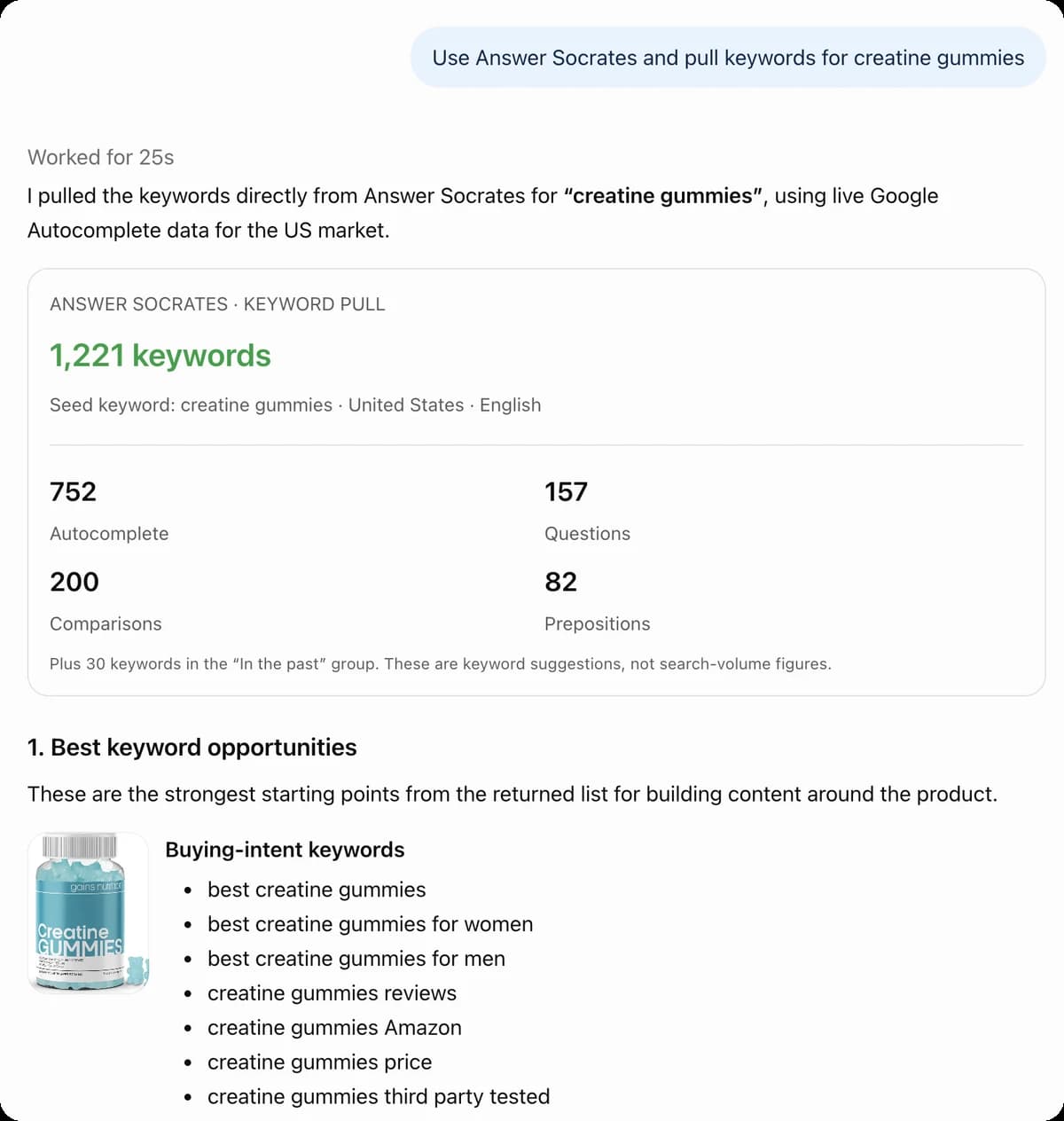
Questions
How, what, why, can: the questions people ask about your topic, ready for FAQs and blog posts.
Prepositions
For, with, without, near: the qualifiers that show what people actually want.
Comparisons
Vs, or, like, and: the head-to-head searches that sit right before a buying decision.
Autocomplete
The full a to z list of Google suggestions for your keyword.
Then ChatGPT does the organising
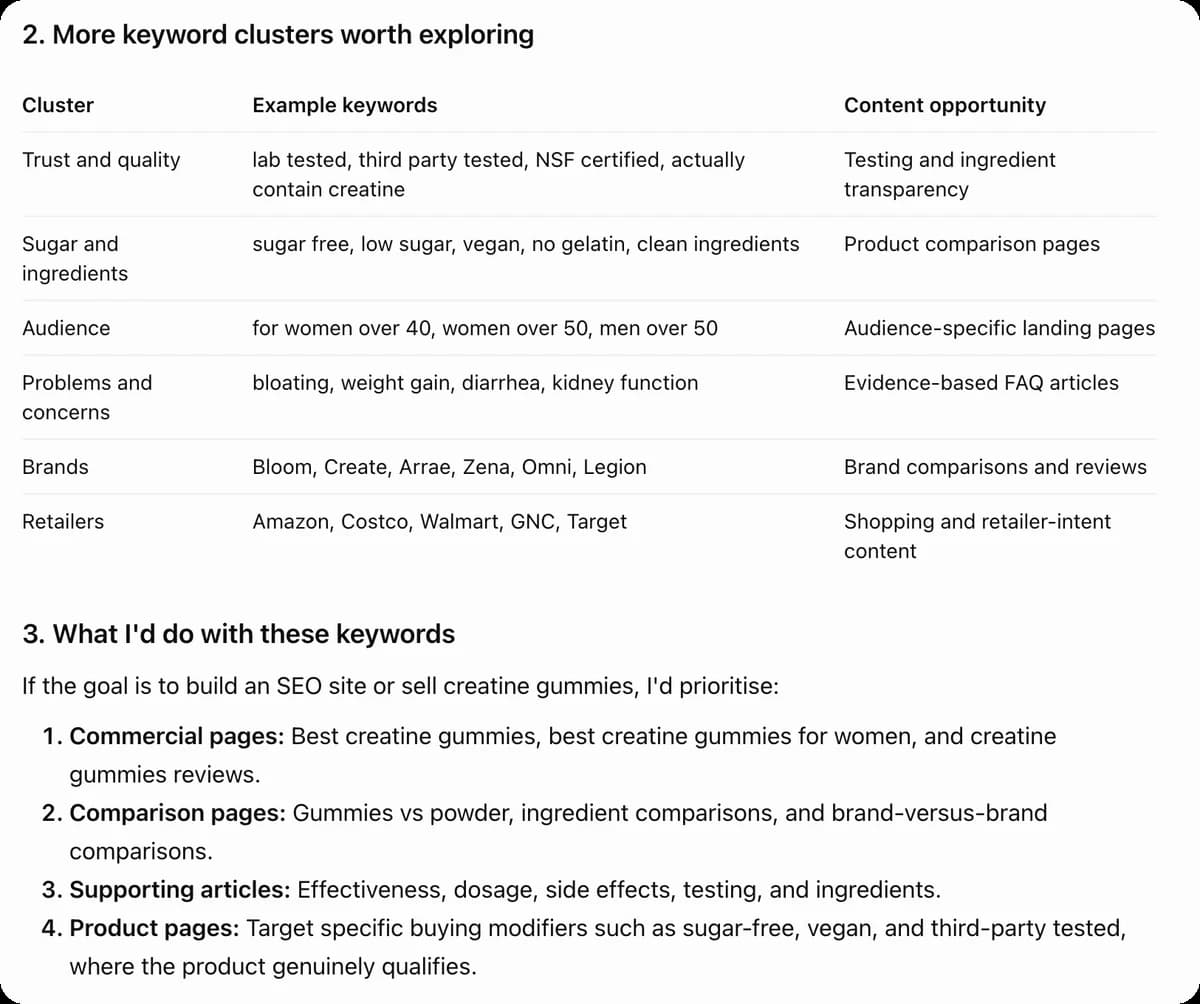
This is where ChatGPT earns its place. The raw pull is a long list of Google searches, and ChatGPT reads every one of them and turns it into something you can act on: themes like trust, ingredients and audience, the content each one calls for, and which pages to build first. Same real data, now a plan. Ask a follow-up to cut it by intent, audience or page type, or run cluster_keywords (below) to group every keyword properly.
YouTube keyword research in ChatGPT
Planning videos? Ask for the YouTube version and ChatGPT pulls what people type into YouTube's own search box, sorted into the same four groups. YouTube searches lean towards tutorials, reviews and how-tos, so the list is different from Google's.
Pull the YouTube keywords for home workout and show me the how-to questions first.
get_youtube_keywords
Here are the YouTube searches for home workout, grouped into Questions, Prepositions, Comparisons and Autocomplete, with the how-to questions up top. Want the Google version too?
Google Trends in ChatGPT
Name a market and ChatGPT maps it: what's climbing, what's seasonal and what's fading, from 12 months of Google Trends data in any country. Rising topics adds the related searches breaking out right now, Breakouts included.
12-month trends
Weekly Google Trends interest for any keyword across the last 12 months, in any country.
Seasonality
See when a keyword peaks and when it dips, so your content is live before the rush.
Compare locations
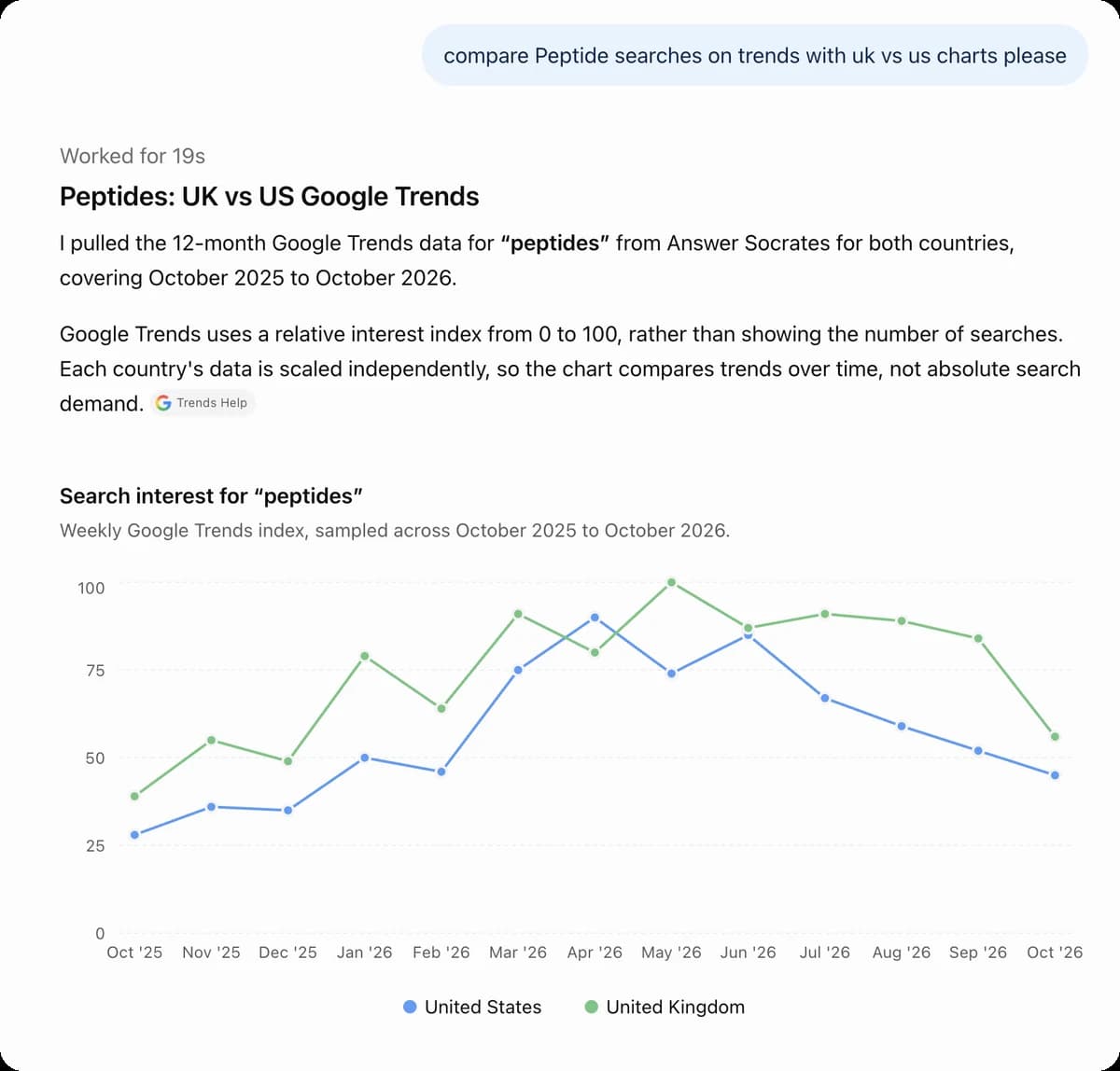
Run the same keyword in the UK, the US or any other country and chart them side by side.
Rank a basket of keywords
Compare 10 or more keywords at once to see which are climbing and which are fading.
Rising and Breakout searches
The related searches growing fastest right now, including brand-new Breakouts.
Charts, tables and CSVs
Ask ChatGPT to chart it, table it or export it. Reworking data it already pulled costs nothing.
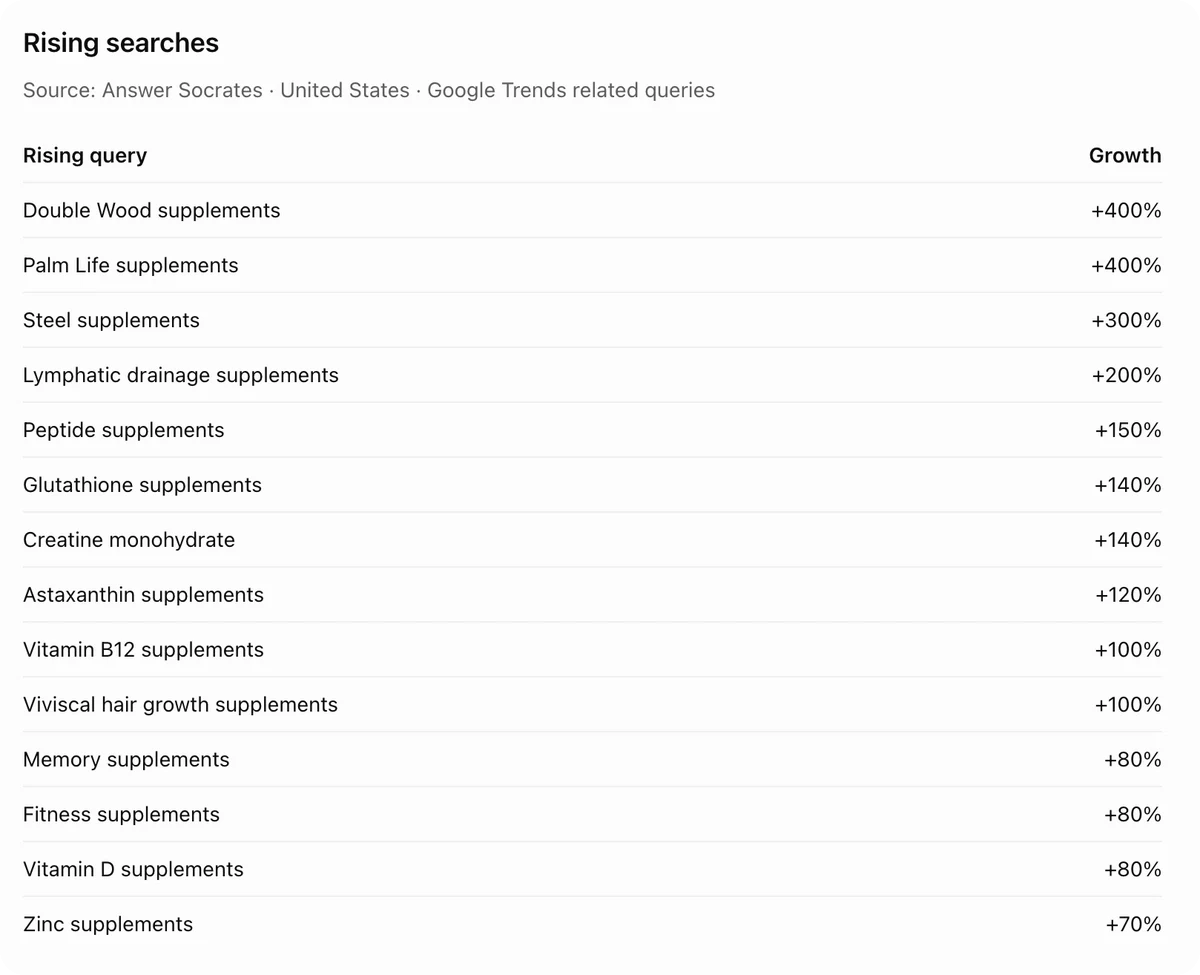
And much more. Ask in plain English and ChatGPT picks the right tools, like this UK vs US comparison:
What's happening in the supplement space?
get_rising_topicsget_trends ×12
Over the last 12 months, the big movers are clear whey +190%, creatine gummies +94% (a real format shift, not hype), electrolytes +63% and magnesium glycinate +62%. Classic whey is resurging (+64%) while ashwagandha is the only decliner (−5%). That trend has peaked.
In the rising searches, Nutricost whey is up +1,850% and two brands hit Breakout. Almost everything peaks in April, so publish by March to catch the crest. Want me to pull the full keyword set for creatine gummies? (1 request)
Keyword clustering in ChatGPT
Use the list ChatGPT just pulled, or paste your own. Answer Socrates groups it into topics and labels every keyword with search intent and funnel stage, so you know what to write first. Clustering is paid in cluster credits, 1 per keyword, not requests.
Group those into topics and tell me which are commercial
cluster_keywords
931 keywords into 18 topics. The biggest is what keyword research is at 206 keywords, almost all top-of-funnel. The money is elsewhere: free keyword research tools (144) and paid tools and pricing (72) are both commercial and mid-funnel.
Only 13% didn't fit a topic. Want me to list any cluster in full, or export the lot as a CSV?
ChatGPT on its own vs ChatGPT with Answer Socrates
ChatGPT is great at writing and planning. What it lacks is live search data, and that is the part Answer Socrates adds.
| Task | ChatGPT alone | With Answer Socrates |
|---|---|---|
| Keyword ideas | Guesses from training data | Hundreds of real Google searches per keyword |
| Questions people ask | Plausible-sounding questions | Real questions from Google autocomplete |
| Search trends | No Google Trends data | 12 months of Google Trends, any country |
| What's rising now | Whatever web search turns up | Google's rising searches, Breakouts included |
| Clustering | Groups whatever you paste | Topics, intent and funnel stage for every keyword |
| Saving the work | Stays in the chat | Saved to your projects for the whole team |
What can you ask ChatGPT?
Anything you would ask an SEO on your team. Name the topic, the market and what you want back.
Keyword research
Pull the keywords
“Pull the full keyword set for “standing desk” in the UK and show me the questions first.”
Content plan
Plan a month of content
“Find what's rising in home fitness, pull keywords for the top three topics and cluster them into a content plan.”
Trends
Compare a basket
“Compare interest in creatine gummies vs powder over the last 12 months. Which one is growing?”
Your website
Research my site
“Read mysite.com and do keyword research for the topics it covers.”
Search intent
Find the money keywords
“Group these keywords by topic and tell me which ones are commercial.”
Projects
Save it for the team
“Save those keywords to my Client X project.”
Can Answer Socrates help me rank in ChatGPT?
That is a different job, on the same account. This page is about using ChatGPT to do your SEO. To find out whether ChatGPT recommends your brand, the LLM Brand Tracker runs your prompts across ChatGPT, Perplexity, Gemini, Claude and more, and shows who gets mentioned.
Track your brand in ChatGPTWhat does it cost?
Connecting is free. The data comes from your Answer Socrates plan, where every plan includes 3 requests a month to try it and Seneca and above include the full allowances. Your plan has two separate allowances:
Requests
1 request per data call: rising topics, Google Trends or a full keyword pull. Checking your usage, saving to projects and exports are free.
Cluster credits
1 credit per keyword you cluster, 10 to 1,000 keywords per call. These are the same cluster credits as the clustering tool in the app, and clustering never spends requests.
| Plan | Requests | Cluster credits |
|---|---|---|
| Free | 3 /mo | ✕ |
| Lite | 3 /mo | ✕ |
| Seneca | 500 /mo | 12,000 /mo |
| Aurelius | 2,500 /mo | 40,000 /mo |
| Senate | 25,000 /mo | 100,000 /mo |
Free and Lite include 3 requests a month to try it, renewed on the 1st, with no clustering through MCP. Yearly plans get 12 months of both allowances up front. Team plans share one pool across all seats.
See plansUse Answer Socrates in other AI assistants
Same account, same tools. Answer Socrates works in any assistant that supports MCP.
ClaudeCustom connector, sign inPerplexityCustom connector, paid planGeminiConnected apps, AI Pro or UltraClaude CodeOne commandCursorMCP config fileVS CodeMCP config, Copilot agent modeCodexconfig.toml entryGemini CLIOne command, paid planGrokCustom connector, sign inLe ChatCustom connector, free planOpenClawopenclaw.json entryHermes Agentconfig.yaml entryManusCustom MCP server, API keyAntigravitymcp_config.json entryCopilot CLIOne command, GitHub CopilotRaycastInstall MCP Server, Raycast ProClinecline_mcp_settings.json entryWindsurfmcp_config.json entry, CascadeZedAdd Remote Server, or sign inKiromcp.json entry, or sign inopencodeopencode.json entryGooseAdd custom extensionLM Studiomcp.json entry, local modelsn8nMCP Client Tool nodeMakeMCP Client app, paid plansZapierMCP Client app, betaCopilot StudioModel Context Protocol toolDifyMCP tools, header or OAuthFlowiseCustom MCP toolLangflowMCP Tools componentLibreChatlibrechat.yaml entryOpen WebUIAdmin IntegrationsAnythingLLManythingllm_mcp_servers.jsonMstyToolbox HTTP toolJanMCP Servers sign-inTypingMindCustom MCP connectorNotionCustom Agent connectionVisual Studio.mcp.json entry, Copilot agent modeWarpAdd MCP server, or sign inRoo Codemcp_settings.json entryKilo CodeAdd remote server, or sign inContinueYAML block, agent modeQwen CodeOne commandAmpOne command, sign inFactory DroidOne commandCrushcrushrc entryGrok BotAdd it in chat, sign inEvery assistantSetup for every MCP client
Frequently Asked Questions
ChatGPT can write, plan and analyse, but on its own it has no live search data, so its keyword ideas are educated guesses. Connect Answer Socrates and ChatGPT can pull real Google searches, Google Trends and rising topics, then cluster them into a content plan, all inside the chat.