Where AI agents get SEO wrong
AI agents get SEO wrong in predictable ways: they invent numbers, use old or wrong-country data, cite sources that do not exist, and read one answer as a trend. Knowing the eight common mistakes lets you check an agent's plan in minutes before you act on it.
Key takeaways
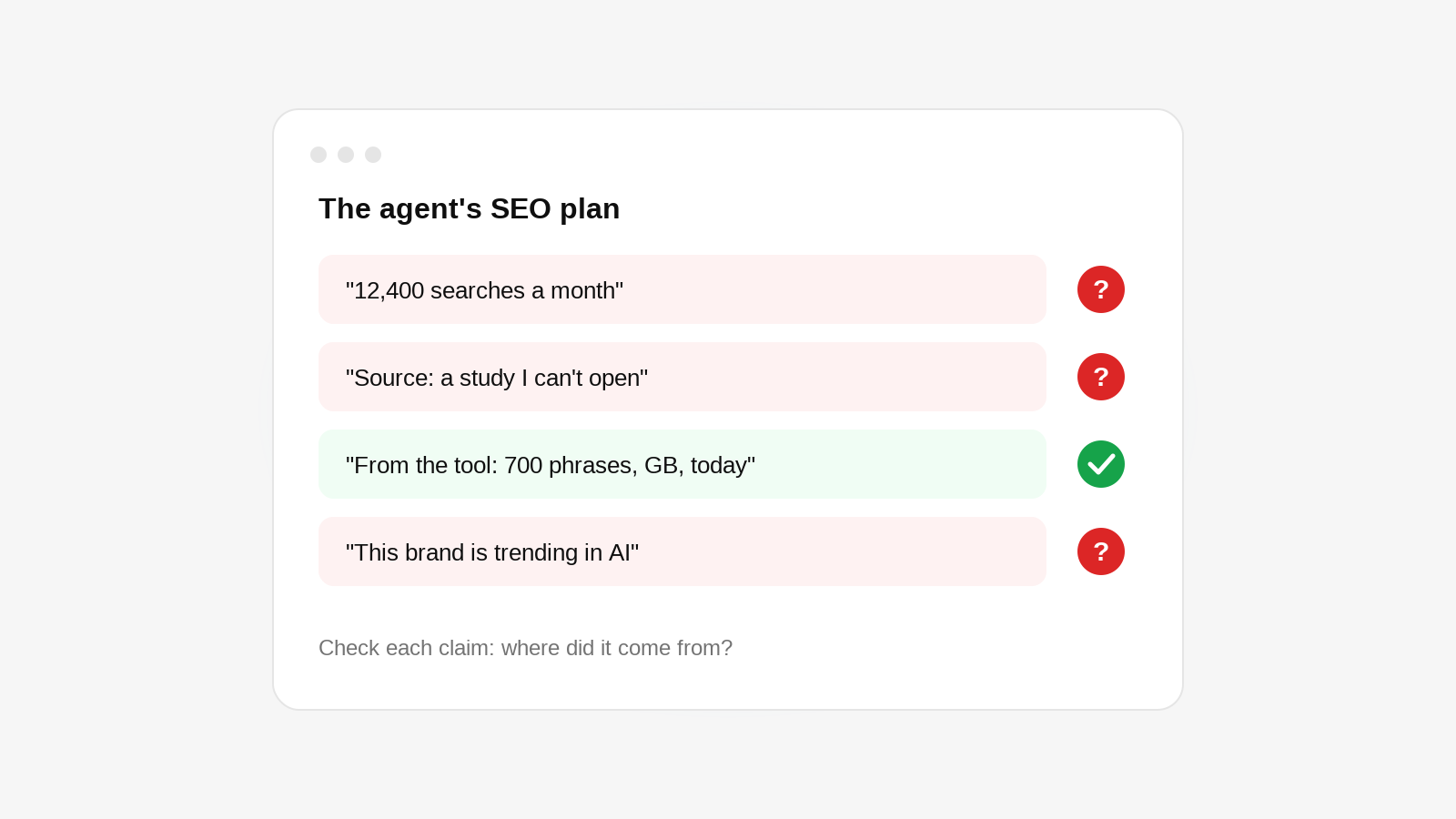
- Any search volume an agent gives with no tool call behind it is a guess; the Answer Socrates MCP server and API return no volumes at all, and real ones come from Check Metrics in the app.
- Check the market and the date on every result: Google autocomplete changes by location, our tools default to the US, and a cached keyword pull can be up to 30 days old.
- Open every link an agent cites: in a 2025 Tow Center test, eight AI search tools answered more than 60% of 1,600 news queries incorrectly.
- When clustering, treat a topic holding over 40% of the list as unsorted, and read the keywords behind any intent label before you choose a page type.
- Repeat a prompt before you call it a trend: SparkToro found less than a 1 in 100 chance that ChatGPT or Google's AI gave the same brand list twice.
Agents fill gaps with confident guesses
An AI agent is an assistant that does more than chat: it plans steps, calls tools and hands you a finished piece of work, such as a keyword plan or a content calendar. That makes it fast. It also means one wrong fact early on can flow through every step after it, still sounding sure of itself.
The root cause is well documented. OpenAI's own researchers wrote in 2025 that "standard training and evaluation procedures reward guessing over acknowledging uncertainty" [1]. A model that is unsure is pushed to produce something plausible rather than say "I don't know". Anthropic's guide to reducing this lists the same fixes you can use as a reader: let the model admit it does not know, and make it cite a source for each claim [2].
So the skill is not "never use agents". It is checking where each claim came from before you act on it.
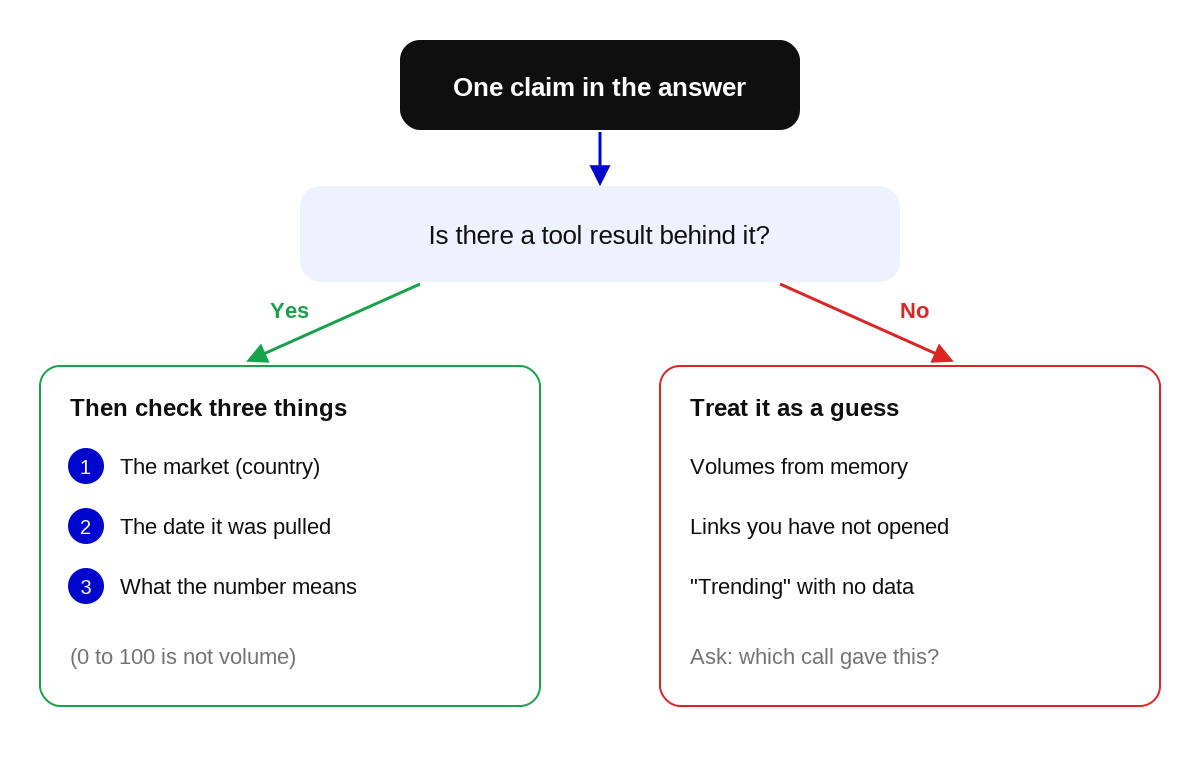
The rest of this lesson walks through the eight mistakes we see most in SEO work done by agents, what each looks like, and the check that catches it.
Invented search volumes
Ask a plain assistant "how many people search for cold brew concentrate in the UK each month?" and you may get a precise number. Some assistants now decline instead, as in the screenshot below, but not all of them do, and not every time. That number has no source. Search volume comes from Google's ad tools, which a model cannot query from memory, so a figure like "12,400 a month" is a pattern-matched guess that reads like data.
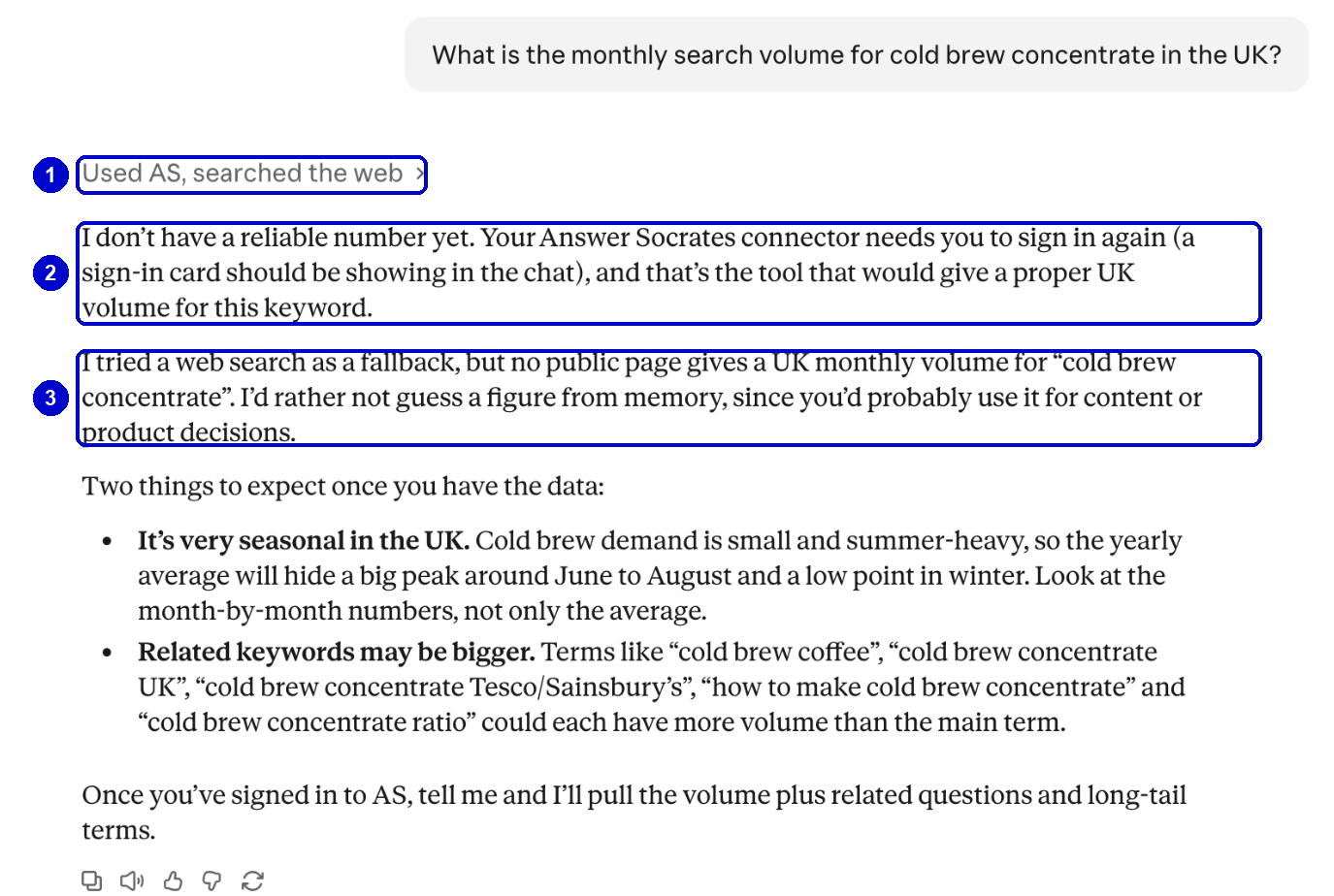
The tell is simple: no tool call, no data. In Claude, a fetched result shows a small "Used ..." line above the answer. In ChatGPT and other apps you see a similar tool card. If the number appears with none of that, treat it as a guess.
Our MCP server and API deliberately return no search volumes at all. They return real autocomplete phrases and Google Trends interest. So if an assistant connected to Answer Socrates quotes a monthly volume in the same reply, that number did not come from us. When you do need volumes, the Check Metrics button on a keyword search in the app pulls search volume, CPC and competition from Google Ads data on paid plans.
Stale data and the wrong market
Every model has a knowledge cutoff: the date its training data stops. Anthropic publishes a "reliable knowledge cutoff" for each Claude model [3], and other labs do the same. Anything after that date, such as a product launch, a new trend or a change in what people search for, is missing unless a tool fetches it. An agent working from memory will still talk about "current trends" with full confidence.
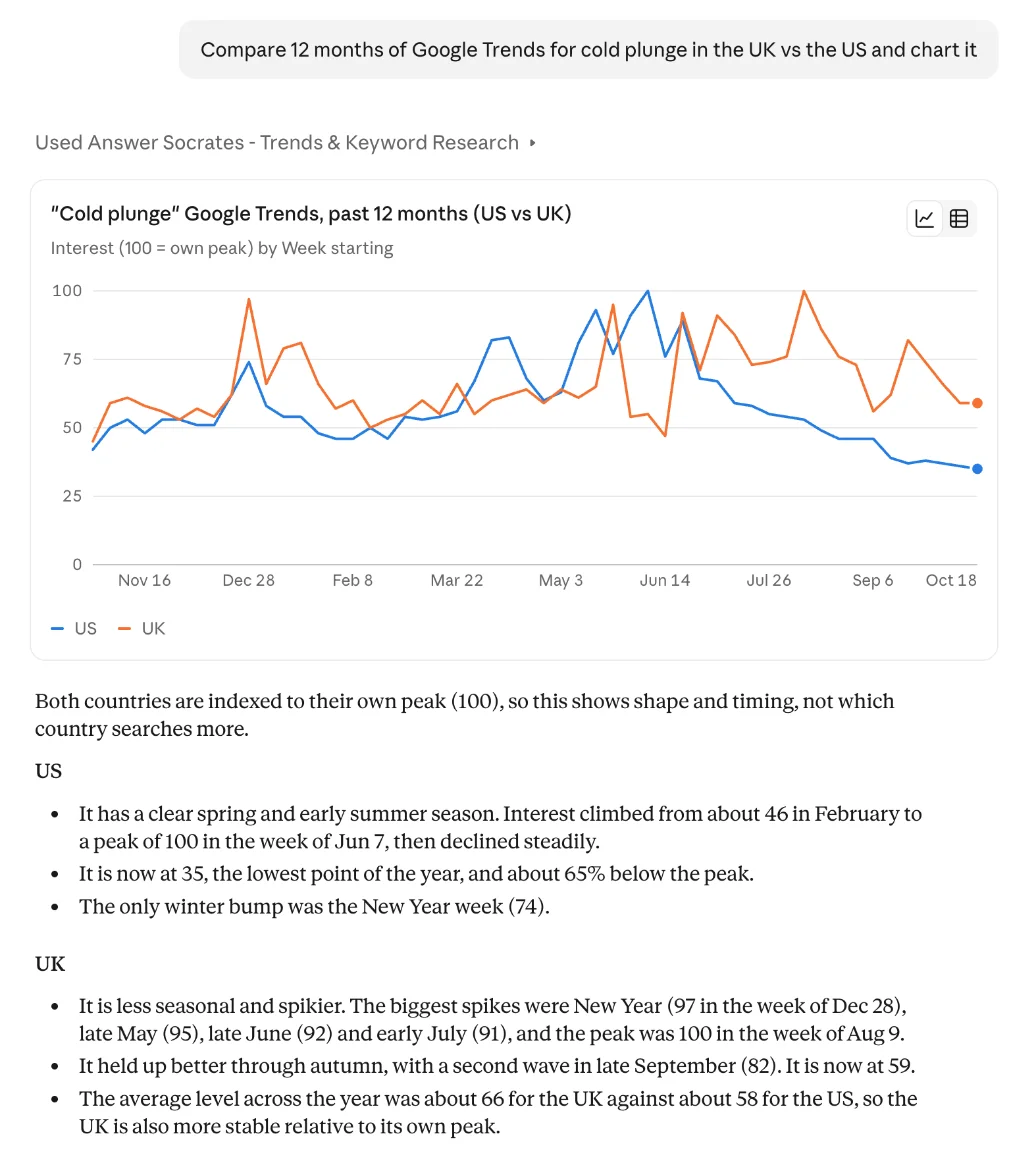
Market is the quieter version of the same mistake. Google says autocomplete weighs "the location it comes from" and the language of the query [4]. So keyword ideas for the US are not keyword ideas for the UK, and a coffee roaster in Leeds who never mentions the country can end up with a plan built on American searches.
Our MCP server tells the assistant, in its standing instructions, that all data defaults to the US, to pass the country when you name one, and to "note which market the results are for". Here is what that looks like in a real Claude session.
Freshness has a second layer: caches. Tools cache results so repeat requests are fast and cheap. Ours keep a keyword pull for a term and country for up to 30 days, and Ask Socrates reopens a pull of the same term and country from the last 7 days for free, saying the date it came from. That is usually what you want. When you need today's data, ask for a fresh pull and check the date in the reply.
Sources and links that do not exist
Agents that search the web still get citations wrong. In a 2025 test by the Tow Center for Digital Journalism, eight AI search tools gave incorrect answers to "more than 60 percent" of 1,600 queries about news articles [5]. More than half of the citations from two of the tools led to fabricated or broken URLs [5].
For SEO work this shows up as a "study" that proves your topic is growing, a competitor page that does not exist, or a statistic with a link to a 404. If you paste that into a brief or an article, you publish the mistake under your own name.
The check is mechanical. Open every link before you use it, and find the exact sentence that supports the claim. If you cannot find it, cut the claim. This is also what Anthropic recommends: have the model find a supporting quote for each claim, and drop any claim it cannot support [2].
Answer Socrates tools do not help here, and we will not pretend they do. Our MCP tools fetch search data, not articles or studies. Checking sources is on you.
Over-clustering and confident intent labels
Clustering means grouping a keyword list into topics, usually with a label for each keyword's search intent (what the searcher wants: to learn, to compare, to buy) and funnel stage. Agents love this job, and they fail at it in two ways.
The first is the catch-all. One topic, often named after the seed word, swallows most of the list. It looks like a finding, but it is really the unsorted pile.
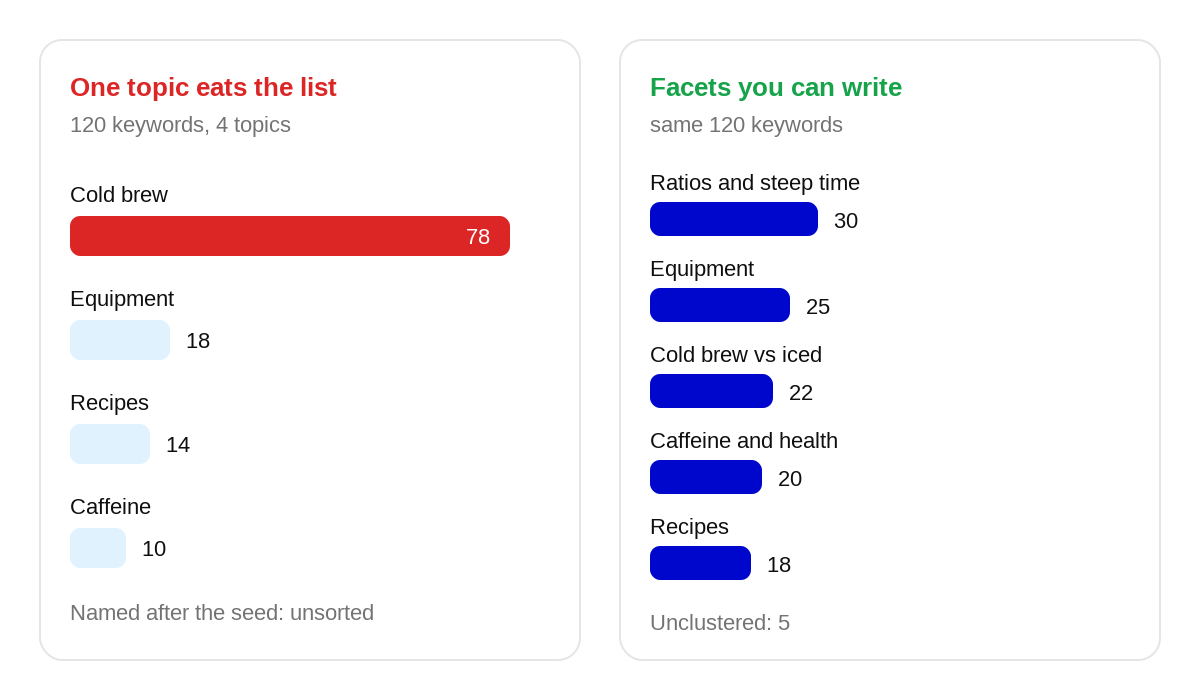
Our cluster_keywords tool flags this. When one topic holds more than about 40% of a run of 40 or more keywords, the result carries a warning to treat that group as unsorted. When more than 35% of keywords fit no topic confidently, it says so and suggests why. Every keyword also comes back with a confidence score for its topic, intent and funnel stage. The warnings cannot catch everything: in one of our own test runs, most of the genuinely off-topic keywords were absorbed into plausible-looking topics instead of being flagged. That is one run, not a rate, but it is why you still read the groups yourself.
The second failure is the confident label. A real example from a Claude session clustering cold plunge questions:
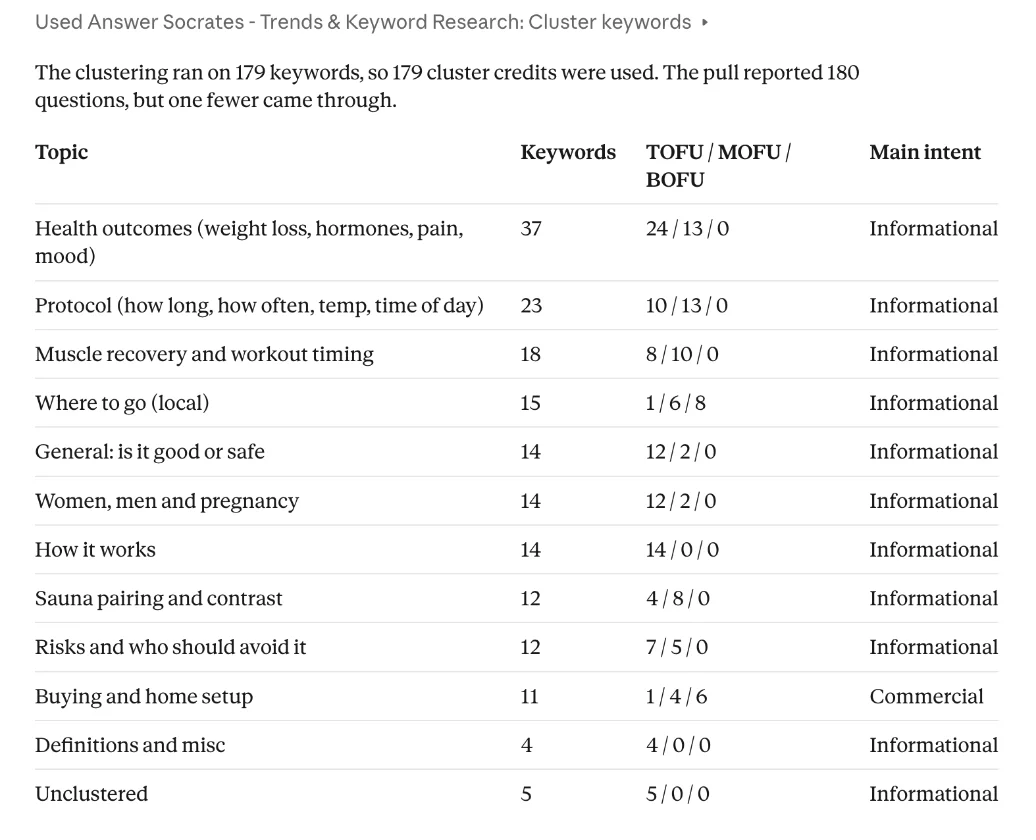
Nothing there is invented: each keyword was labelled, and "main intent" is simply the most common label in the group. But read quickly, it says a topic full of people looking for a place to go is informational. Before you decide a topic gets a blog post rather than a landing page, open the keywords and check.
Spending credits without asking
An agent with tools can spend money. Each call to a paid data tool uses part of an allowance, and an agent that "fans out" (pulls ten seeds when you asked about one) can use a month's worth in a single chat.
Our MCP server's instructions try to prevent this. They tell the assistant to offer the full keyword pull after trend research "rather than fanning out uninvited", and, for clustering, to say how many keywords it is about to send (which is the cluster-credit cost, 1 per keyword) and wait for you to agree. Usage checks are free, so the assistant can always tell you what is left.
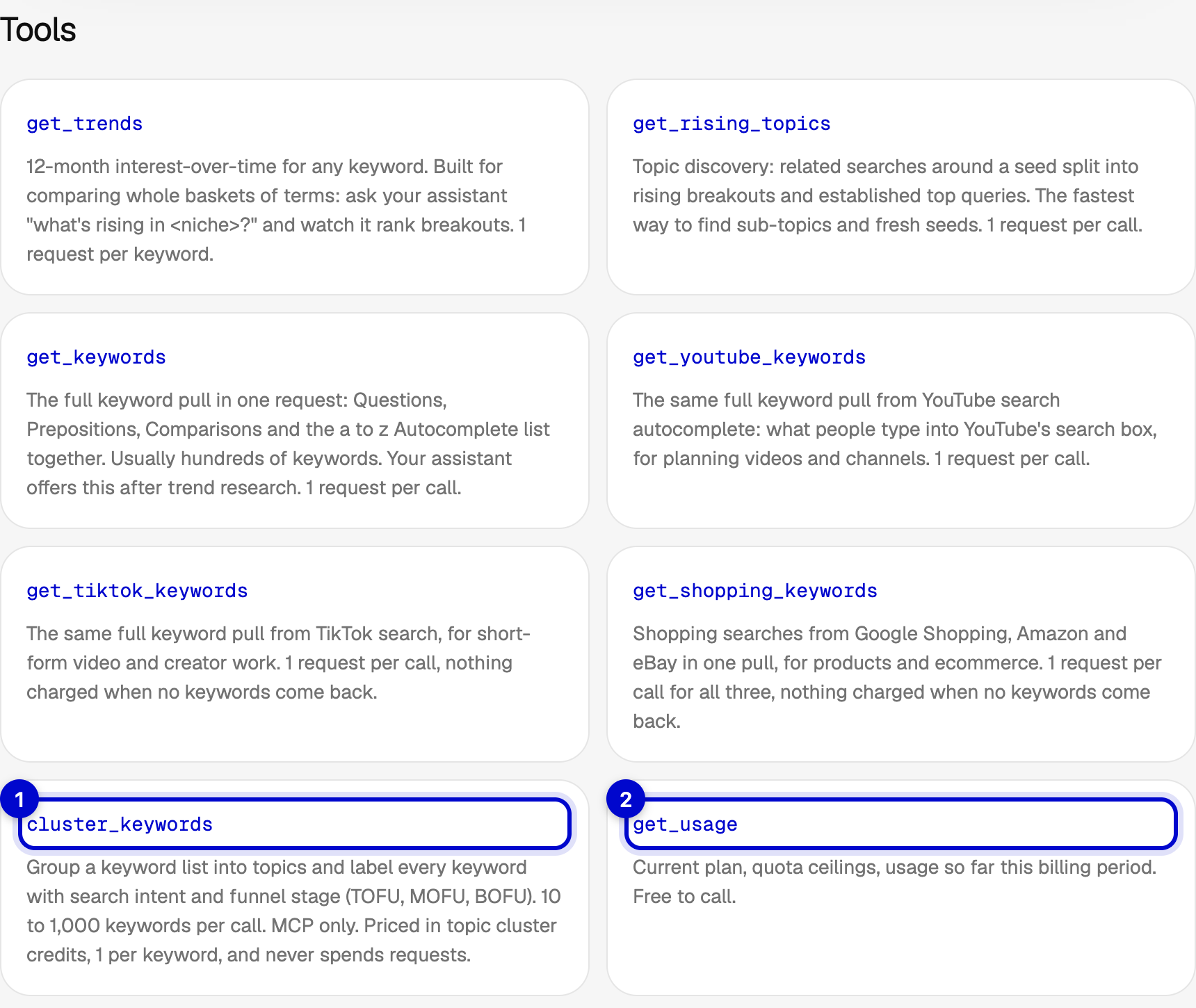
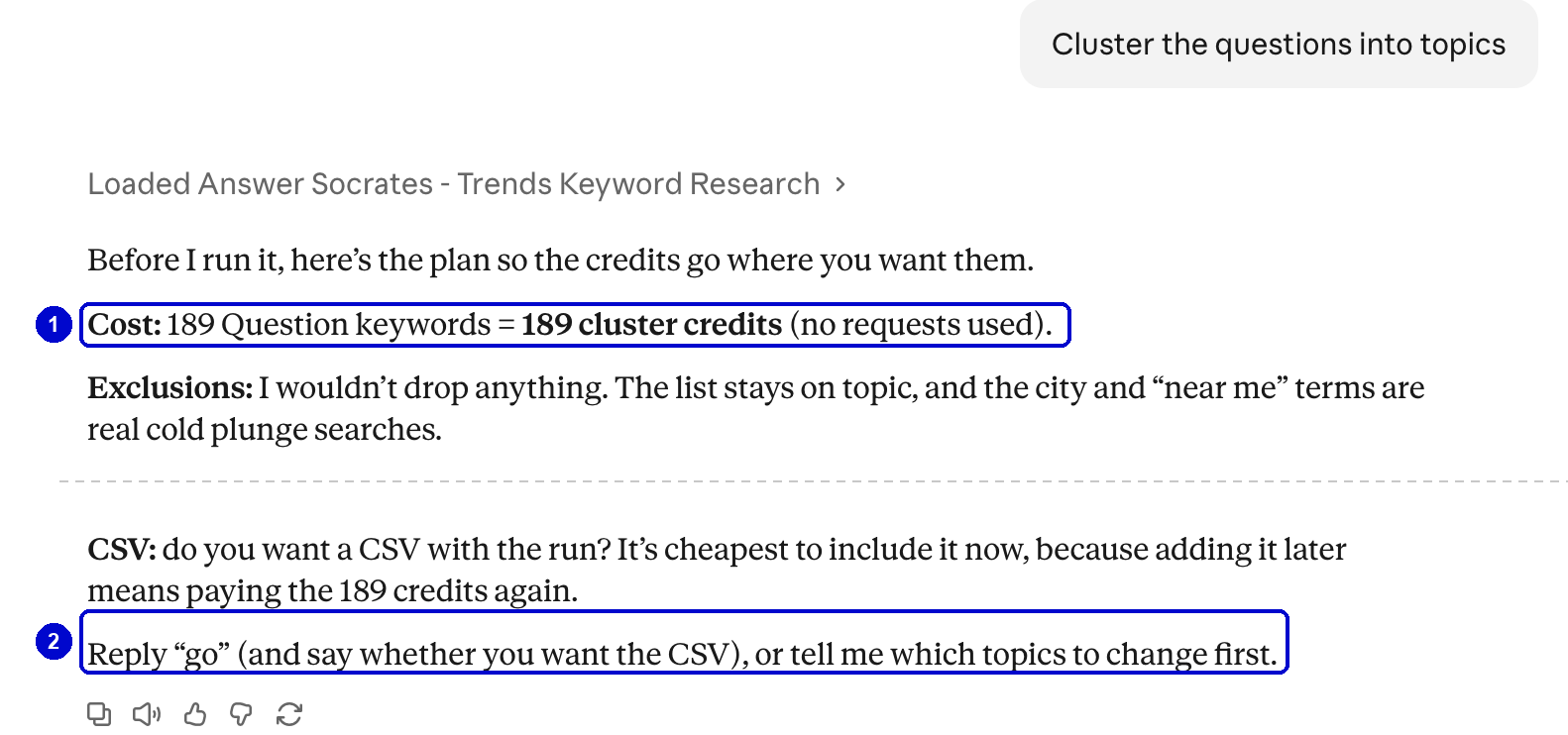
Instructions are not a lock. A model can still skip them, and the same server cannot control what other connectors in your chat do. In Ask Socrates, whether the chat asks first depends on your spending setting: "Asks before spending" shows an approval card for each paid step, while "Auto up to" a number lets it spend that much without asking.
One AI answer is not a trend
The last mistake is reading one AI answer as the state of the world. "ChatGPT recommends Brand D for beginners, so Brand D is winning" sounds like research. It is one sample.
SparkToro ran the same brand-recommendation prompts many times across ChatGPT, Claude and Google's AI in 2026. For ChatGPT and Google's AI, there was less than a 1 in 100 chance that two answers listed the same brands, and the same order was rarer still [6]. In their words, "AIs rarely give the same list of brands or recommendations twice" [6].
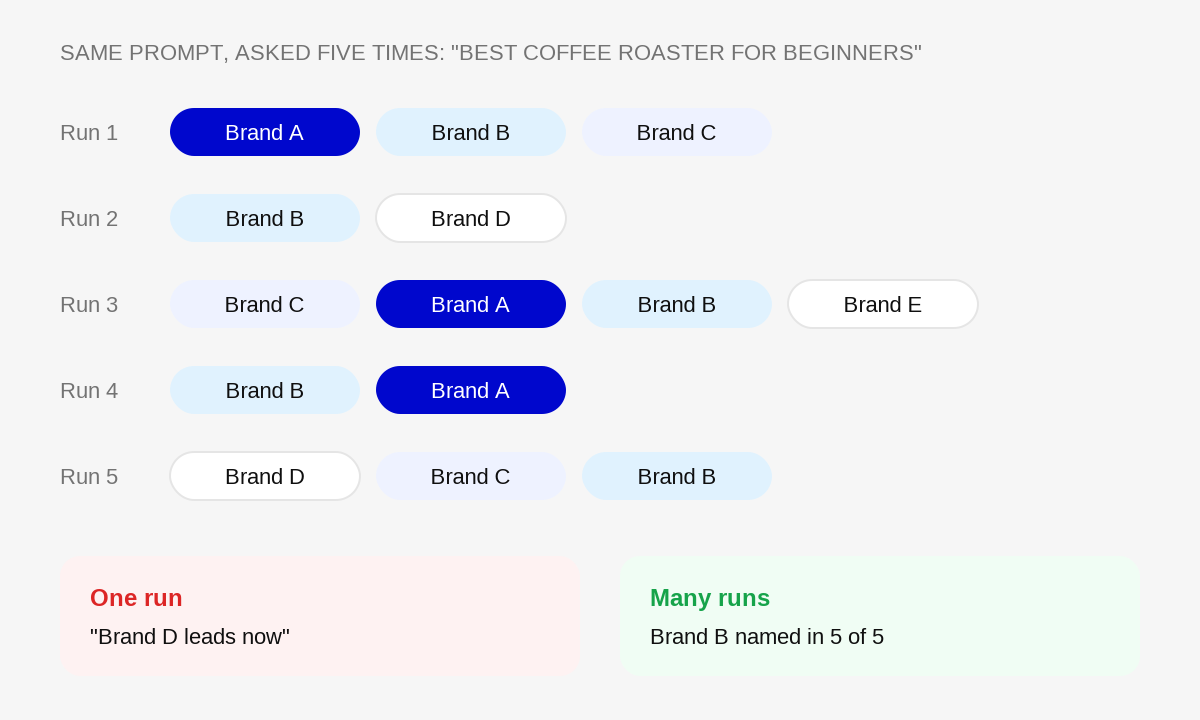
The fix is repetition. Ask the same prompt several times, across more than one engine, and count how often each name appears. Anthropic suggests the same idea for spotting made-up claims: run the prompt more than once and compare [2]. If a claim changes every time, it is not a finding.
What our tools fix, and what they do not
Here is the honest summary. Tools reduce some of these mistakes by replacing memory with fetched data. They do nothing for others.
| Mistake | What Answer Socrates tools do | What you still check |
|---|---|---|
| Invented search volumes | MCP and API return no volumes; real volumes come from Check Metrics in the app | Any volume in an agent reply with no tool behind it |
| Stale data | Live autocomplete and Trends; cached pulls show their date | The date, and ask for fresh data when it matters |
| Wrong country | Server tells the assistant to pass the country and name the market | The market named in the reply |
| Made-up sources | Nothing: our tools do not fetch articles | Open every link, find the sentence |
| Over-clustering | Catch-all and unclustered warnings, confidence per keyword | Read the biggest group and the unclustered list |
| Confident intent labels | Labels per keyword, with confidence | The keywords behind any label you act on |
| Skipped cost checks | Instructions to quote cost and wait; free usage check | That it asked before a paid call |
| One answer as a trend | Nothing on the MCP side | Repeat the prompt and count |
Use the last column as a checklist before you trust any agent's SEO plan.
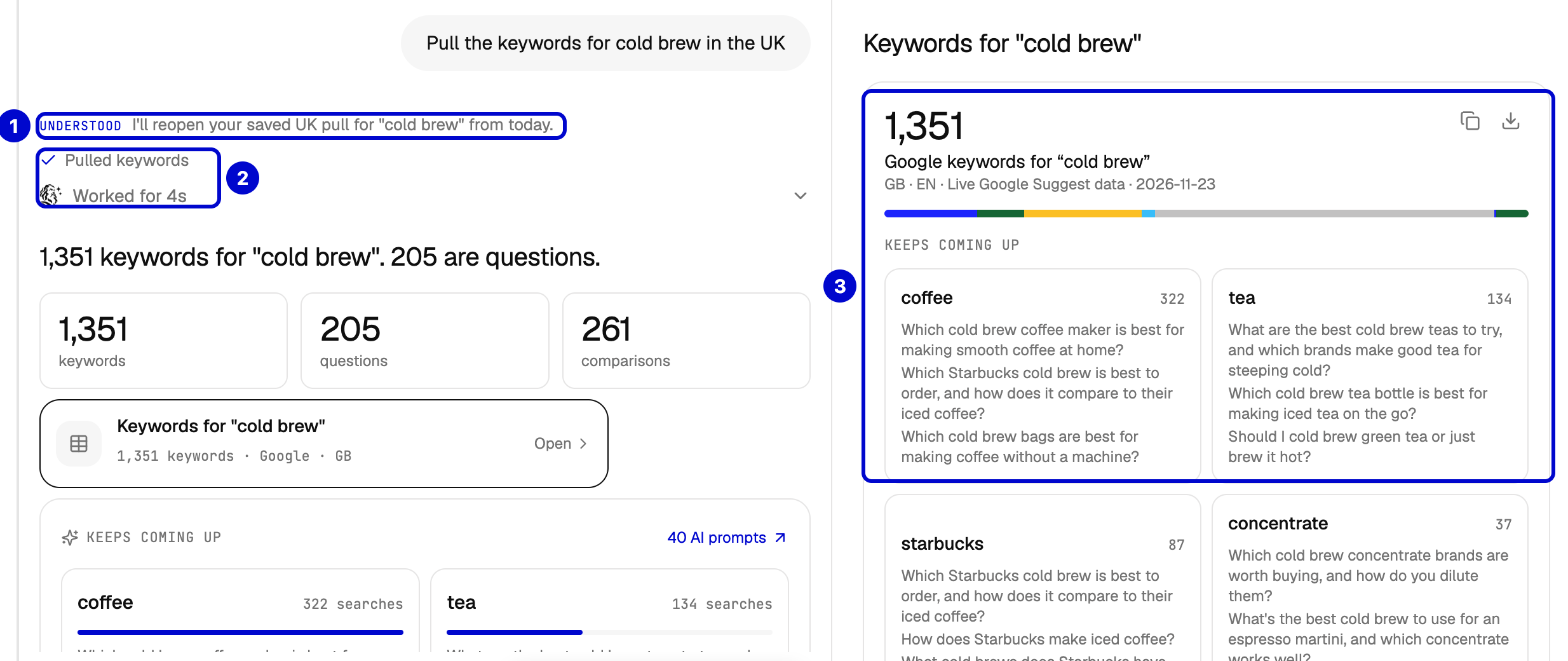
Ask Socrates, the chat inside Answer Socrates, also tells you when it reuses a saved pull instead of fetching a new one.
Where to go next
| If you want to... | Read |
|---|---|
| Understand how assistants call live tools | What is MCP? A plain-words guide for SEOs |
| Run research in Claude with the checks built in | Keyword research from inside Claude |
| Let an agent build a plan you can verify | Building a content plan with an AI agent |
| Read clusters properly before you trust them | Keyword clustering: turning a list into topics |
| Measure AI answers over many runs, not one | Tracking AI visibility over time |
| Pull the raw data into your own sheets | Using the Answer Socrates API |
Sources
- Why language models hallucinate, OpenAI, 2025
- Reduce hallucinations, Anthropic (Claude Docs), 2026
- Models overview, Anthropic (Claude Docs), 2026
- How Google autocomplete predictions work, Google Search Help, 2026
- AI Search Has a Citation Problem, Columbia Journalism Review (Tow Center), 2025
- New Research: AIs are highly inconsistent when recommending brands or products, SparkToro, 2026
- FAQ about Google Trends data, Google Trends Help, 2026
