Why AI cites some pages and not others
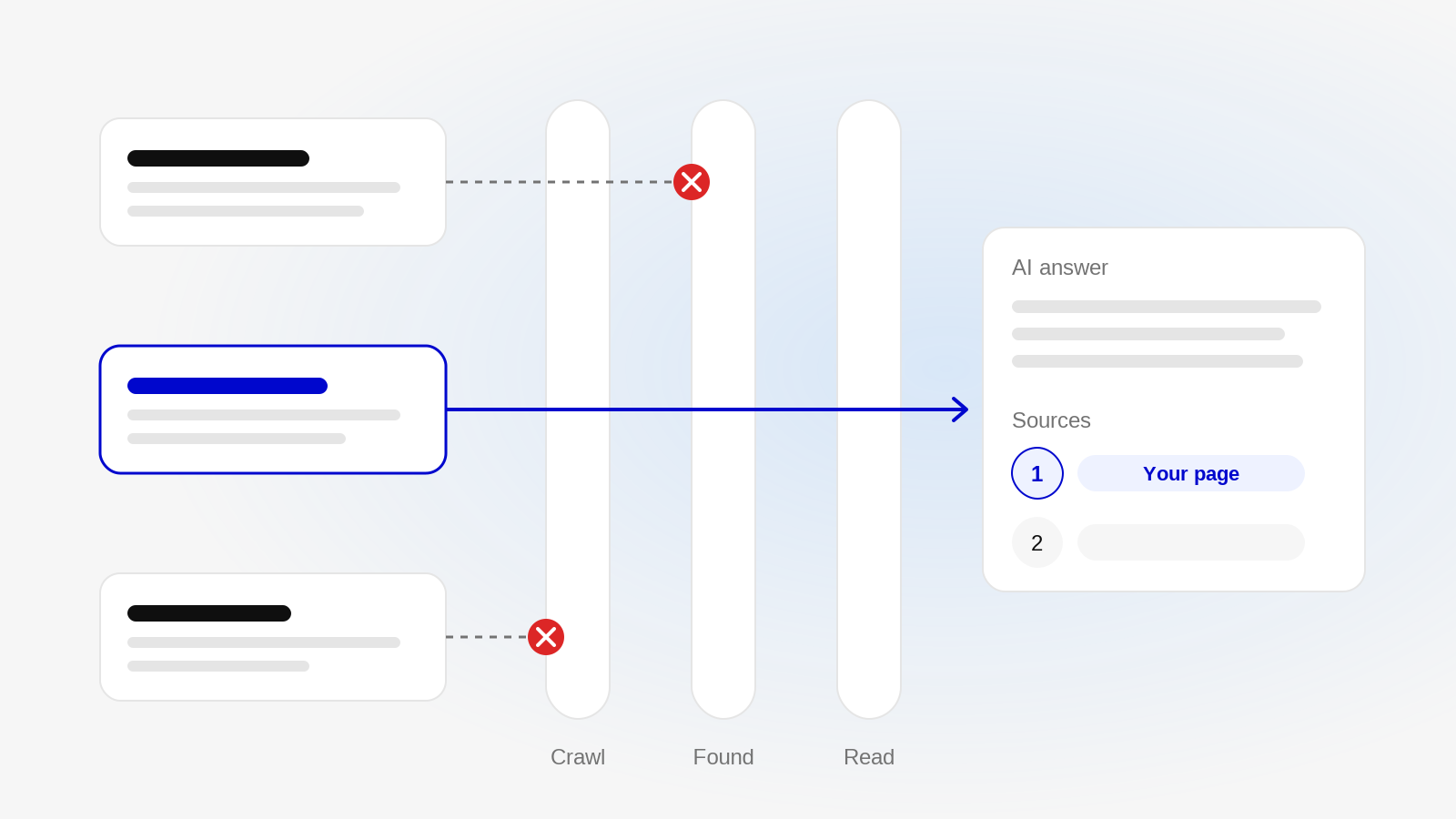
AI answers cite pages that their search bot may crawl, that rank for one of the searches the AI runs, and that state something the answer can use. Knowing which of those gates a page fell at tells you what to fix, and stops you rewriting pages that were never found.
Key takeaways
- A page must pass four gates to be cited: the search bot is allowed, the page is found by one of the AI's searches, it is read, and the answer uses it.
- Blocking OAI-SearchBot keeps a site out of ChatGPT search answers; blocking GPTBot only concerns model training. Check robots.txt by bot name.
- Ahrefs' share of AI Overview citations that rank top 10 fell from about 76% (July 2025) to 37.9% (March 2026), so single studies are readings, not laws.
- The GEO study found quotations, statistics and cited sources helped and keyword stuffing hurt, but on a simulated 2023 engine with pages already in the top 5.
- Answer Socrates calls a page sticky when it is cited in at least 2 of every 3 runs; Ask Socrates shows Winning, Close, Losing and Targets for free from saved checks.
A citation is the last of four gates
A citation is a link to one of your pages that an AI answer shows as a source: the numbered links under a Perplexity answer, the link cards beside a Google AI Overview, or the Sources list in ChatGPT. Before a page can be cited, it has to pass four gates, and most pages fall at the first two.
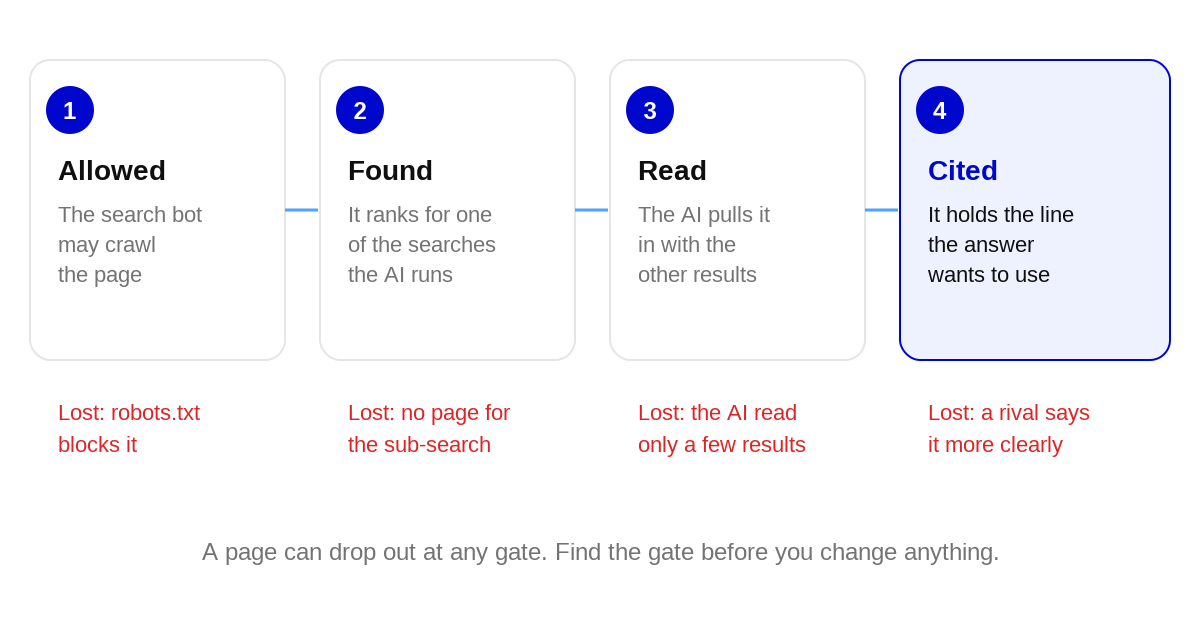
- Allowed. The engine's search crawler may fetch the page. OpenAI says a site must allow its search crawler to be eligible for ChatGPT search [4]. Google says a page must be indexed and eligible to show with a snippet [1].
- Found. The page comes back for one of the searches the AI runs. ChatGPT "rewrites your query into one or more targeted queries" [4], and Google's AI features may split one question into many searches [1].
- Read. The AI pulls the page in with the other results. It only reads what its own searches returned.
- Cited. The answer uses something from the page and links it.
When a page is not cited, find the gate it fell at before you change anything.
Gate one: the search bot must be allowed in
robots.txt is the plain text file at the root of your site that tells crawlers which URLs they may fetch [11]. Each AI company runs separate bots for separate jobs, and a robots.txt rule applies to one bot name at a time. That is where many sites hide from AI search without meaning to.
| Company | Search bot (affects answers) | Training bot | What its docs say |
|---|---|---|---|
| OpenAI | OAI-SearchBot | GPTBot | Sites opted out of OAI-SearchBot "will not be shown in ChatGPT search answers" [3] |
| Perplexity | PerplexityBot | None named; PerplexityBot is not used for training | Allow PerplexityBot "to ensure your site appears in search results" [5] |
| Anthropic | Claude-SearchBot | ClaudeBot | Blocking Claude-SearchBot "may reduce your site's visibility" in search results [6] |
| Googlebot (normal indexing) | Google-Extended (training and grounding in some other Google systems) | No extra requirements for AI Overviews or AI Mode [1] |
Two details trip people up. First, blocking a training bot is a separate choice from blocking a search bot: OpenAI says disallowing GPTBot is about training its foundation models [3], so it does not remove you from ChatGPT search. Second, robots.txt is not a way to keep a page out of Google; Google says to use noindex for that [11]. If you change robots.txt for ChatGPT, OpenAI says its systems take about 24 hours to adjust [3].
Gate two: rank for the searches behind the answer
AI search engines search first and write second. So the pages they can cite are pages that rank for something. But not always for the words the user typed: Google says AI Mode works by "issuing multiple related searches concurrently across subtopics" [2]. This is query fan-out: one prompt becomes several searches, and a page only has to rank for one of them to be read.
The numbers on how much ranking matters are shakier than most blog posts suggest. Here is a clear case.
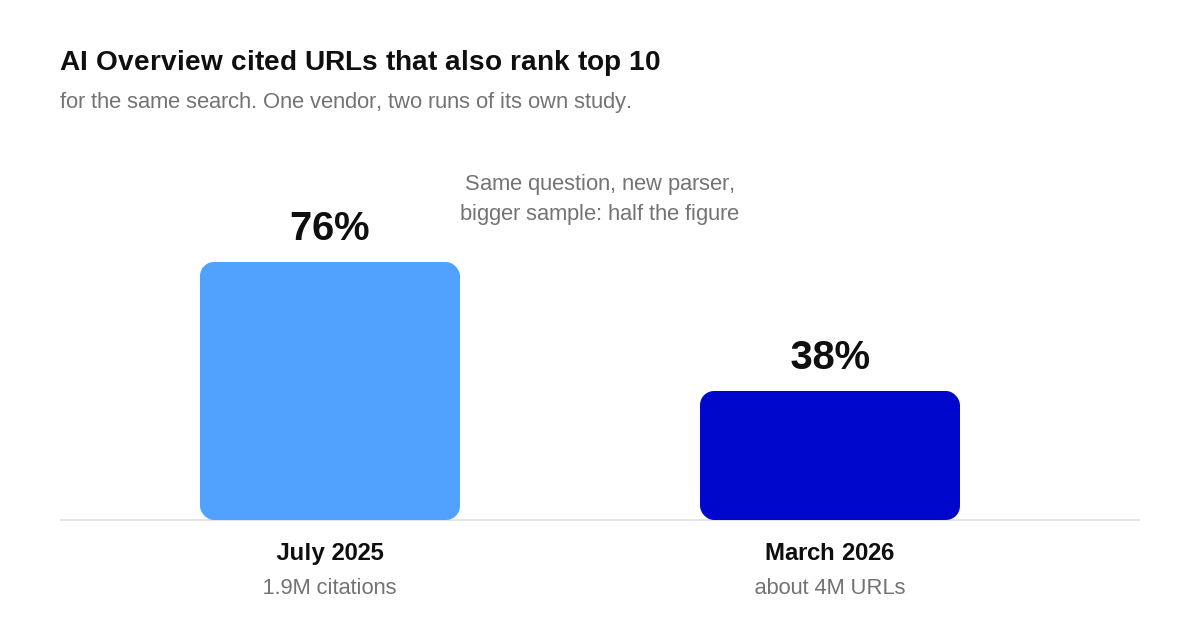
In July 2025 Ahrefs, an SEO tool vendor, reported that about 76% of URLs cited in AI Overviews also ranked in Google's top 10 for the same search, from 1.9 million citations. In March 2026 it re-ran the study on 863,000 keyword results and about 4 million AI Overview URLs, and got 37.9%. Another 31.2% ranked 11 to 100, and 31.0% were beyond the top 100 [7]. Ahrefs offers fan-out as a possible reason, and also says it improved how it reads citations, without saying how much that changed the result [7].
So what can you take from it? Ranking for the main keyword is a weaker predictor of being cited than it looked in 2025. Ranking for the sub-searches around it may matter more. That second part is a reasonable reading of Google's own description of fan-out [1][2], but no study has proven it.
Gate three: give the engine a line worth quoting
Once a page has been read, why does the answer use it over the next one? The platforms say little. Google's guide to its AI features lists ordinary SEO: important content in text form, internal links, a good page experience, and structured data that matches the visible text [1]. It also says you do not need "new machine readable files, AI text files, or markup" to appear [1]. In a May 2025 post, Google's John Mueller put the content advice in one line: "Focus on making unique, non-commodity content" [10]. Non-commodity content says something the other results do not: your prices, your test results, your own photos, your numbers.
The study most often quoted here is the GEO paper (Aggarwal and others, accepted to KDD 2024) [8]. The authors rewrote pages nine ways and measured how much of the answer each page supplied. They used 10,000 test queries and a simulated answer engine built on GPT-3.5 that read the top 5 Google results, plus a 200-query test on Perplexity. Adding quotations, statistics and cited sources helped most. Keyword stuffing did worse than leaving the page alone. The abstract sums it up as visibility gains of "up to 40%" [8].
What cited pages have in common
Put the documented rules and the studies side by side and a short list survives. The last column is the part most guides leave out.
| Trait | Evidence | How strong |
|---|---|---|
| Search bot allowed, page indexed | OpenAI, Perplexity, Anthropic and Google docs [1][3][5][6] | Documented requirement |
| Ranks for the AI's sub-searches | Google on fan-out [1][2]; Ahrefs data [7] | Documented mechanism, one vendor's numbers |
| Key content in text, markup matches the page | Google AI features guide [1] | Documented best practice |
| Unique, non-commodity information | Google Search Central blog [10] | Platform advice |
| Quotes, statistics and sources on the page | GEO paper [8] | One lab study, simulated engine |
| Keyword stuffing | GEO paper [8] | Did worse than no change in that study |
| llms.txt or special AI markup | Google says it is not needed [1] | Not needed for Google's AI features |
Notice what is missing: there is no documented "AI ranking factor" you can tick off. A cited page is usually a page that ranks for one of the searches and states the answer plainly, with facts the others lack.
Citations come and go between runs
AI answers change on every run, and so do their sources. In a SparkToro study, 600 volunteers ran 12 prompts 2,961 times through ChatGPT, Claude and Google's AI; the engines returned the same brand list fewer than 1 time in 100 [9]. One check that cites your page proves little, and one check that skips it proves little too.
So read citations across runs. In Answer Socrates a page cited in at least 2 of every 3 runs is sticky: the engine relies on it. A page that is cited only sometimes "comes and goes". A page cited before but in none of the last 3 runs has "dropped out". A prompt with fewer than 3 runs "needs more runs" before anything can be called sticky.
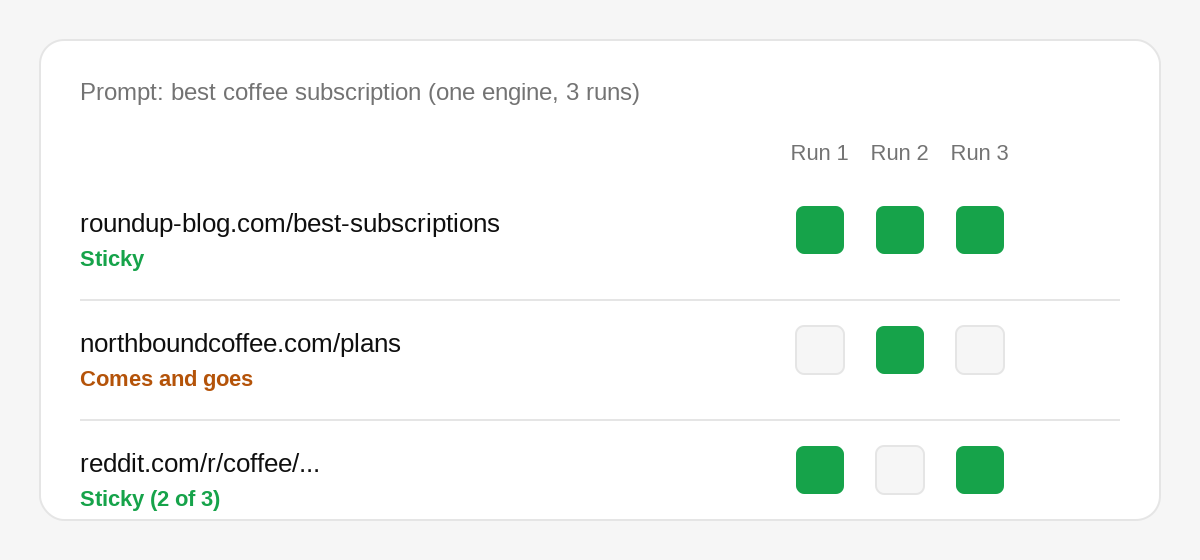
A made-up example: Northbound Coffee, a small roaster, checks "best coffee subscription" three times in one engine. A roundup blog is cited every time. A Reddit thread is cited twice. Northbound's own plans page is cited once. That tells the roaster two things. Its page is close: it passed the first three gates and lost at the last. And the engine leans on the roundup, so getting onto that list may move the answer faster than any edit. The next lesson covers both jobs.
How to see who gets cited in Answer Socrates
Step 1. Run the Radar on your domain. Open the LLM Brand Tracker and type your domain. Radar searches recorded ChatGPT answers and Google AI Overviews for your site. Sign in to run it: your first domain is free and the count is free. Seeing each prompt, the page cited and your rank costs credits, and the cost is shown before you confirm.
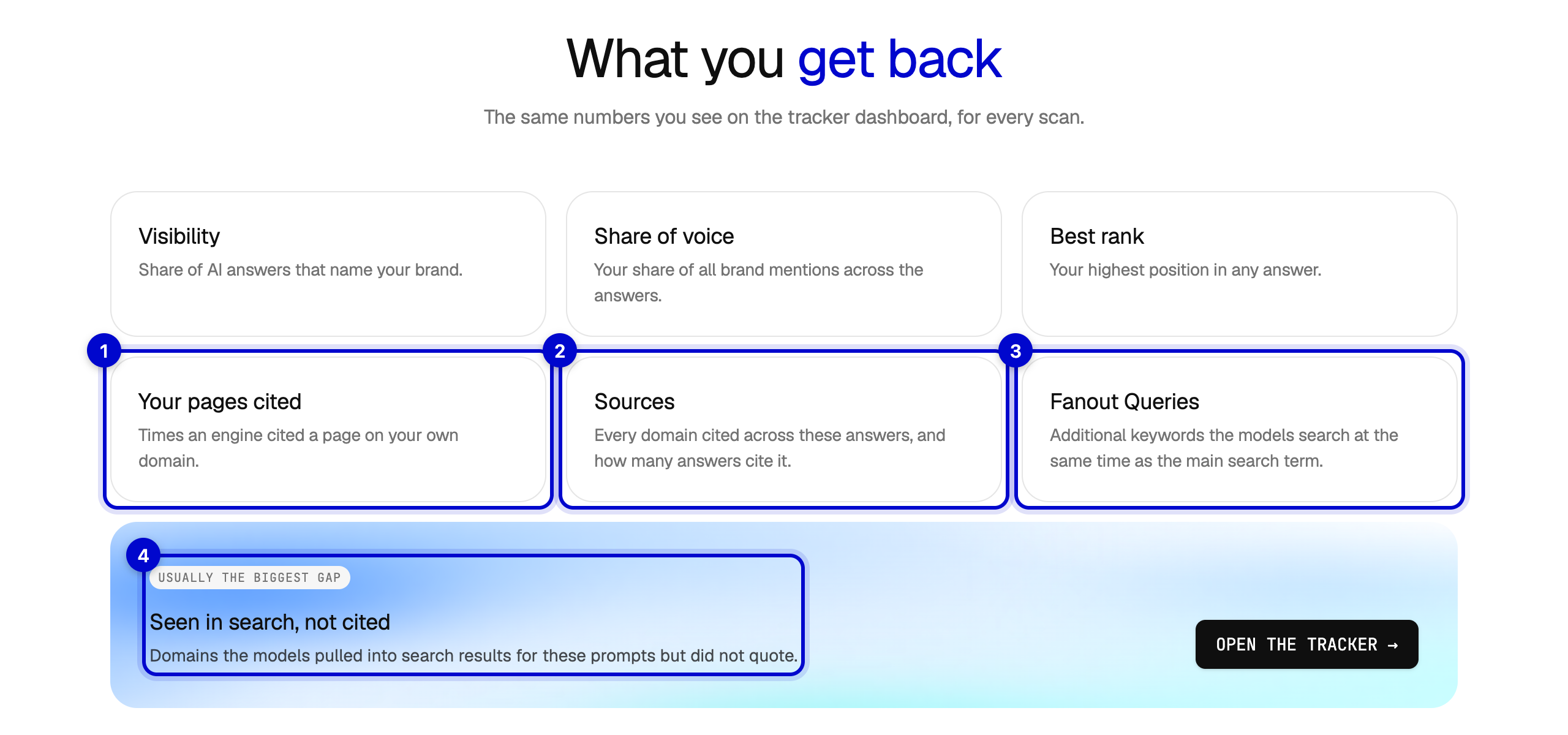
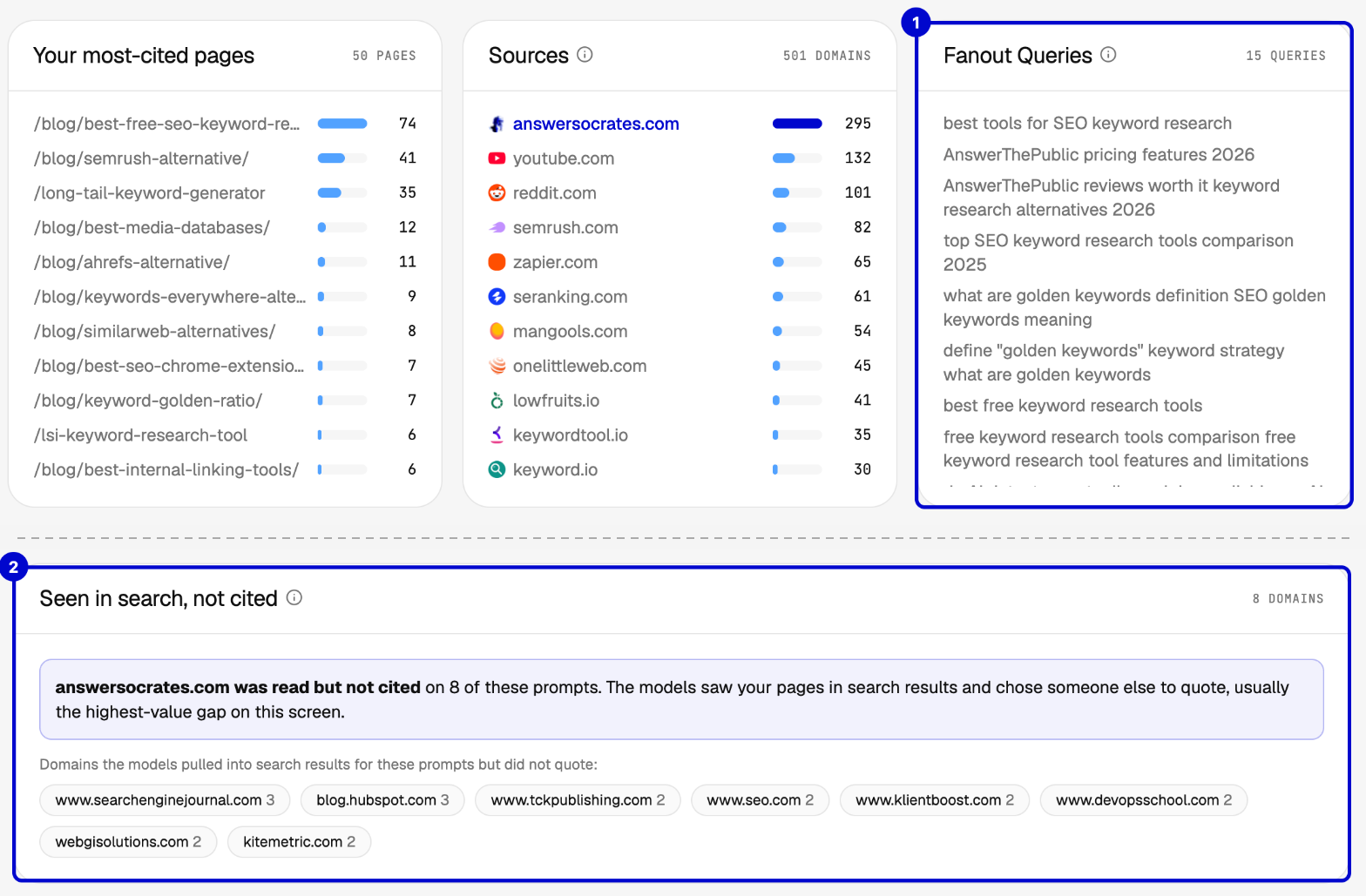
The results line up with the gates. Your most-cited pages and Sources list who was cited. Fanout Queries are "additional keywords the models search at the same time as the main search term". Seen in search, not cited lists domains the models pulled into search results but did not quote.
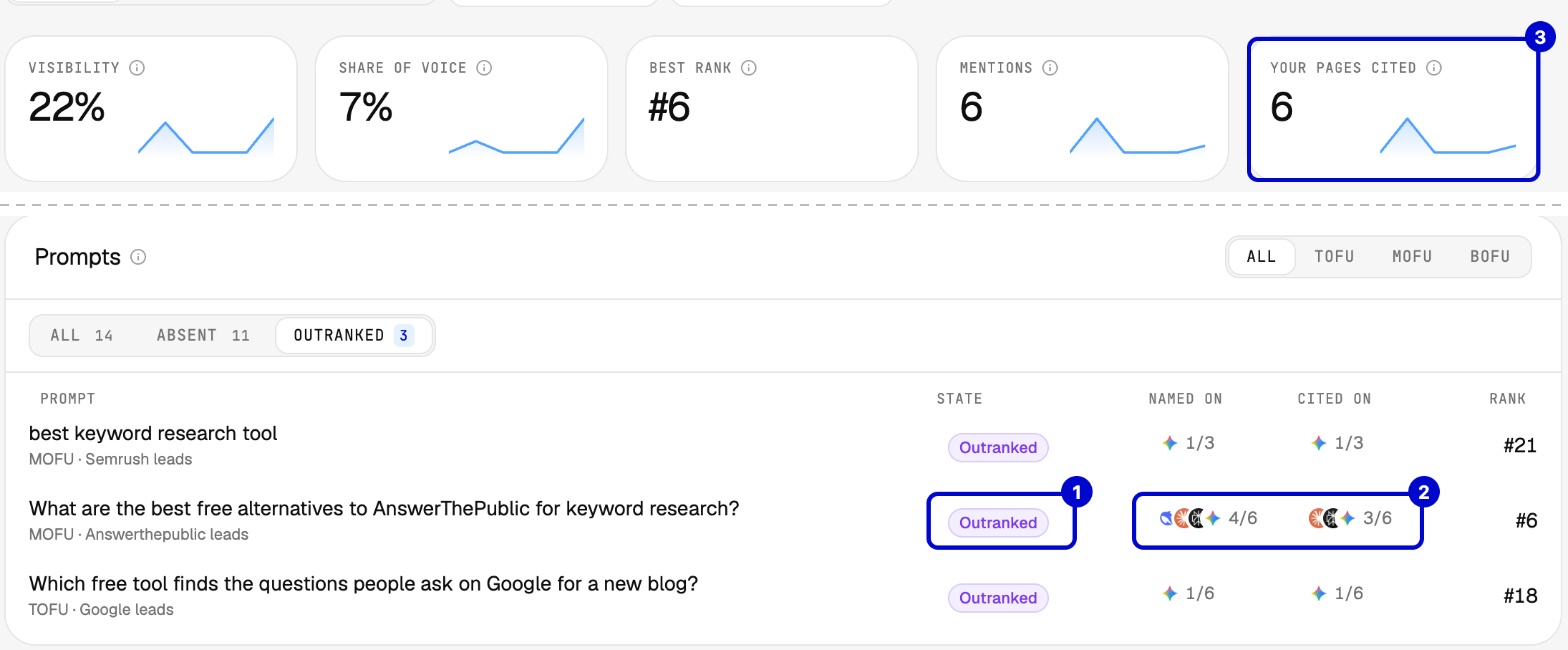
Step 2. Read the prompt states on the Dashboard. Live scans (paid plans, 1 credit per engine) feed the tracker's Dashboard. Its Prompts table gives each prompt a state: Absent (not named and none of your pages cited), Cited, not named, Named, not cited, Outranked (named and cited, but a competitor comes first) or Leading. The Your pages cited number counts the times an engine cited a page on your own domain.
Step 3. Open Citations. In the tracker sidebar, Citations lists every page the engines cite for your brand, as Pages, Domains or Targets. Filter by type (Owned, Competitor, Social, Third-party), switch on Lists only for best-of lists and roundups, and use Export CSV to keep a copy. Targets are third-party and social pages cited in answers that name your competitors but never you.
The same thing in Ask Socrates
Ask Socrates, our chat, reads the same saved checks. Open a project with your brand set and type:
This is free: it reads saved checks and runs nothing. A panel opens with four counts (pages cited, sticky pages, how many of yours are sticky, runs read) and a Where you stand block with four tabs. Winning: your page is cited in at least 2 of every 3 answers. Close: your page is cited some of the time. Losing: your site is never cited, and the tab shows who gets it instead. Targets: pages you could get featured on.
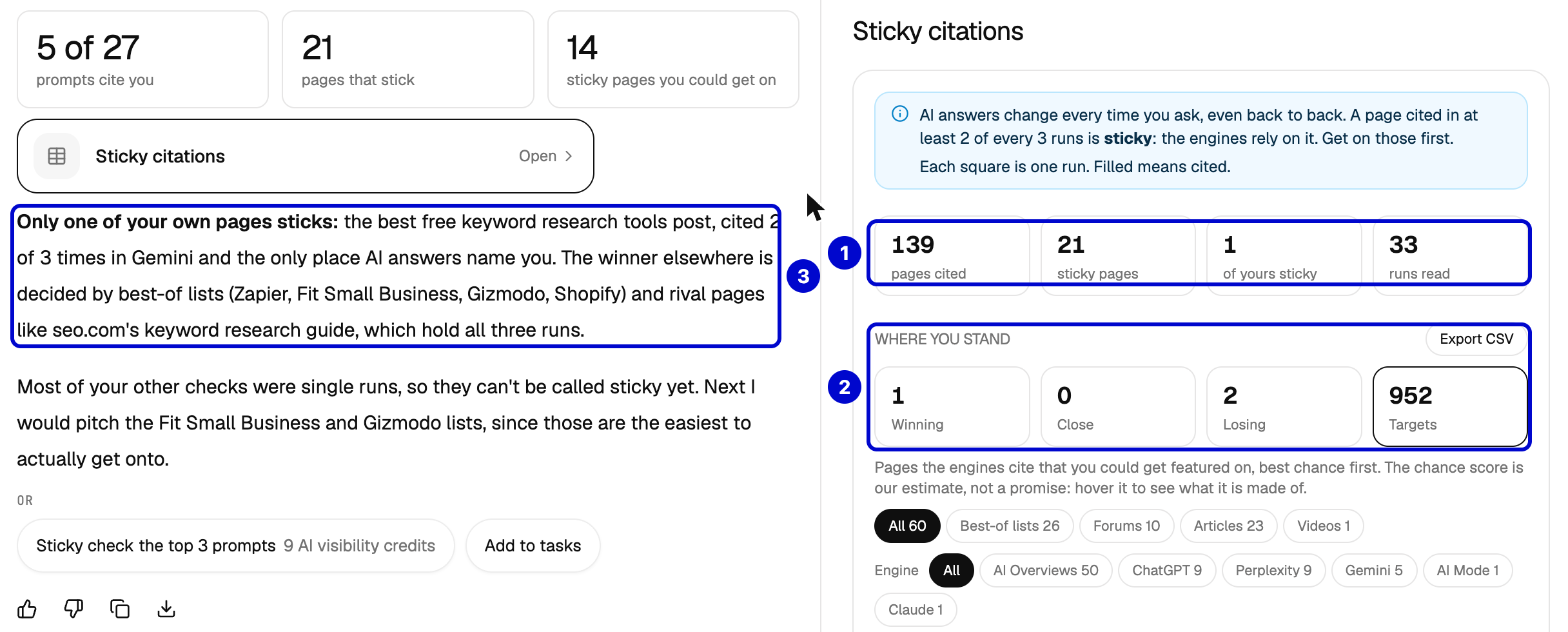
Below that, each prompt has a row of squares per cited page, one square per run, with its label.
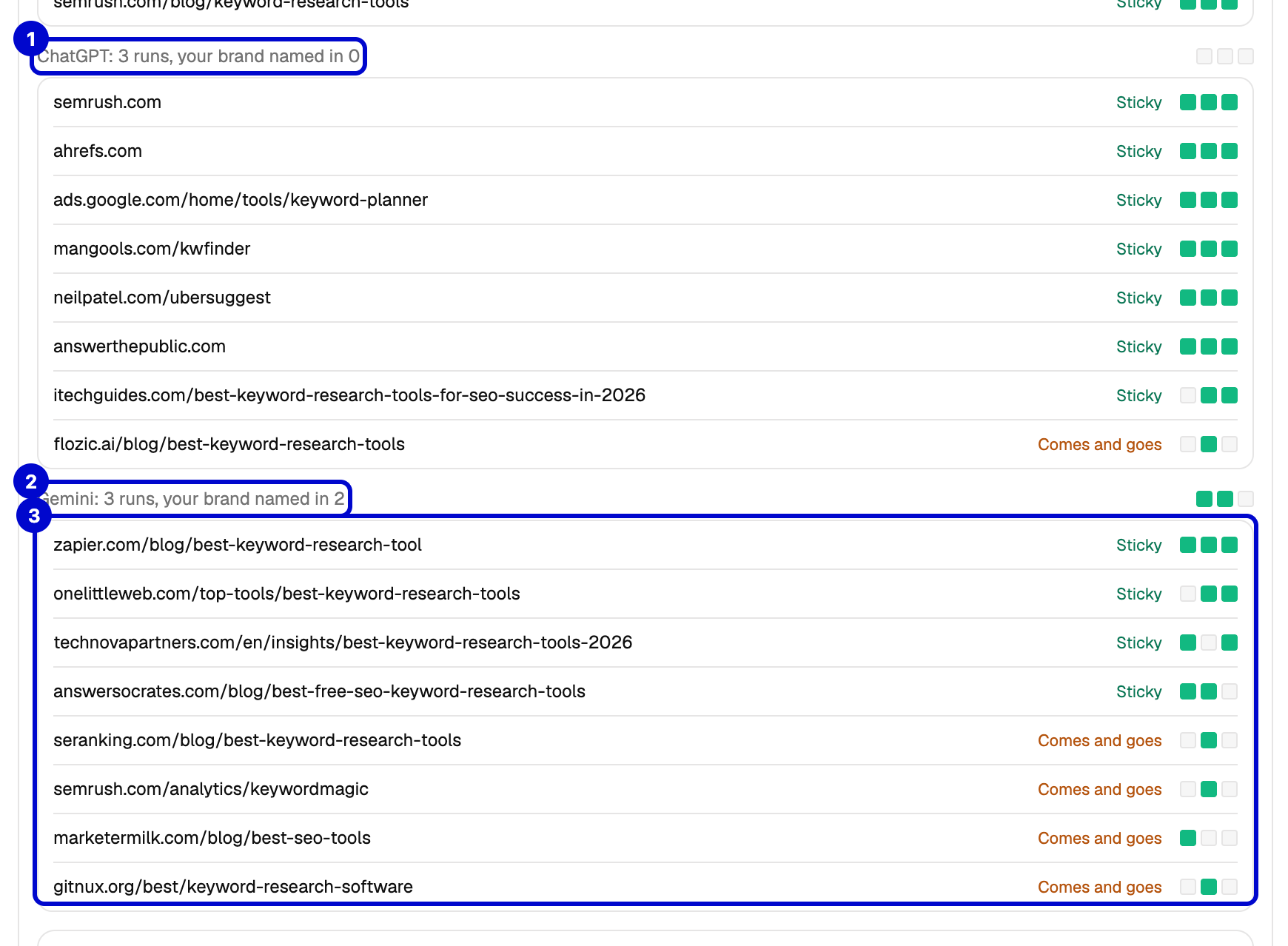
Prompts with fewer than 3 runs are not counted as sticky yet. The chat offers a Sticky check for them: each engine asked 3 times, at 3 credits per engine. Whether it asks you to approve first depends on your spending setting.
Where to go next
| If you want to... | Read |
|---|---|
| Make your pages easier to cite | Getting your pages cited in AI answers |
| Recap how AI answers are built | What is AI search? ChatGPT, AI Overviews and AI Mode |
| Check whether the answers name you | Is AI mentioning your brand? How to check |
| See which rivals get named instead | Competitors in AI answers: who gets named instead of you |
| Watch citations week by week | Tracking AI visibility over time |
Sources
- AI features and your website, Google Search Central, 2026
- Expanding AI Overviews and introducing AI Mode, Google, 2025
- Overview of OpenAI Crawlers, OpenAI, 2026
- Searching the web with ChatGPT, OpenAI Help Center, 2026
- Perplexity Crawlers, Perplexity, 2026
- Does Anthropic crawl data from the web, and how can site owners block the crawler?, Anthropic Help Center, 2026
- Update: 38% of AI Overview Citations Pull From The Top 10, Ahrefs, 2026
- GEO: Generative Engine Optimization (Aggarwal et al., KDD 2024), arXiv, 2024
- NEW Research: AIs are highly inconsistent when recommending brands or products, SparkToro, 2026
- Top ways to ensure your content performs well in Google's AI experiences on Search, Google Search Central Blog, 2025
- Introduction to robots.txt, Google Search Central, 2026
