Links vs mentions in the age of AI
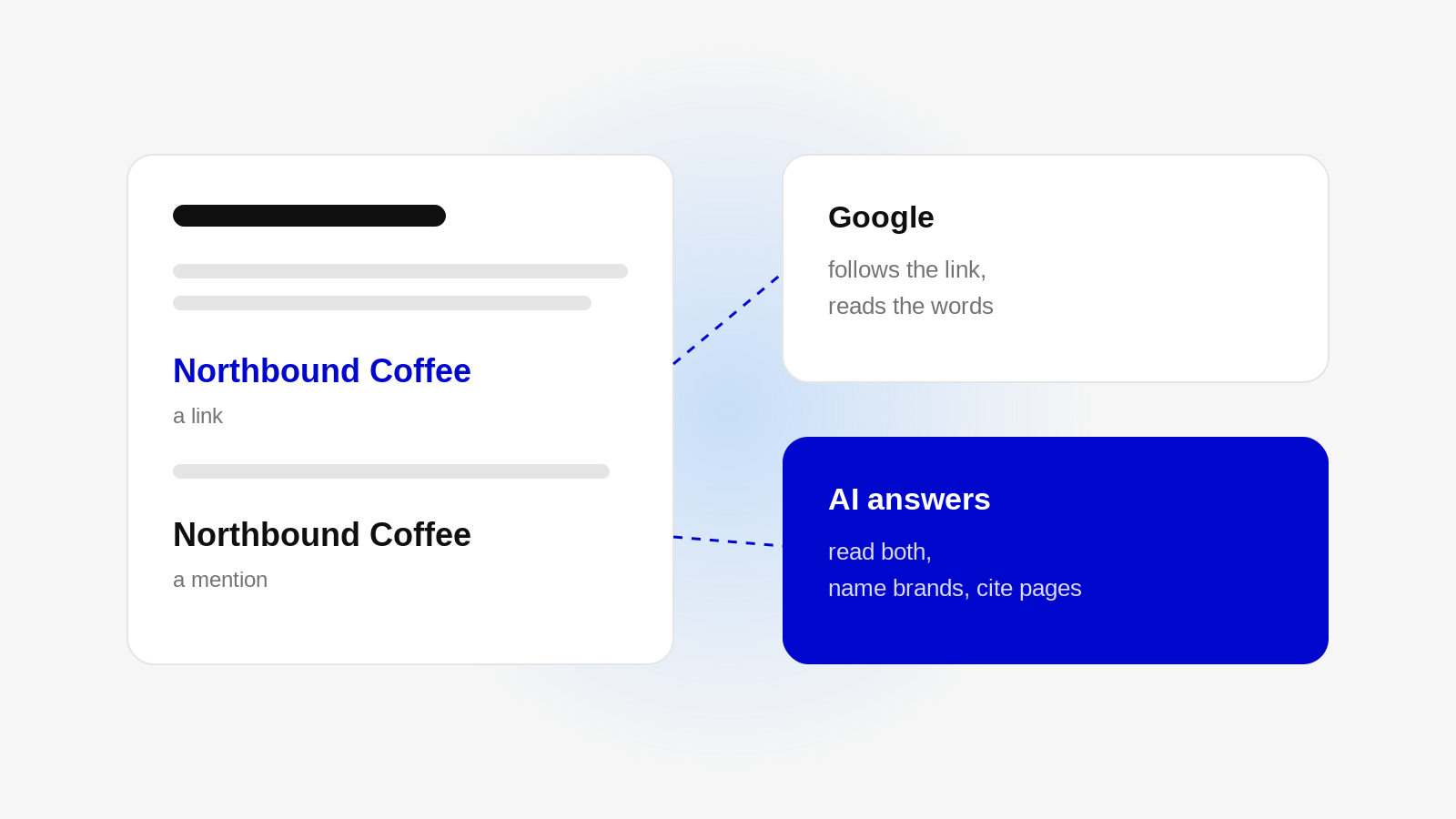
A link is a clickable route to your site; a mention is your brand named in plain text. Google documents links as a ranking and discovery signal, while AI answers repeat brand names and cite linked pages, so you need both.
Key takeaways
- Google says links help it find pages and judge relevance, and its ranking guide checks whether prominent sites "link or refer" to content, but it has not published how it weighs unlinked mentions.
- AI answers credit brands two ways: the answer text names brands (mentions), and the sources list links to pages (citations), which must be indexed to appear in Google's AI features.
- In Ahrefs' study of 75,000 brands, branded web mentions correlated 0.664 with AI Overview mentions, against 0.218 for backlinks, and Ahrefs warns this is not proof of cause.
- Ask for a link when a relevant article or best-of list names you and links to rivals; leave forum posts and news quotes as mentions.
- Answer Socrates finds unlinked mentions with the Mentions tactic (1 credit a run) and shows AI mentions and citations separately in the LLM Brand Tracker.
A mention is your name without the click
A link sends a reader to your page. A mention names your brand in plain text, with nothing to click. "Northbound Coffee roasts to order" in a gift guide is a mention. The same words wrapped in a link to northboundcoffee.com are a link.
Most brands collect far more mentions than links. Writers name the tools they use, forum posters recommend shops, podcasts get transcribed, and nobody stops to add a link. The question this lesson answers is what each one is worth now that people search in both Google and AI chats.
What Google says about links and mentions
For links, Google is clear. It uses them "to find new pages to crawl" and to judge relevance [2], and it treats paid or manipulated links as spam [5]. The whole system of rel values (sponsored, ugc, nofollow) exists because links carry weight [5].
For mentions, Google says much less. Its guide to ranking says one sign of quality is "if other prominent websites link or refer to the content" [1]. That word "refer" is as far as Google goes in public. It has not published how, or whether, an unlinked mention is counted.
So be careful with two claims you will often read:
- "Unlinked mentions are as good as links for Google." Nothing Google has published says this.
- "Unlinked mentions are worthless for Google." Google's own wording leaves room for them, so this is not proven either.
There is also a middle case: a link marked nofollow, sponsored or ugc. Google says links with those labels "will generally not be followed" [6], so for rankings it sits close to a mention. It still sends readers who click, and your name is still on the page, so do not ask a site to remove the label. Treat it as a mention that also brings visits.
The honest position: a link is a documented signal, a mention is a possible one, and neither is worth chasing on a site nobody reads.
AI answers name brands and cite pages
AI answers give credit in two different ways, and they line up with mentions and links.
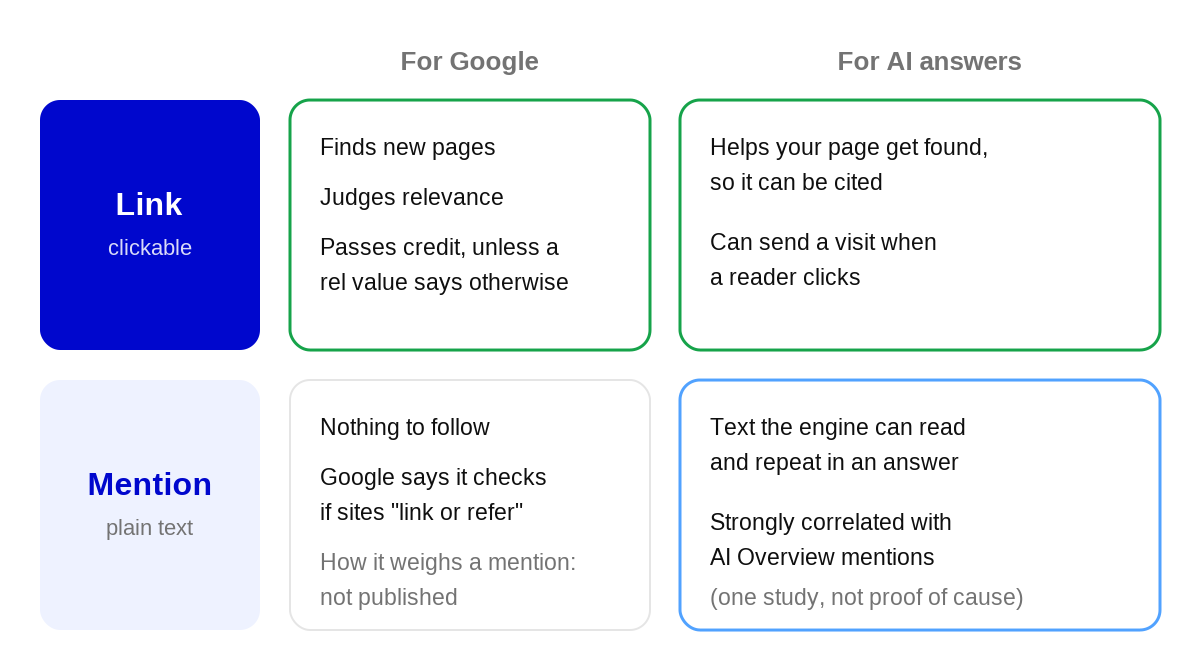
The answer text names brands. When ChatGPT recommends three coffee subscriptions, it is writing names, not links. Those names come from what the model learned and what it read for this answer, and those pages can name brands without linking to them.
The sources are links. ChatGPT's search answers "may include citations", and a Sources button lists them [3]. Google's AI Overviews and AI Mode show supporting links, and a page must be indexed and "eligible to be shown in Google Search with a snippet" to be one [2]. Google also says there are no special optimizations for its AI features: normal SEO best practices still apply [2].
That gives each one a clear job. A link helps a page get found and cited, and it is the only thing that can send a visit. A mention is what the engine can repeat when it names brands in its answer.
What the evidence on mentions shows
The best-known data comes from Ahrefs, which studied 75,000 brands and how often Google's AI Overviews mentioned them (published May 2025) [4]. It compared that with several things about each brand.
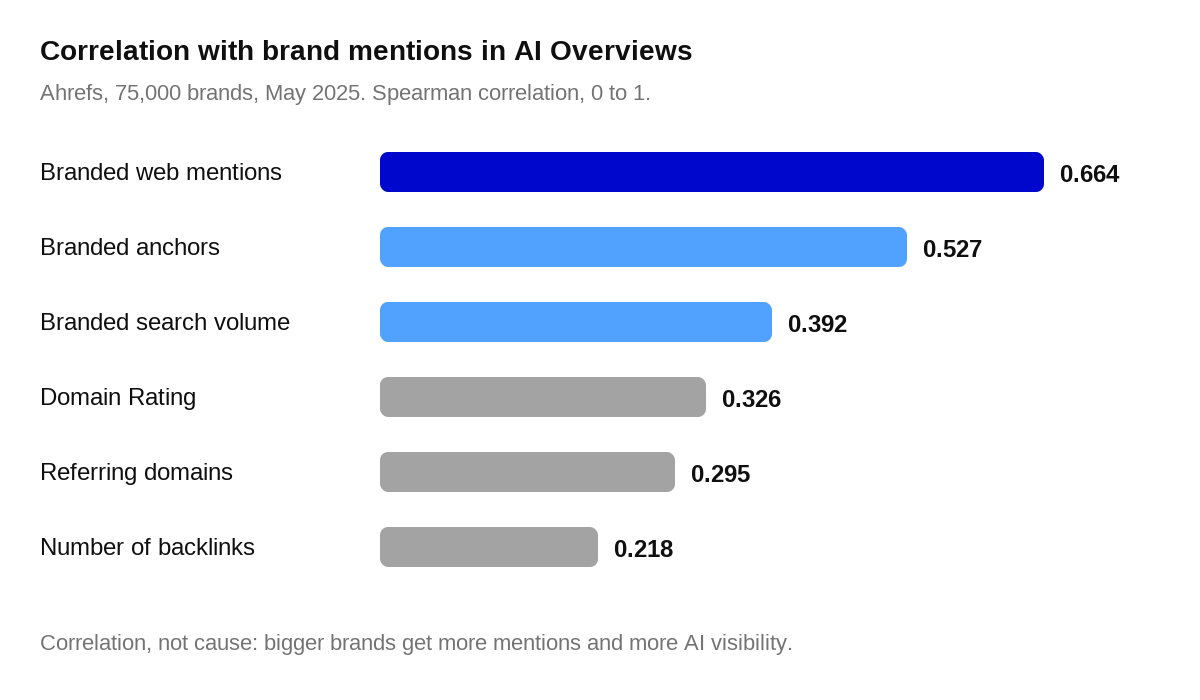
Branded web mentions had the strongest correlation, 0.664. Branded anchors (links whose anchor text is the brand name) came second at 0.527, and the number of backlinks was much weaker at 0.218 [4]. Ahrefs itself warns that correlation does not equal causation [4].
Read it with three limits in mind:
- It is one AI surface. The study measured Google's AI Overviews, not ChatGPT, Claude or Perplexity.
- Big brands win everything. A famous brand gets more mentions, more searches and more AI visibility at the same time. The study cannot show which causes which.
- About 26% of brands had no AI Overview mentions at all and were left out of the correlation [4].
When to ask for the link and when to leave it
A mention is not a failure to get a link. Often it is the win. But some mentions are worth turning into links, and the reason is usually the reader, not the ranking.
| Situation | Ask for the link? | Why |
|---|---|---|
| A relevant article names you and links to your competitors | Yes | Readers expect to click through, and the writer already links out |
| A best-of list names you in plain text | Yes, politely | Buyers on lists want to click, and the ask is small |
| A news story quotes your founder | Maybe once | Many news sites rarely link out; a mention there still counts as coverage |
| A forum or Reddit thread recommends you | No | You cannot ask strangers to edit posts, and links there are usually ugc or nofollow |
| A page that sells links or posts mentions you | No | Not worth a link even if they offered one |
| An AI answer names you but does not cite you | Find its sources | Look at which pages it cites and get onto those |
A made-up example: Northbound Coffee finds three mentions in a month. A coffee blog's "best subscriptions" list names them with no link, while linking two rivals: they ask, and point to their subscription page. A local paper quotes the founder in a story on rising bean prices: they send a thank-you and no request. A Reddit thread recommends their espresso blend: they leave it alone.
How to see both in Answer Socrates
Answer Socrates tracks the two kinds of credit in two places: Link Building for mentions on web pages, and the LLM Brand Tracker for mentions and citations in AI answers.
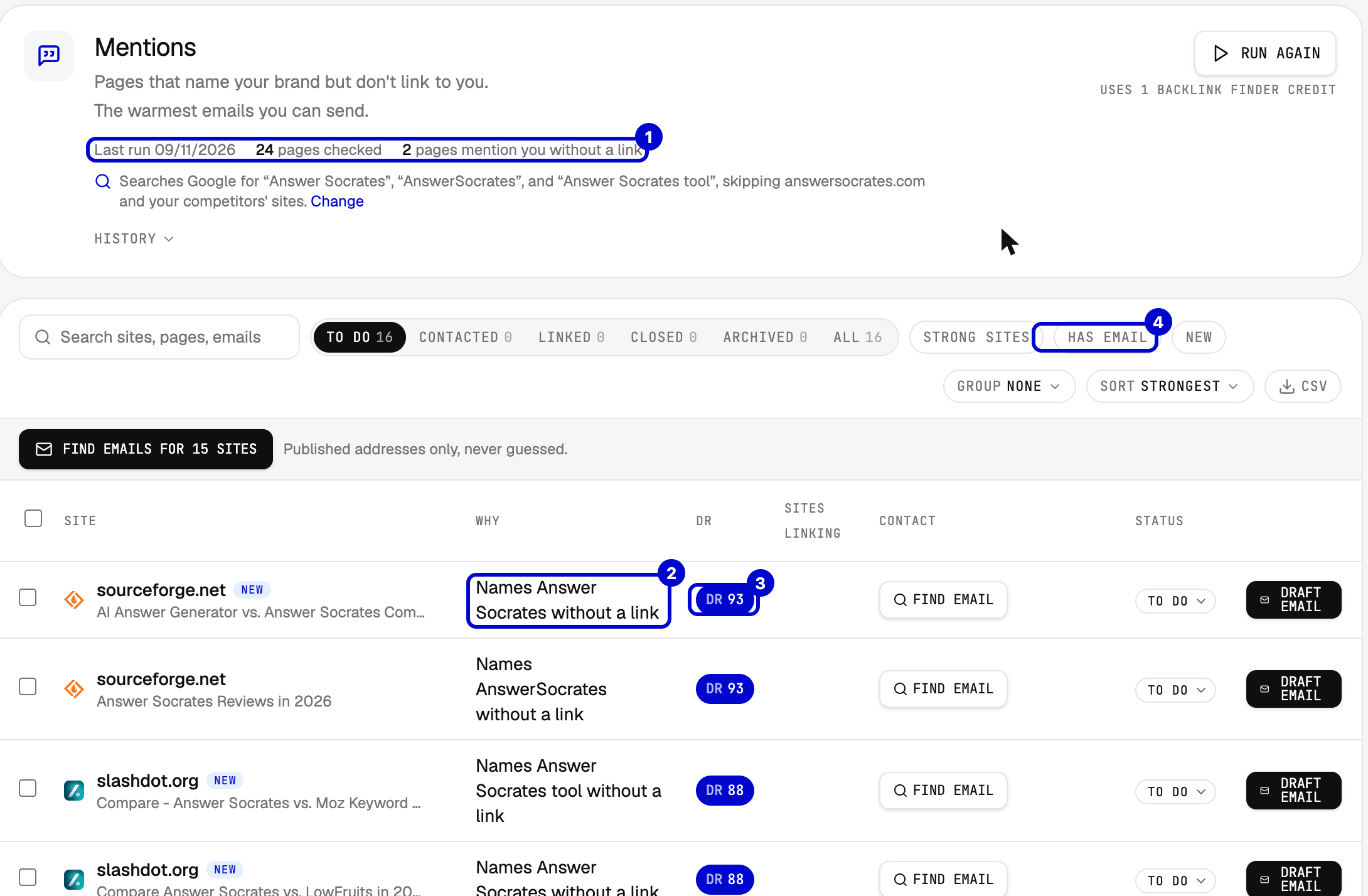
Step 1: Find pages that name you without linking. In Link Building, run Mentions. It searches Google for your brand name, up to three other names you added (a product, the founder, a common misspelling) and your domain written as text. It skips your own site, your competitors' sites and social sites, then reads each page live. A page that already links to your domain, even with nofollow, is dropped. One run uses 1 credit.
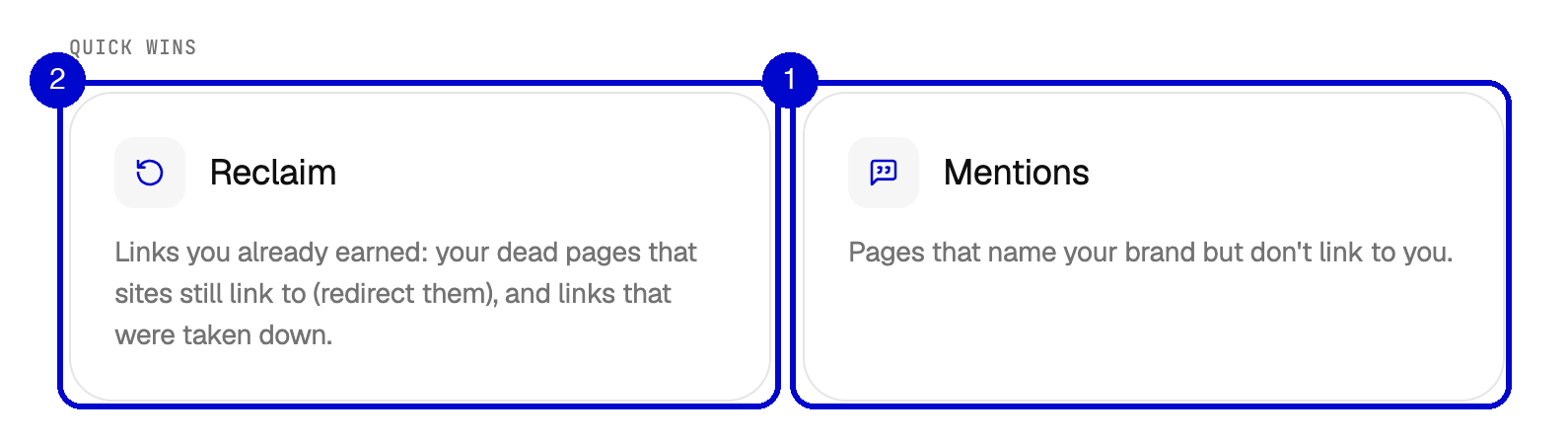
Step 2: Read the Why column. Each row says which of your names the page uses, for example "Names Northbound Coffee without a link". If a site blocks the live check, the page stays on the list anyway (Google matched your exact name), and nothing in the list marks which rows those are. Open each page before you write.
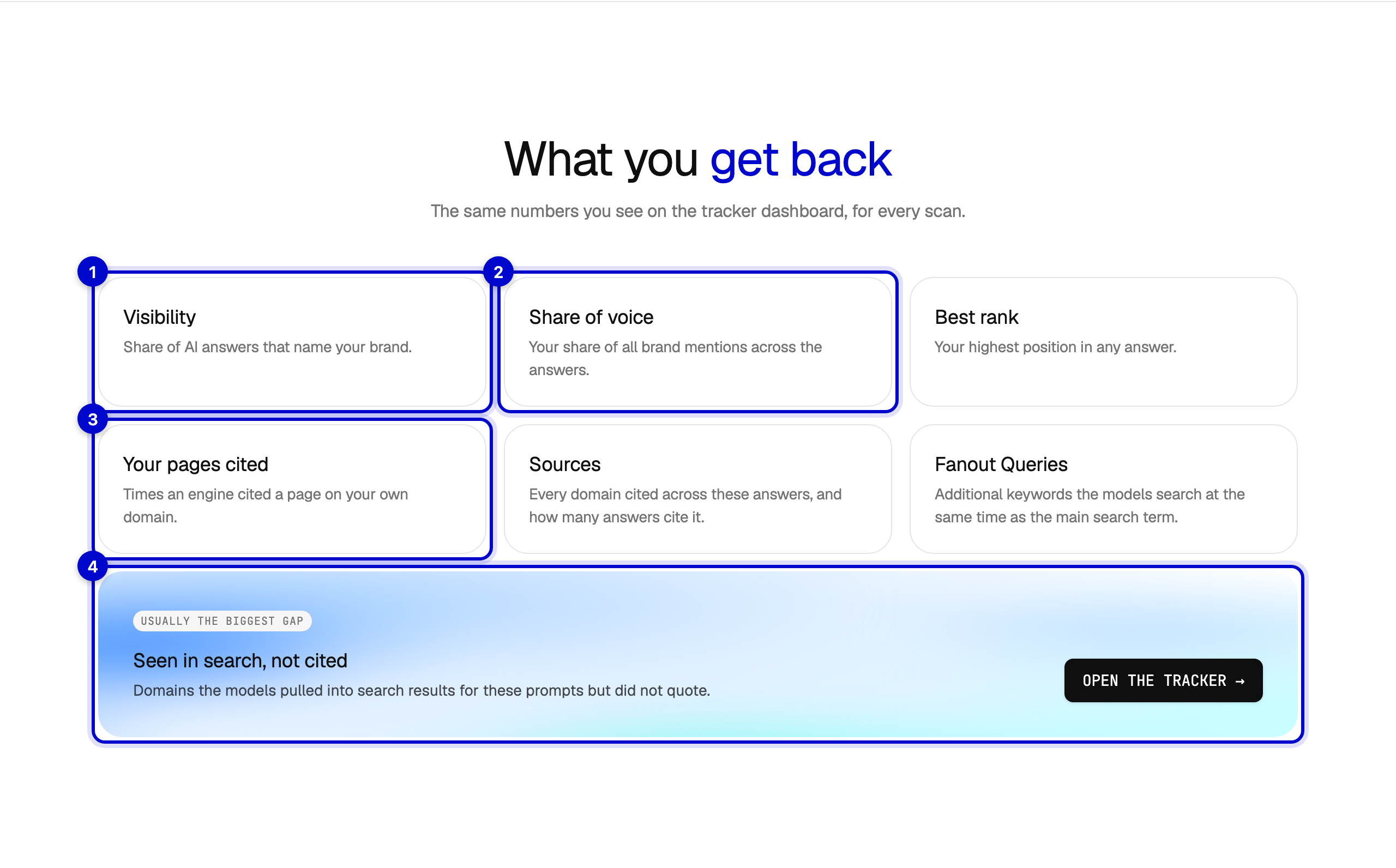
Step 3: Check mentions and citations in AI answers. In the LLM Brand Tracker, a scan shows Visibility (the share of AI answers that name your brand) separately from Your pages cited (how often an engine cited a page on your own domain). That split is the mention versus link split, inside AI answers.
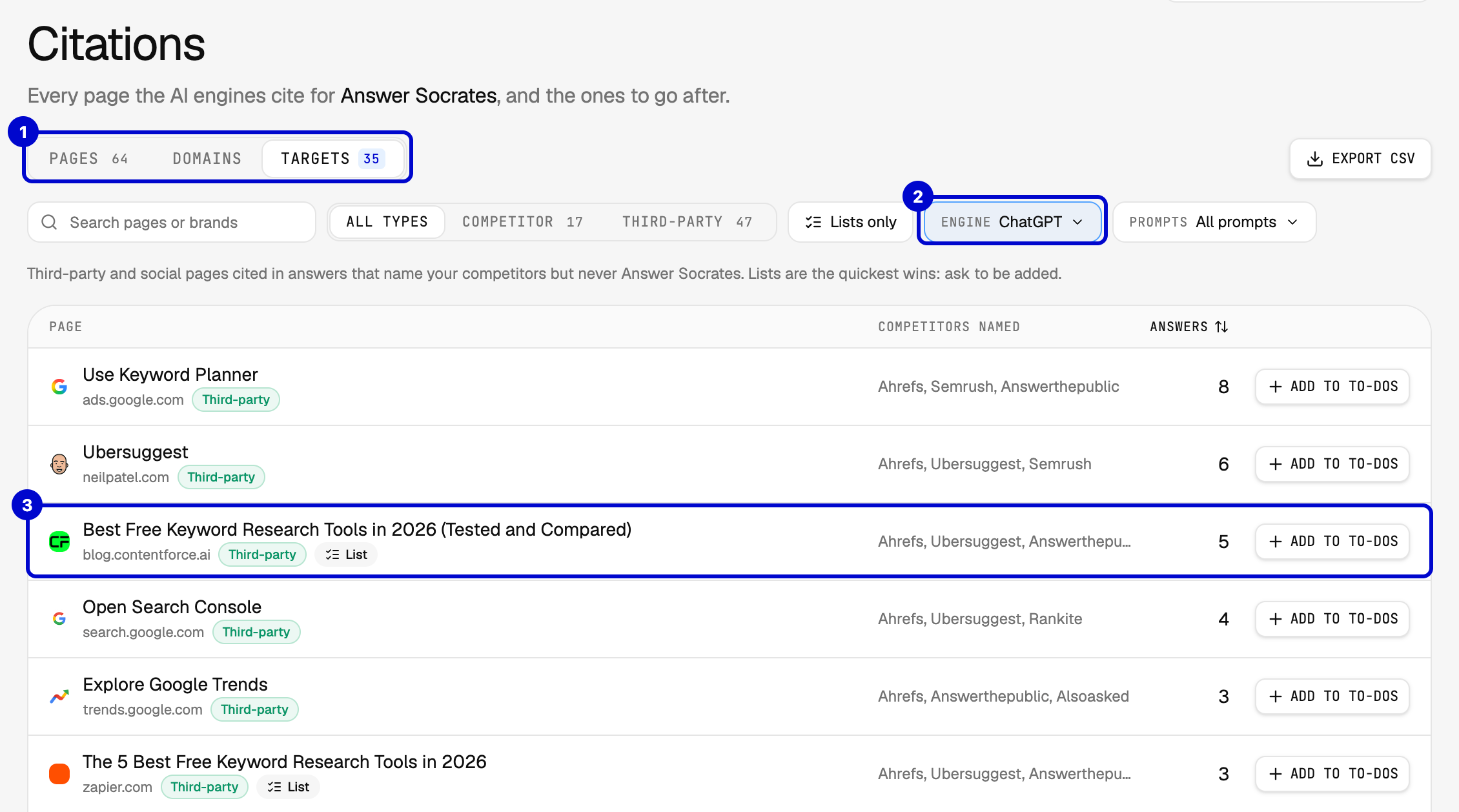
Step 4: Find the pages AI cites for your rivals. On the tracker's Citations page, the Targets view lists third-party pages cited in answers that name your competitors but never you. These are the pages where a mention is most likely to reach AI answers.
The same thing in Ask Socrates
Ask Socrates, the chat in Answer Socrates, can work through both halves, but word the two asks so it knows which kind of mention you mean. "Mention" on its own reads as AI mentions. For web pages, say it is for link building:
Find web pages that mention Northbound Coffee without linking to us, for link building.
That runs Mentions, the same Link Building tactic. A card shows the credit cost, and whether it asks before spending depends on your spending setting.
For the AI side, ask:
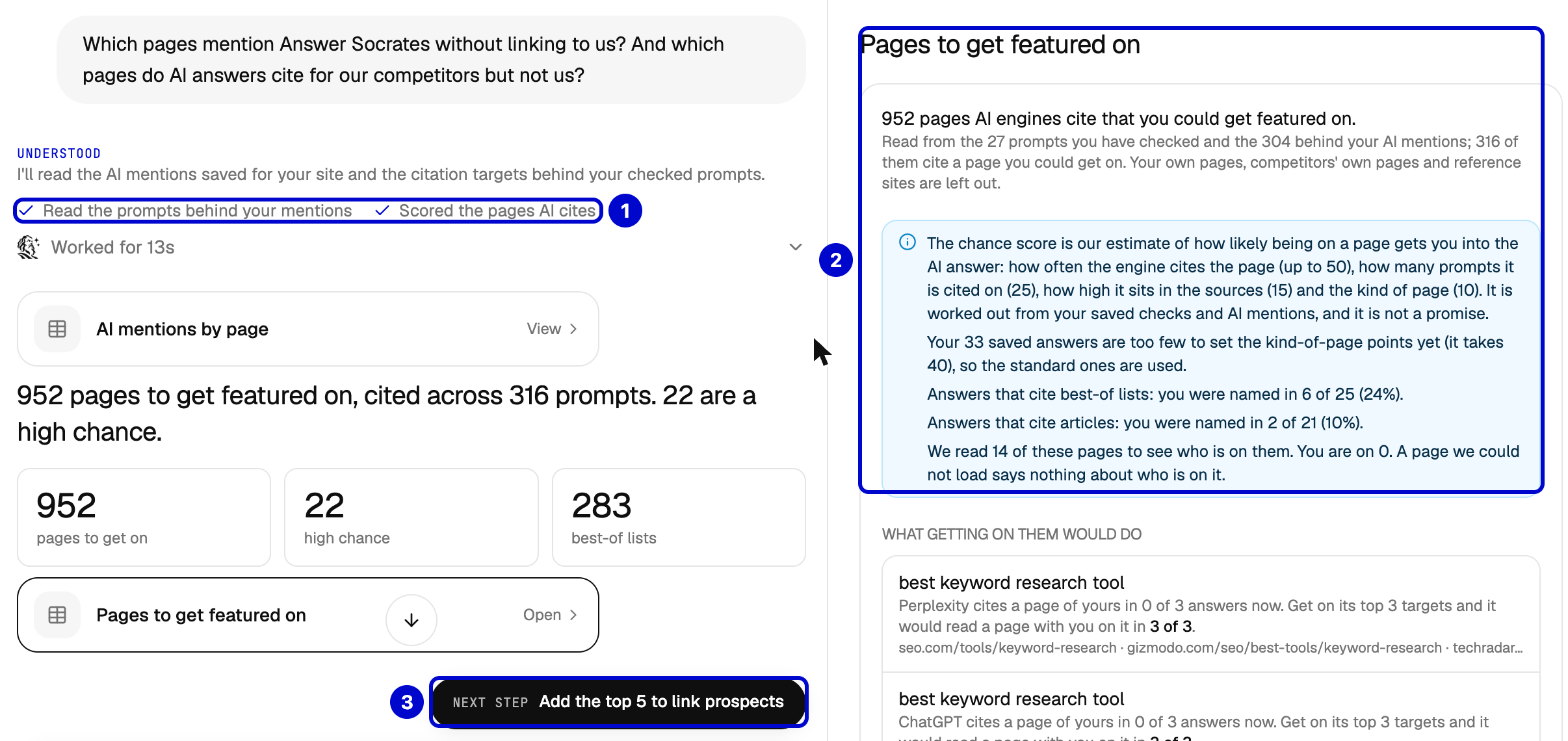
Which pages do AI answers cite for our competitors but not us?
- Citation targets are free. The chat reads your saved AI checks and scores the cited pages you could get onto, with how many are best-of lists and which are a high chance.
- If you want to go after those cited pages, say "add these to my link prospects". That is free and asks on a confirm card first, then the pages appear in Link Building with a contact finder.
When we asked both questions in one message on the Answer Socrates project, the chat read the word "mention" as AI mentions: it read the prompts behind our AI mentions and scored the cited pages, and ran no web Mentions search. That is why the two asks are split above.
Where to go next
| If you want to... | Read |
|---|---|
| Learn what makes a link count | What backlinks are and why they still matter |
| Turn a mention into a link | Turning unlinked brand mentions into links |
| Check how often AI names you | Is AI mentioning your brand? How to check |
| Understand why AI cites some pages | Why AI cites some pages and not others |
| Find more places to earn links | Finding link opportunities |
Sources
- How Search works: Ranking results, Google, 2025
- AI features and your website, Google Search Central, 2025
- ChatGPT search, OpenAI Help Center, 2025
- An Analysis of AI Overview Brand Visibility Factors (75K Brands Studied), Ahrefs, 2025
- Spam policies for Google web search (Link spam), Google Search Central, 2025
- Qualify your outbound links to Google, Google Search Central, 2025
