From cluster to content plan: what to write first
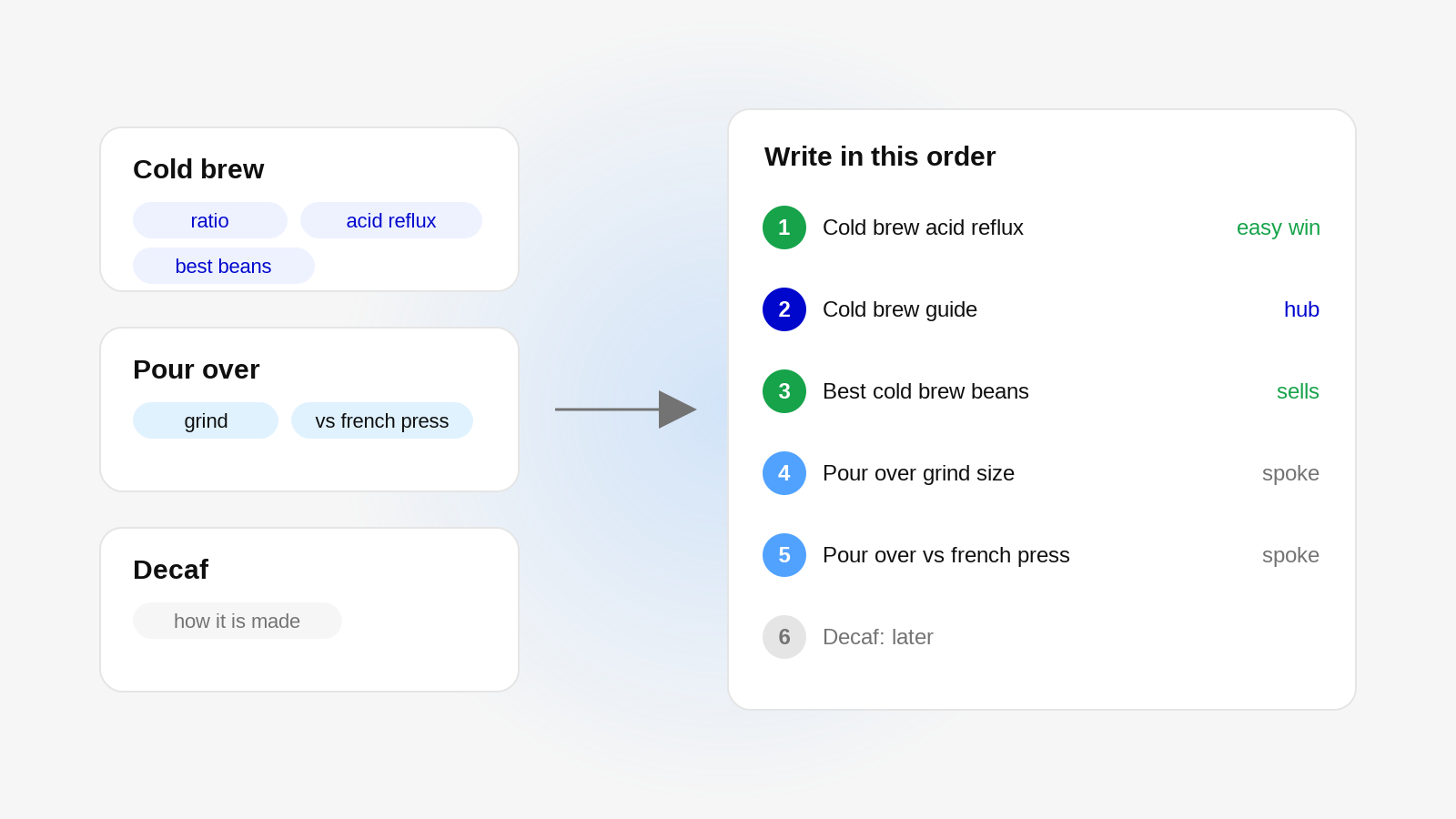
A content plan is the list of pages you will write, in the order you will write them, with one main search for each. Order matters because new pages take weeks or months to earn, so the first pages should be the ones that can win soonest and that give later pages somewhere to link from.
Key takeaways
- Score every planned page 1 to 3 on value, ease and fit, then multiply, so a big-volume page with no chance of ranking (3 x 1 x 2 = 6) sinks below a small easy one (2 x 3 x 3 = 18).
- Publish the hub page in the first wave even if it scores lower, so every spoke has a page to be linked from the day it goes live.
- Finish one cluster (hub, best spokes, one buying page, then the rest) before starting the next; ten pages on one topic beat ten scattered pages.
- The Jev AI Site structure tab gives you hub and page cards with volume and funnel mix, and Export Excel puts them on a sheet where you add the three scores.
- The Topical map's Do next list ranks new pages and fixes by clicks a month, assuming a new page ranks around fifth (about 5% of searches), so check its picks against your ease score.
A content plan is an order, not a list
A content plan is the list of pages you will write, in the order you will write them, with one main search for each. The order is the part that matters. A spreadsheet of 60 topics is a backlog; a plan says which three go first and why.
You get the raw material from Keyword clustering: turning a list into topics, where a long keyword list becomes groups, and from One page or many? Reading a keyword cluster, where each group becomes one page or a hub with spokes. This lesson starts where those end: you have a pile of planned pages, and you can only write a few this month.
Order matters for two reasons. New pages take time to show results: Google says some changes take effect in hours, "others could take several months" [3]. So the first pages you publish should be the ones that can start earning soonest. And a small site has a small budget. Every week spent on a page that cannot rank is a week not spent on one that can.
Score each planned page on value, ease and fit
You need a way to compare a hub page about cold brew with a small page about cold brew and acid reflux. Give every planned page three scores from 1 to 3.
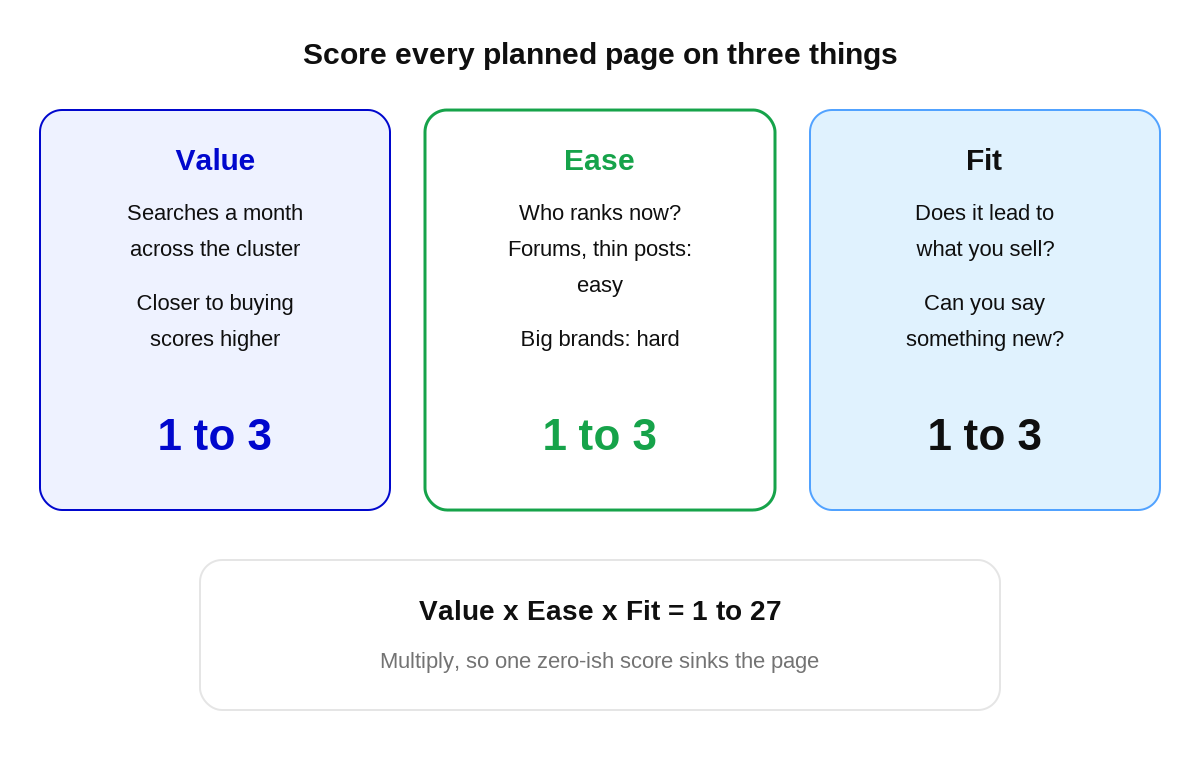
| Score | 1 | 2 | 3 |
|---|---|---|---|
| Value | Few searches, and readers are only learning | Moderate searches, or readers are comparing options | Plenty of searches, or readers are close to buying |
| Ease | Big brands built a page for exactly this search | A mix of strong and weak pages | Forums, Q&A threads, old or thin posts |
| Fit | Loosely related to what you sell, nothing new to say | Related, and you can add some first-hand detail | Leads straight to your product, and you know more than the ranking pages |
Multiply the three. A page that scores 3, 3, 3 (27) goes first. A page that scores 3, 1, 2 (6) waits, however big its volume.
The scores are rough on purpose. You are not predicting traffic; you are sorting a list. Ten minutes per page is enough: read the cluster's numbers, search the main keyword once in a private window, and ask yourself whether you have something to say.
Publish the hub early, then the easy wins around it
Scores sort the pages. Structure decides a few exceptions. If a cluster became a hub and spokes, publish the hub in the first wave, even if its own score is middling.
The reason is links. A hub page is one broad page on a topic; spoke pages are the detailed pages around it, each linking back to the hub. Google's link guidance says "every page you care about should have a link from at least one other page on your site" [2]. If the hub exists, each new spoke has an obvious place to be linked from on the day it goes live, and the hub gains a new link with every spoke.
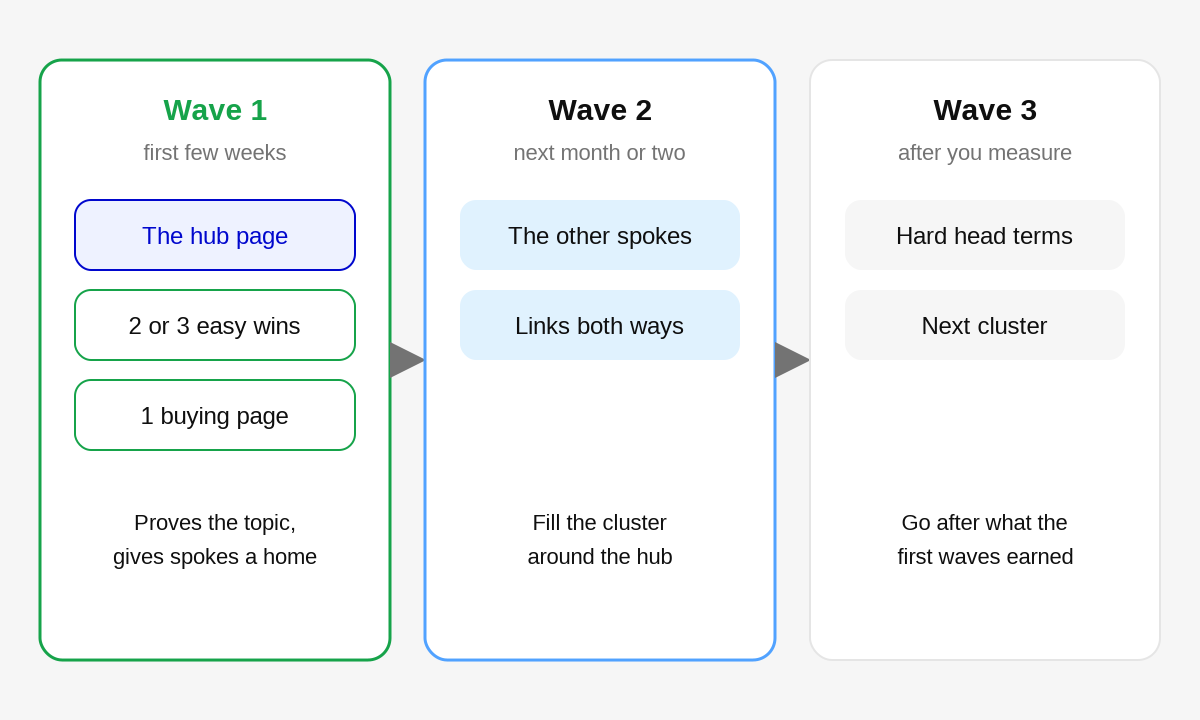
A workable order for one cluster:
- Wave 1. The hub, the two or three highest-scoring spokes, and one page close to buying (a product comparison or a "best X for Y" page) if the cluster has one.
- Wave 2. The rest of the spokes, each linked from the hub and linking back.
- Wave 3. The hard head terms and the next cluster, once you can see what the first two waves earned.
Stay in one cluster until wave 2 is done. Ten pages that cover one topic properly say more about your site than ten pages scattered across five topics.
How to do it in Answer Socrates
You can do the scoring in any spreadsheet. Answer Socrates fills in most of the columns for you.
1. Turn your clusters into hubs and pages
Run your keyword list through the Jev AI keyword tool (or click Cluster Keywords on a search and pick Jev AI). It costs 1 topic cluster credit per keyword.
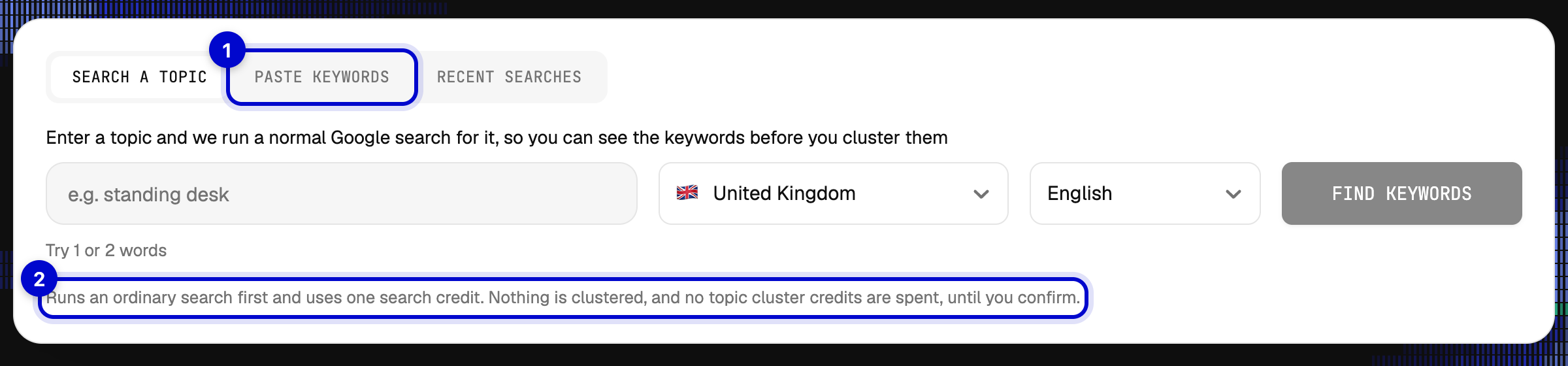
When the run finishes, open the Site structure tab: every topic becomes a Hub page card, with Page cards under it for the keywords that earned their own page.
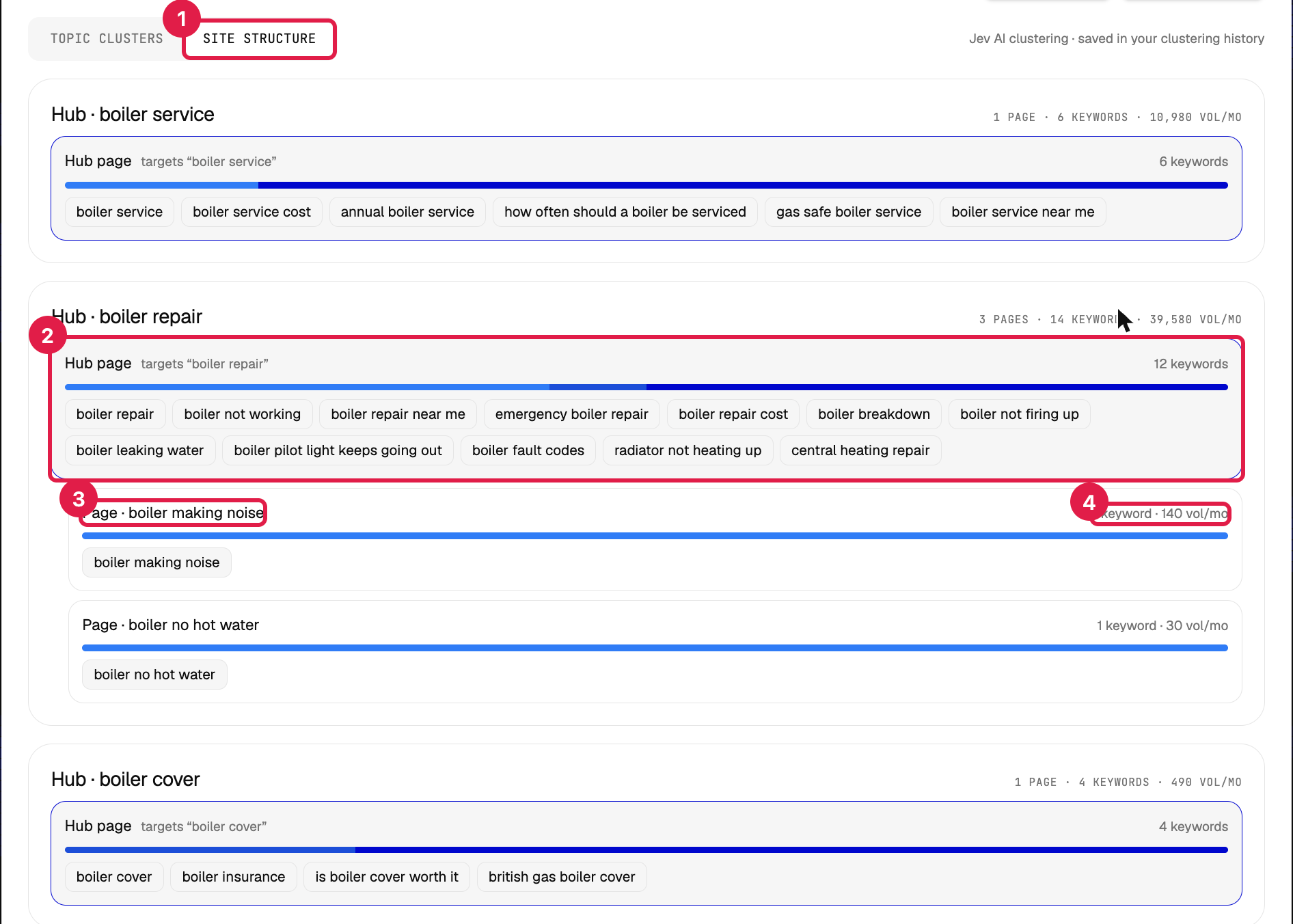
2. Export and add your three scores
Click Export Excel. The workbook holds the keywords, the clusters and the site structure on separate sheets. On the site structure sheet, add three columns (Value, Ease, Fit) and a fourth that multiplies them. The topic table already gives you volume and the funnel mix (TOFU, MOFU, BOFU) for each topic, which covers most of the value score.
Ease is the column no tool fills honestly from a keyword alone. Search each main keyword and look at who ranks. That is five minutes a page, and it is the column that saves you the most wasted weeks.
3. Check what your site already has
If you have a site already, a new page is not always the answer. The Topical map in Ask Socrates reads your site's pages (free), looks up what people search around each one, and then groups those searches into topics (1 topic cluster credit per search, and it shows the total before you start). Every topic is marked No page yet, Add to a page or Done.
Its Do next list ranks the jobs worth most, writing new pages and improving existing ones, "by the clicks a month each could bring". For a page you have not written yet, the estimate assumes it ranks around fifth, where the map counts about 5% of searches as clicks. So a topic with 2,000 searches a month shows as roughly 100 clicks a month.
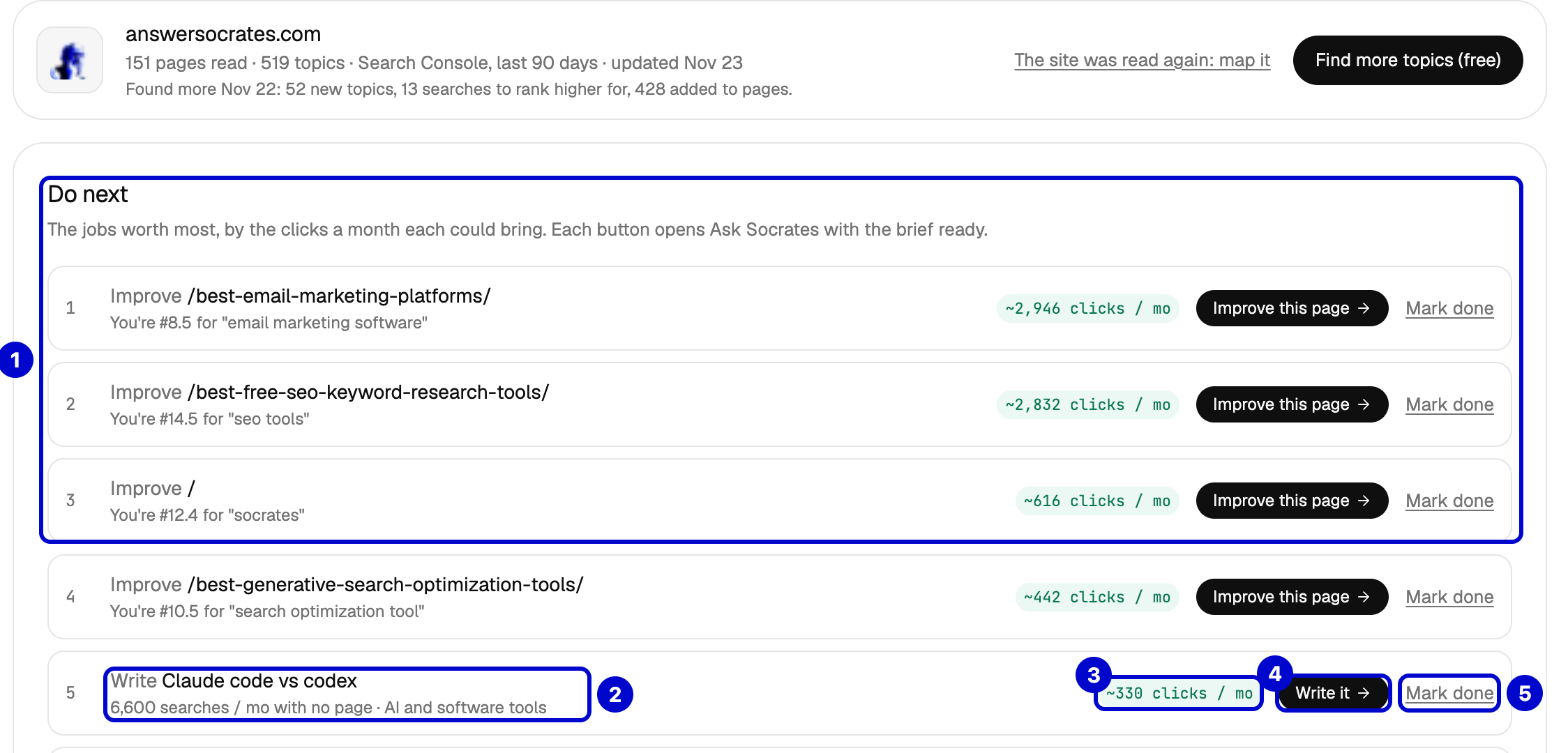
Treat that number as a way to sort, not a forecast. Fifth place is an assumption, and it says nothing about whether you can get there. Your ease score is the check on it.
4. Put the plan on a calendar
Content Studio holds your planned articles on a calendar, and its setup builds a topic plan from your site and real Google searches. Add your wave 1 pages there first. Automatic writing only runs if you switch it on, so a page sitting on the calendar does nothing until you decide.
A made-up example: a coffee roaster's first wave
A made-up example: Hillside Roasters sells beans online. A Jev AI run on her cold brew and pour over keywords gives two hubs and nine pages. She scores them in the exported workbook; here are seven of them.
| Planned page | Type | Value | Ease | Fit | Score | Wave |
|---|---|---|---|---|---|---|
| Cold brew and acid reflux | Spoke | 2 | 3 | 3 | 18 | 1 |
| Best beans for cold brew | Spoke, buying | 3 | 2 | 3 | 18 | 1 |
| Cold brew coffee guide | Hub | 3 | 1 | 3 | 9 | 1 (hub) |
| Cold brew ratio | Spoke | 2 | 2 | 2 | 8 | 2 |
| Pour over grind size | Spoke | 2 | 3 | 3 | 18 | 2 (next cluster) |
| Pour over vs french press | Spoke | 3 | 1 | 2 | 6 | 3 |
| Cold brew maker reviews | Spoke | 3 | 1 | 1 | 3 | Skip |
Three calls are worth noticing. The cold brew hub scores only 9, because big sites own "cold brew coffee", but it goes in wave 1 so the spokes have a home. Pour over grind size scores 18 but waits: she finishes cold brew first. And maker reviews never get written. Big volume, but she does not sell makers, and review sites own the results.
The same thing in Ask Socrates
Ask Socrates, the Answer Socrates chat, has a What to write next skill. Type /what-to-write or just ask in plain words:
What it does first depends on what the project already has. With no map yet, it starts from your site and saved searches, checks rising topics (free), then offers one keyword pull on the strongest seed (1 search credit) and clustering of the result (topic cluster credits, with the count shown first). With a topical map saved, it reads the map, your page and your sitemap and checks rising searches, all free, and builds the plan from that. Whether it waits for you to approve a spend depends on your spending setting: on "Asks before spending" you see a card for each.
The answer is a short plan, best first, that says for each item whether it is a new page or a fix to one you have, and ends with buttons for the next step, each with its price.
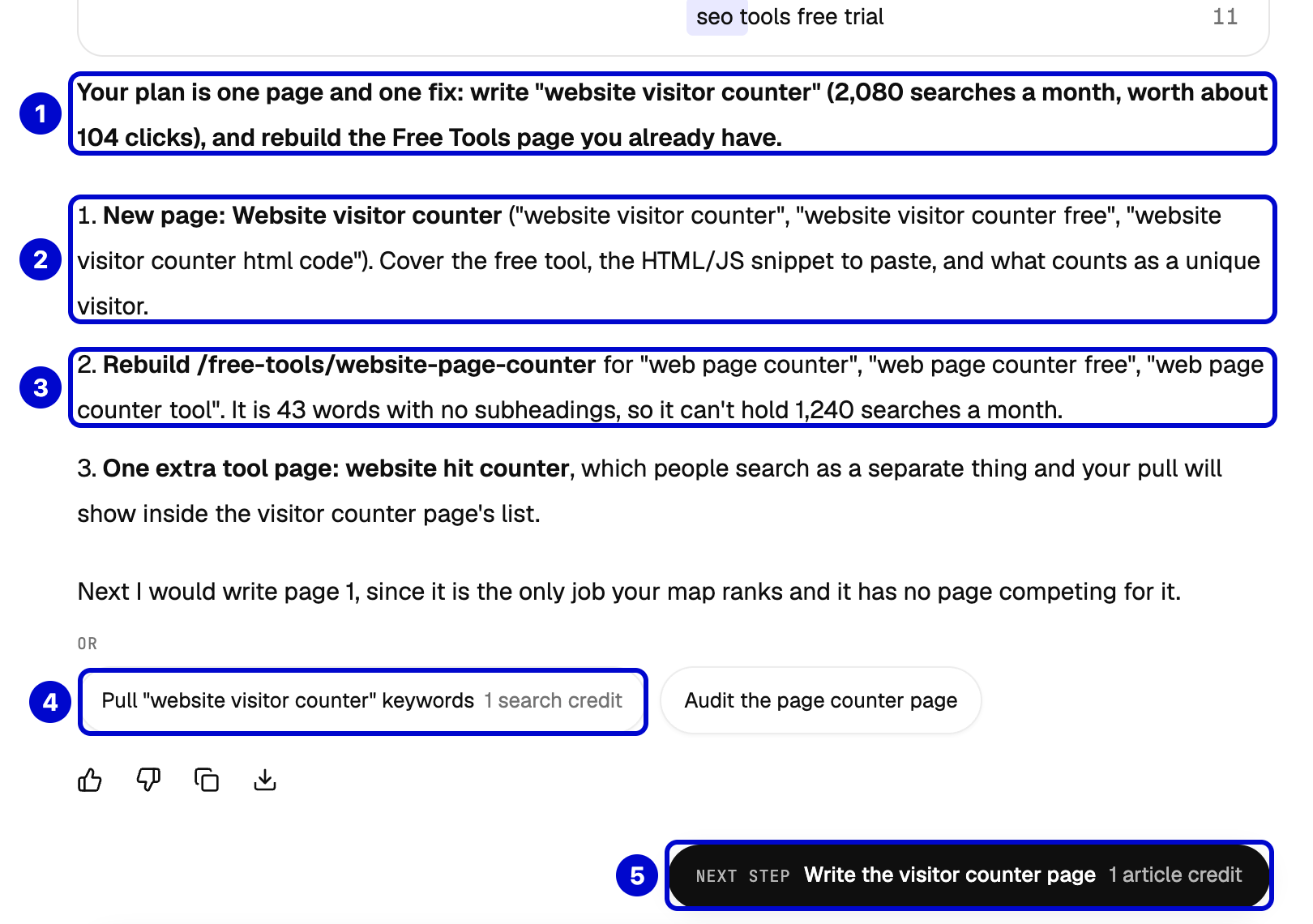
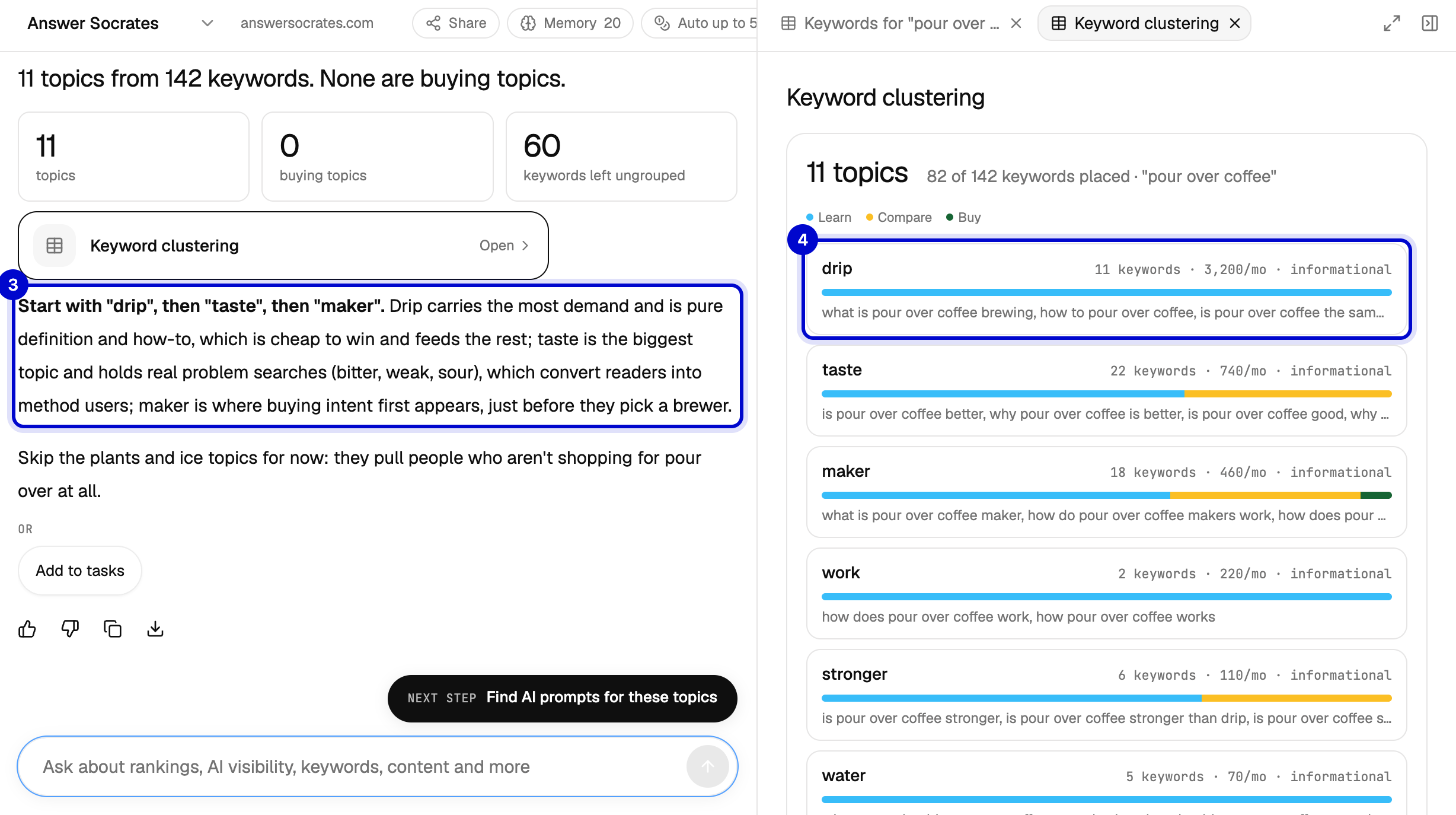
If you already have a keyword clustering run in the chat, ask what to build first. In this real run on pour over coffee, the chat ordered the topics by demand and how cheap they are to win.
With a topical map built, the starting question "Read my topic map and tell me what to write or fix first" makes the chat read the saved map (free) and talk you through its Do next list.
Where content plans go wrong
| Mistake | What happens | Fix |
|---|---|---|
| Sorting by volume alone | The first pages fight big brands and stay on page three | Multiply by an ease score from a real look at the results |
| Spreading across clusters | Ten loose pages, no topic covered well | Finish one cluster's waves 1 and 2 first |
| Skipping the hub | Spokes have nothing to link from | Publish the hub in wave 1 |
| Writing what you already have | Two of your pages compete for one search | Check your site (or the Topical map's Add to a page topics) before writing new |
| Never revisiting the plan | Wave 3 is built on guesses | After a couple of months, re-score using what your first pages actually earned |
The last row is the one people skip. A plan is a forecast made before you had data. Once the first wave has been live for a while, look at what it earned and re-score what is left.
Where to go next
| If you want to... | Read |
|---|---|
| Group a keyword list into topics first | Keyword clustering: turning a list into topics |
| Decide which keywords share a page | One page or many? Reading a keyword cluster |
| Turn each planned page into instructions for a writer | Content briefs: what to give a writer (or an AI) |
| Make each page worth ranking | Information gain: adding what other pages lack |
| Link hubs and spokes together | Internal links: connecting your pages |
| Let an AI agent build the plan | Building a content plan with an AI agent |
Sources
- Creating helpful, reliable, people-first content, Google Search Central, n.d.
- Link best practices for Google, Google Search Central, n.d.
- Search Engine Optimization (SEO) Starter Guide, Google Search Central, n.d.
