What backlinks are and why they still matter
A backlink is a link on another website that points to a page on yours. Google still uses links to find pages and as one sign that other sites trust them, so earning a few good ones does more than buying many.
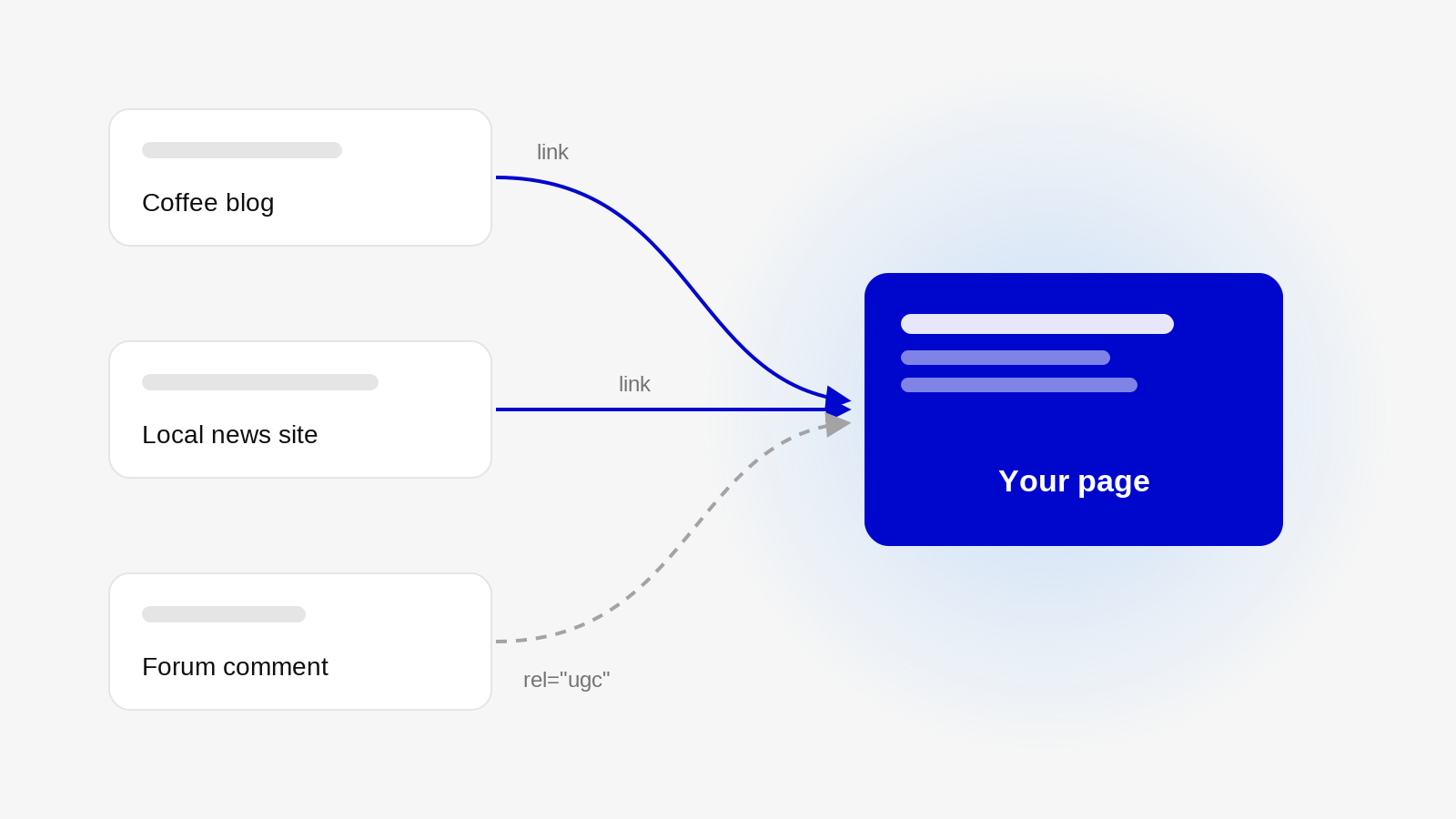
Key takeaways
- Google says it checks whether "other prominent websites link or refer to" a page as one sign of quality, and it uses links to find new pages to crawl.
- Links marked rel="sponsored", rel="ugc" or rel="nofollow" are generally not followed, and Google treats all three as hints rather than strict rules.
- Referring domains (different sites linking) tell you more than backlinks (total links): one partner's footer can add thousands of links and still count as one site.
- Paid links, excessive link swaps, automated links and low-quality directories are link spam under Google's policies unless paid links carry sponsored or nofollow.
- In Answer Socrates, Reclaim finds your dead pages that sites still link to, and Ask Socrates checks the domain rating of up to 20 sites at a time for free.
A backlink is another site pointing at yours
A backlink is a link on someone else's site that sends readers to a page on yours. If a coffee blog writes "the best cold brew guide we have read is Northbound Coffee's" and makes those words clickable, that is a backlink to Northbound Coffee.
Every link on the web is a small piece of HTML with three parts worth knowing by name.
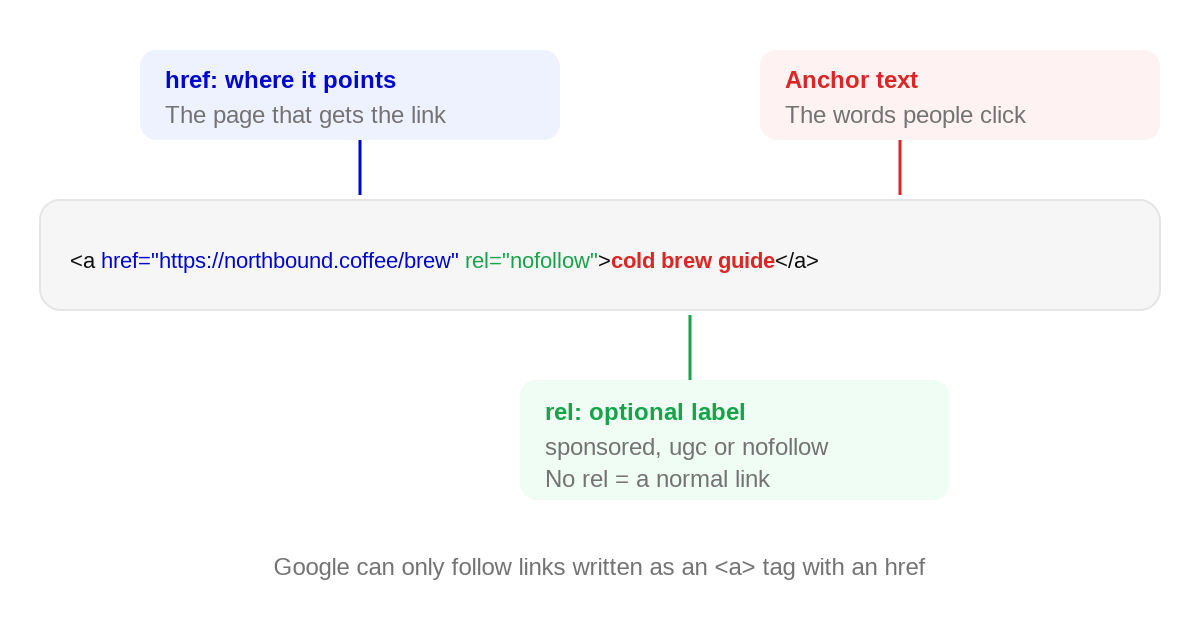
- The href is the address the link points to. For you, it is the page that gets the backlink.
- The anchor text is the words people click. Google asks for anchor text that is "descriptive, reasonably concise, and relevant" [2], so "cold brew guide" tells it more than "click here".
- The rel attribute is an optional label such as
nofolloworsponsored. No rel means a normal link.
One more detail matters. Google says it can only crawl a link if it is an <a> HTML element with an href [2]. A button that opens a page with a script, or a brand name in plain text, is not a link Google can follow.
Links still help Google find and judge pages
Google has never said links are the only thing that matters, and they are not. But it still says they count, in its own words.
Google's guide to how ranking works says one factor in judging quality is "understanding if other prominent websites link or refer to the content" [1]. It calls that "generally a good sign that the information is trustworthy" [1]. Its link guidelines add that links help it decide "the relevancy of pages and to find new pages to crawl" [2].
So a backlink does two jobs:
- Discovery. Google follows links to find pages. A new page that nothing links to is harder to find.
- Trust. A link from a relevant, respected site is a sign that someone outside your company thinks the page is worth reading.
The same pages feed Google's AI answers. To appear as a supporting link in AI Overviews or AI Mode, a page must be indexed and "eligible to be shown in Google Search with a snippet" [7], and Google says normal SEO best practices still apply [7]. A page that is hard to find through links is hard to cite.
That is why the old "links are votes" picture still works, with one change. Votes are not equal. A link from a coffee magazine to a coffee roaster says much more than a link from a forum comment anyone could post.
Not every link counts the same way
Sites can label a link with a rel value to tell Google what kind of link it is. Google documents three values [3].
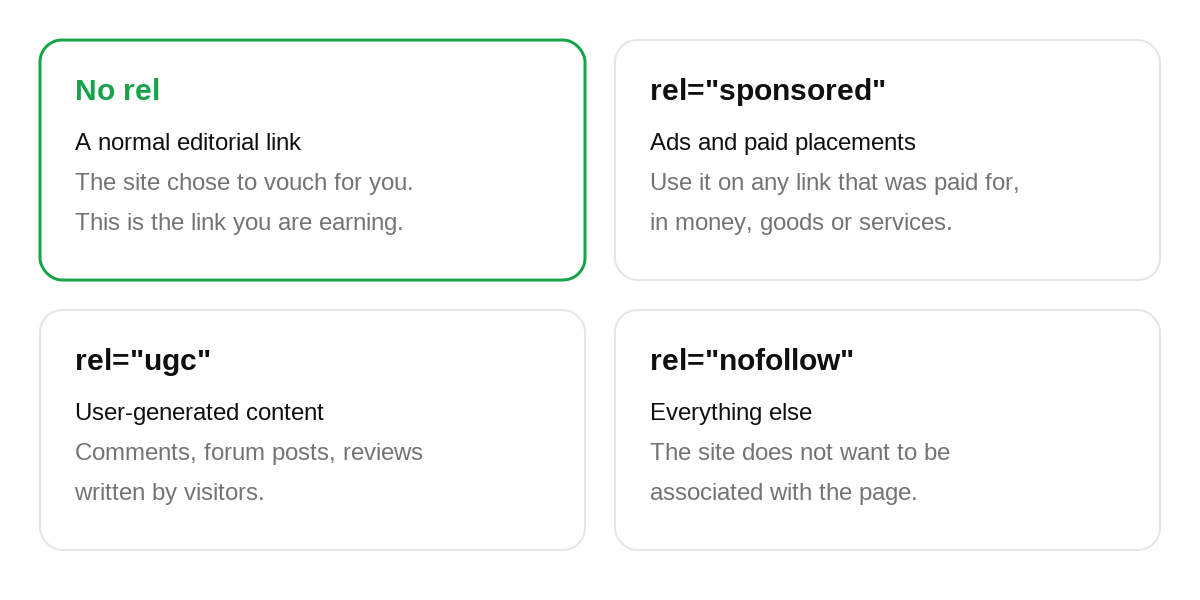
rel="sponsored"marks ads and paid placements.rel="ugc"marks user-generated content, such as comments and forum posts.rel="nofollow"is for anything else the site would rather not be associated with [3].
Google says links with these labels "will generally not be followed" [3], and since 2019 it treats all three as hints rather than strict rules [4]. Some SEOs read "hint" as "nofollow links secretly count". Google has not said that, so plan as if they pass little or nothing, and value them for the visitors they send.
Here is a quick way to sort the links you see:
| Link you find | Likely value for rankings | Worth having? |
|---|---|---|
| Editorial link in an article on a relevant site | Highest | Yes, this is the goal |
| Link on a curated resource or "best X" list | Good, if the list is relevant | Yes |
| Comment, forum post or profile link (usually ugc or nofollow) | Little | Only for the visitors it brings |
| Paid placement marked sponsored | Little | Only as advertising |
| Paid link without a sponsored label | Risky | No: it breaks Google's spam policies |
| Footer or sitewide link from a partner | Counts as one site | Rarely worth chasing |
Count sites, not links
Backlink tools show two numbers that sound alike. Backlinks is the total number of links. Referring domains is the number of different websites those links come from.
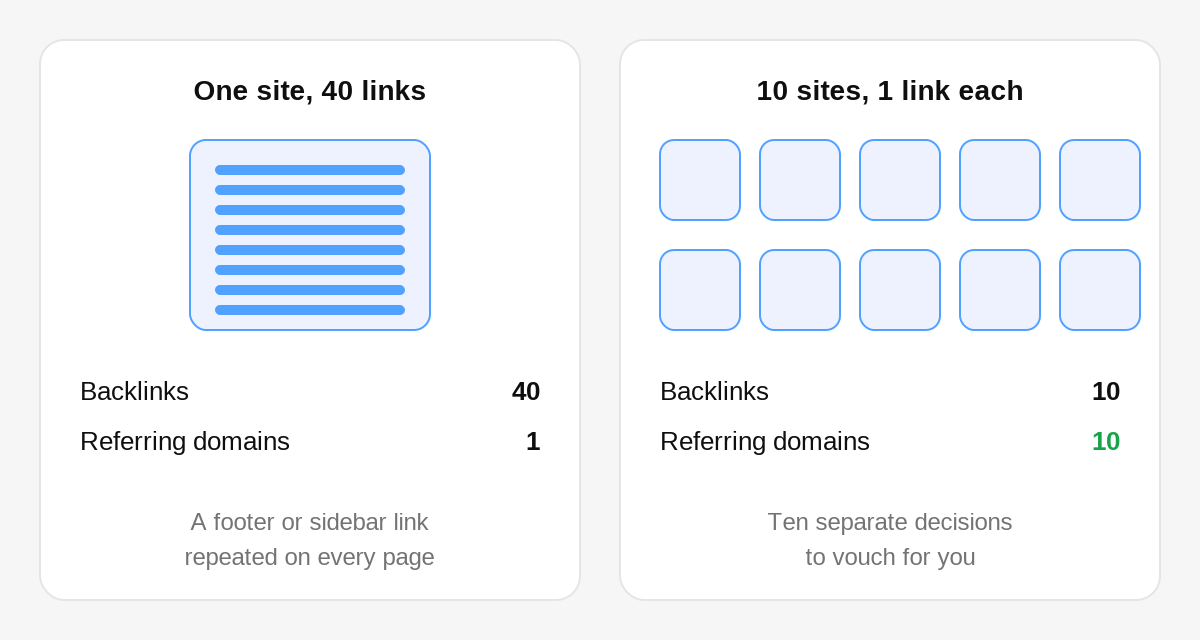
The second number usually tells you more. A partner who puts your link in their footer can create thousands of backlinks overnight, but it is still one site. Ahrefs' Domain Rating (DR), the 0 to 100 score many tools show, is built the same way: it counts linking domains, and only the first followed link from each domain adds to it [6].
DR is useful for a quick read on a site, with three limits worth remembering. It is Ahrefs' own score, not Google's. It is "purely link-based", so it ignores whether a site gets any search traffic [6]. And it runs on a logarithmic scale, so moving from 70 to 75 is far harder than moving from 10 to 15 [6].
The links that can hurt you
Google defines link spam as creating links "primarily for the purpose of manipulating search rankings" [5]. Its spam policies name the common forms [5]:
- Buying or selling links that pass ranking credit, including sending free products in return for a link.
- Excessive link exchanges ("link to me and I'll link to you").
- Links created by automated programs or services.
- Low-quality directory and bookmark sites.
- Guest posts, articles and press releases with keyword-stuffed anchor text.
- Links hidden in widgets, or spread across many sites in footers and templates.
Paying for a placement is allowed when the link carries rel="sponsored" or rel="nofollow" [5]. It just will not help your rankings.
The safe rule is simple. Earn links by giving a site a reason to link: a page that replaces a dead one, a product that belongs on a list, data a journalist wants. If the only reason a site would link to you is money or a swap, leave it.
A made-up example: Northbound Coffee, a small roaster, gets two emails in one week. One offers "10 guest posts on DR 60 sites for $300". The other is a food writer who wants to quote their brewing ratios in a cold brew article. The first fails every test above. The second is a real backlink, from a relevant page, given for a reason.
How to check links in Answer Socrates
The Link Building section of Answer Socrates is where backlinks show up in the app. It does not sell or place links. It finds pages worth asking, checks them live and gives you a published contact.
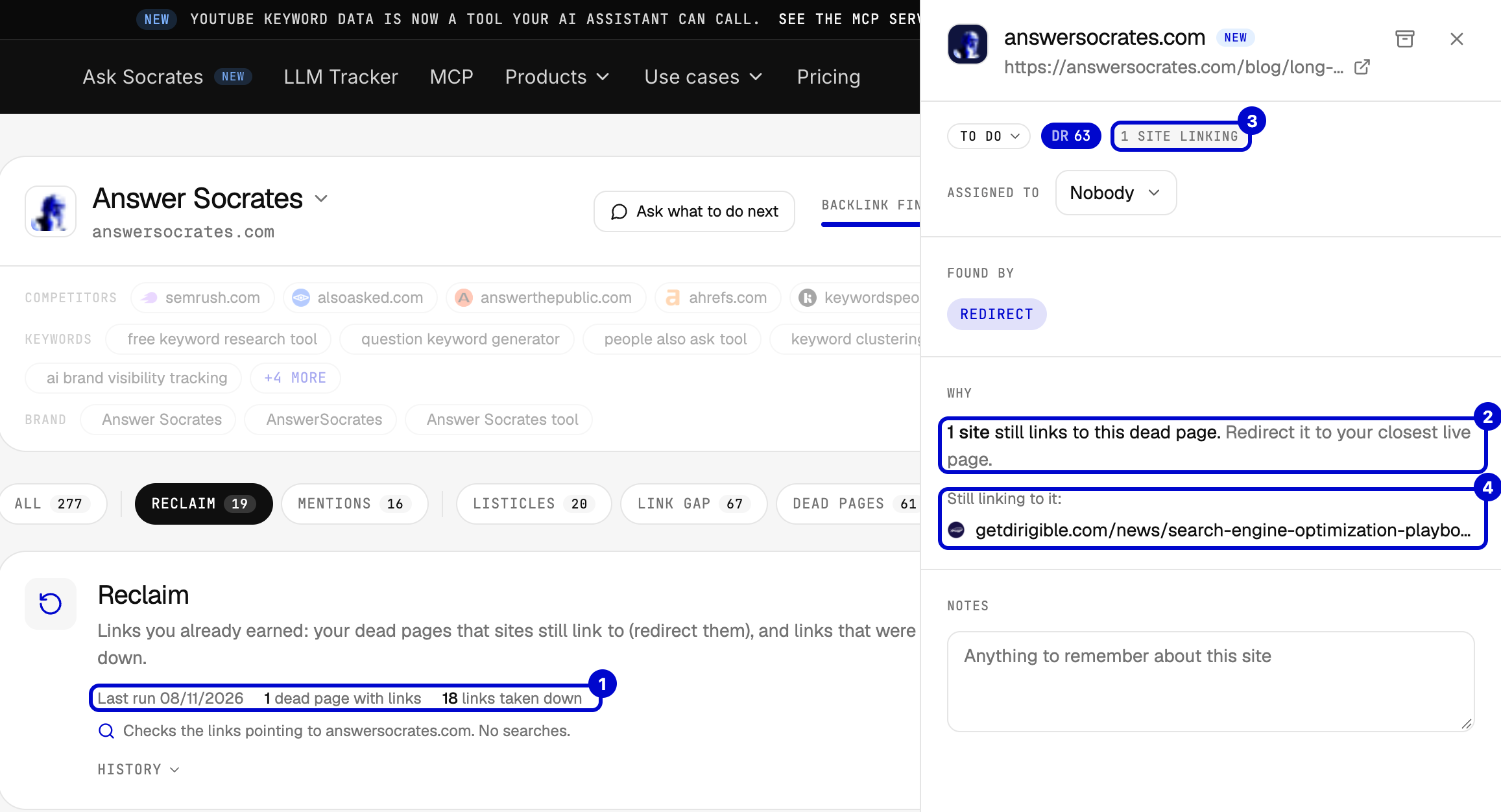
Step 1: Start with links you already earned. Open Link Building and run Reclaim. It pulls your own backlink data and finds two things: dead pages on your site that other sites still link to, and links that were removed from pages that still exist. Each dead page row says how many sites still link to it, with the advice "Redirect it to your closest live page."
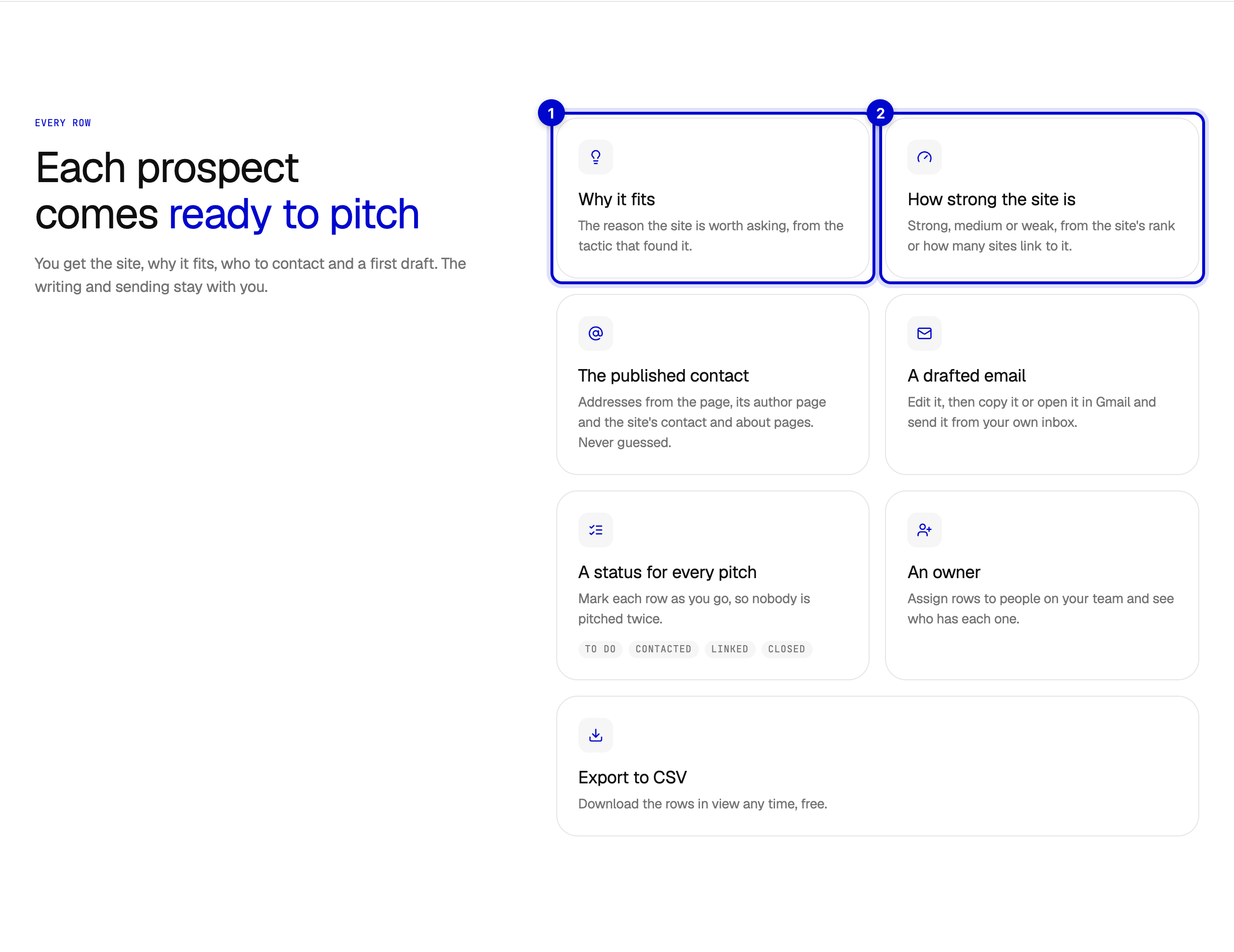
Step 2: Read the strength badge on every row. Each prospect shows a strength badge. When Ahrefs DR is available it shows as DR with the number; 50 and up is shaded as strong and 20 and up as medium. Otherwise you see Strong, Medium or Weak from the backlink data.
Step 3: Look at "sites linking", not "links". For dead pages and competitors' top pages, the row shows how many different sites link to the page. That is the referring domains idea from earlier, applied to one page.
Step 4: Check traffic by hand. The badge measures links. Before you pitch a strong-looking site, search for a few of its articles and see whether they rank for anything.
The same thing in Ask Socrates
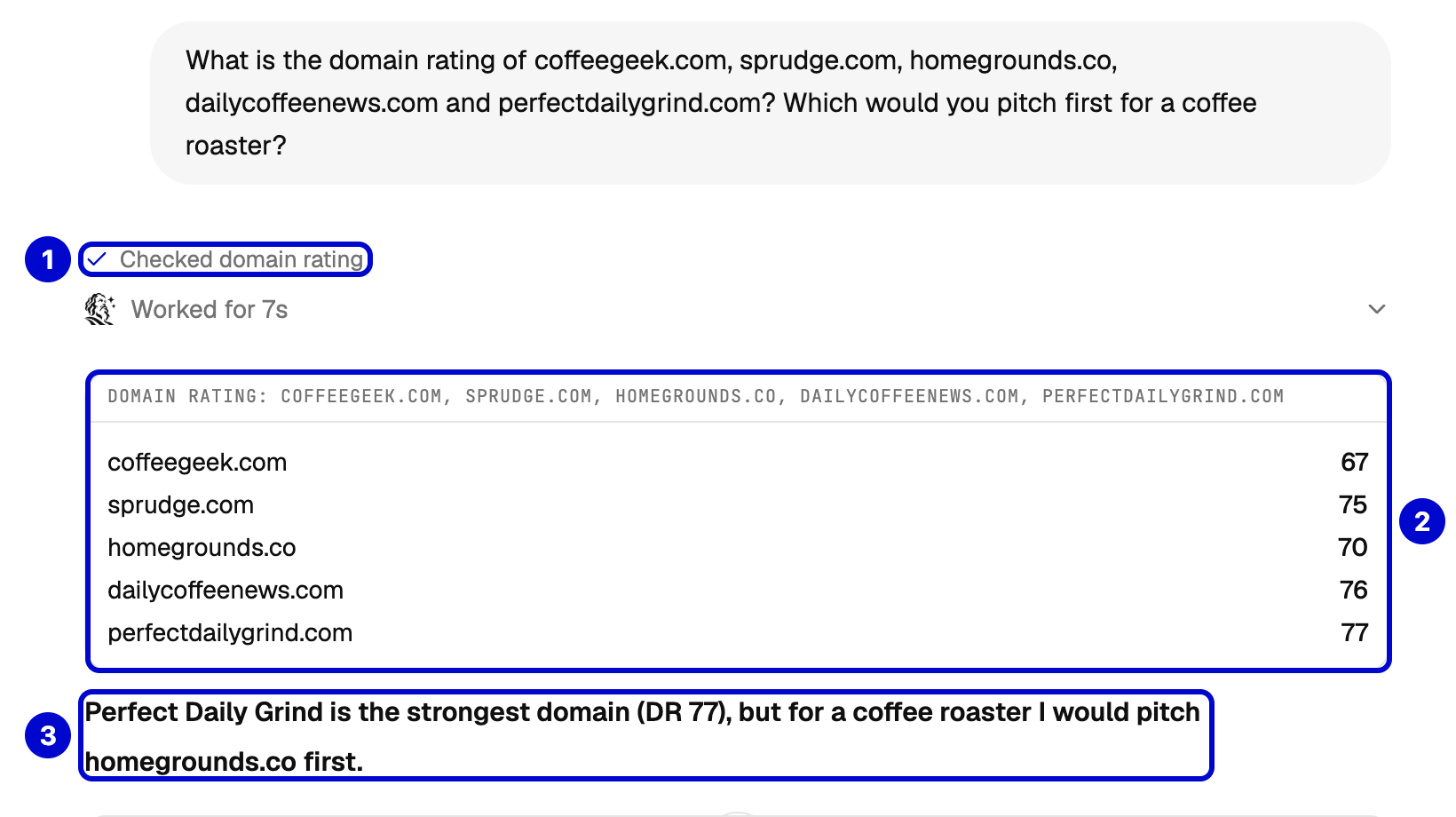
Ask Socrates, the chat in Answer Socrates, can size up sites for you without spending credits. Domain rating lookups are free, for up to 20 sites at a time. Type:
What is the domain rating of coffeegeek.com, sprudge.com, homegrounds.co, dailycoffeenews.com and perfectdailygrind.com? Which would you pitch first for a coffee roaster?
It returns each site's rating and its view of which ones fit. If your project already has link building prospects, ask "Which of my link prospects are the strongest sites with an email?" and it reads the saved lists, which is free too.
Where to go next
| If you want to... | Read |
|---|---|
| Find the links you can realistically win | Finding link opportunities |
| Understand mentions without a link | Links vs mentions in the age of AI |
| Replace dead pages people still link to | Broken link building |
| Turn mentions of your brand into links | Turning unlinked brand mentions into links |
| Write the email that asks for the link | Writing outreach emails that get replies |
Sources
- How Search works: Ranking results, Google, 2025
- Link best practices for Google, Google Search Central, 2025
- Qualify your outbound links to Google, Google Search Central, 2025
- Evolving "nofollow": new ways to identify the nature of links, Google Search Central Blog, 2019
- Spam policies for Google web search (Link spam), Google Search Central, 2025
- Domain Rating (DR): What It Is and How to Use It, Ahrefs, 2025
- AI features and your website, Google Search Central, 2025
