Long-tail keywords: finding the easy wins
A long-tail keyword is a search few people make each month, usually because it is specific, like "low acid coffee beans for cold brew" instead of "coffee beans". Each one is small, but there are far more of them than head terms, they carry clear intent, and they are often open to a small site.
Key takeaways
- Long tail is about low volume, not length: Ahrefs reports almost 93% of its US keyword database gets fewer than 10 searches a month.
- In Answer Socrates the Letters and Prepositions sections hold most long-tail searches; For and Without cards name who searches and what they want to avoid.
- The LONG label marks keywords of five or more words only when no place, buying, how-to or question word matched first, so many long searches show as BOFU or TOFU.
- Judge each one with five checks: is it a real search, is the intent clear, who ranks now, can you answer it best, and does it need its own page.
- The Long Tail Keyword Generator writes 30 AI ideas (10 TOFU, 10 MOFU, 10 BOFU) with no volume data, so confirm any idea with a real search before writing.
A long-tail keyword is a small, specific search
A long-tail keyword is a search that few people make each month, usually because it is specific. "Coffee beans" is a big, broad search. "Low acid coffee beans for cold brew" is a small one, and the person typing it has told you exactly what they want.
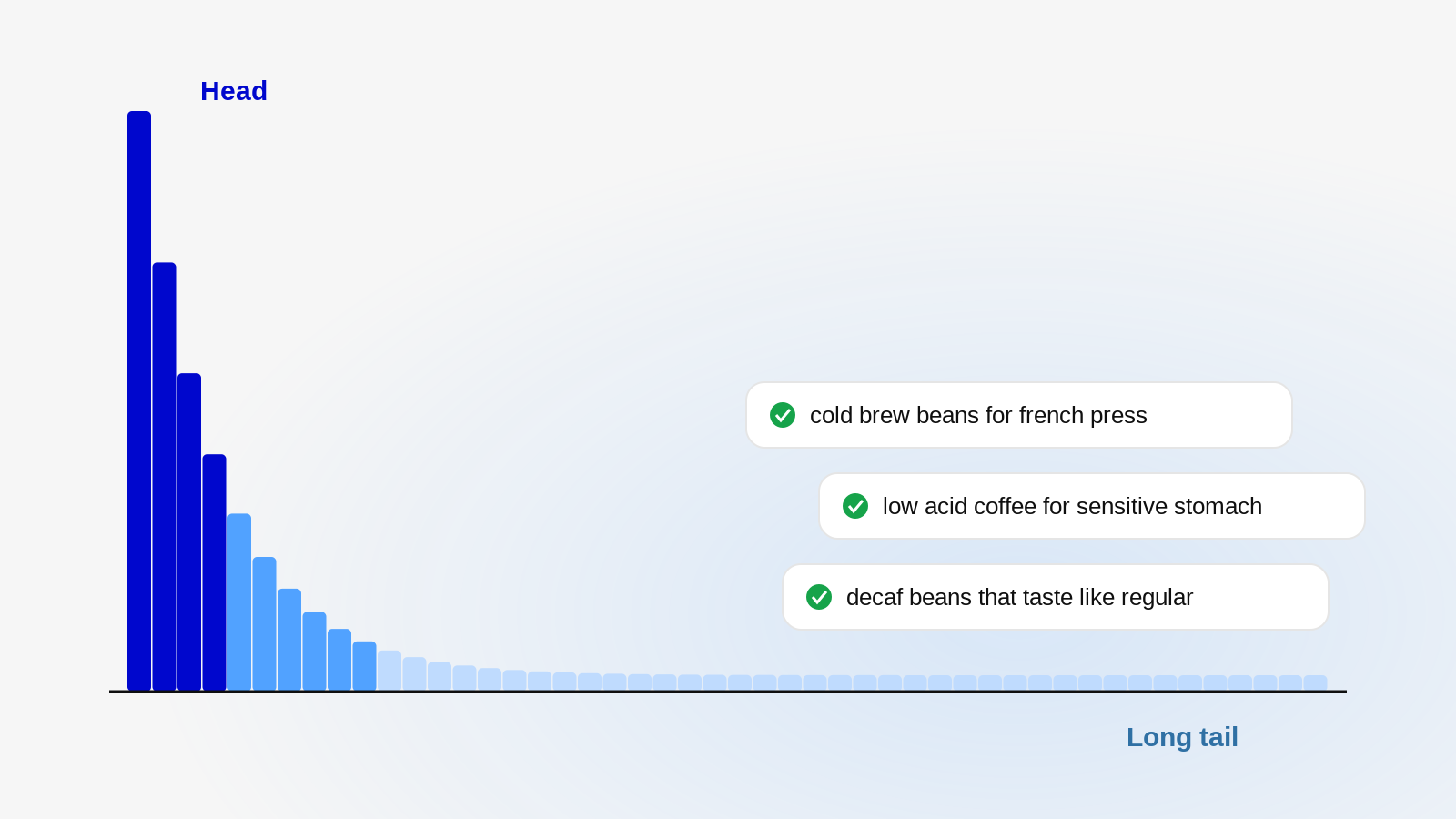
The name comes from the shape of search demand. Line up every search about a topic from biggest to smallest and you get a curve: a few huge searches on the left (the head), then a long, flat stretch of small ones running off to the right (the tail).
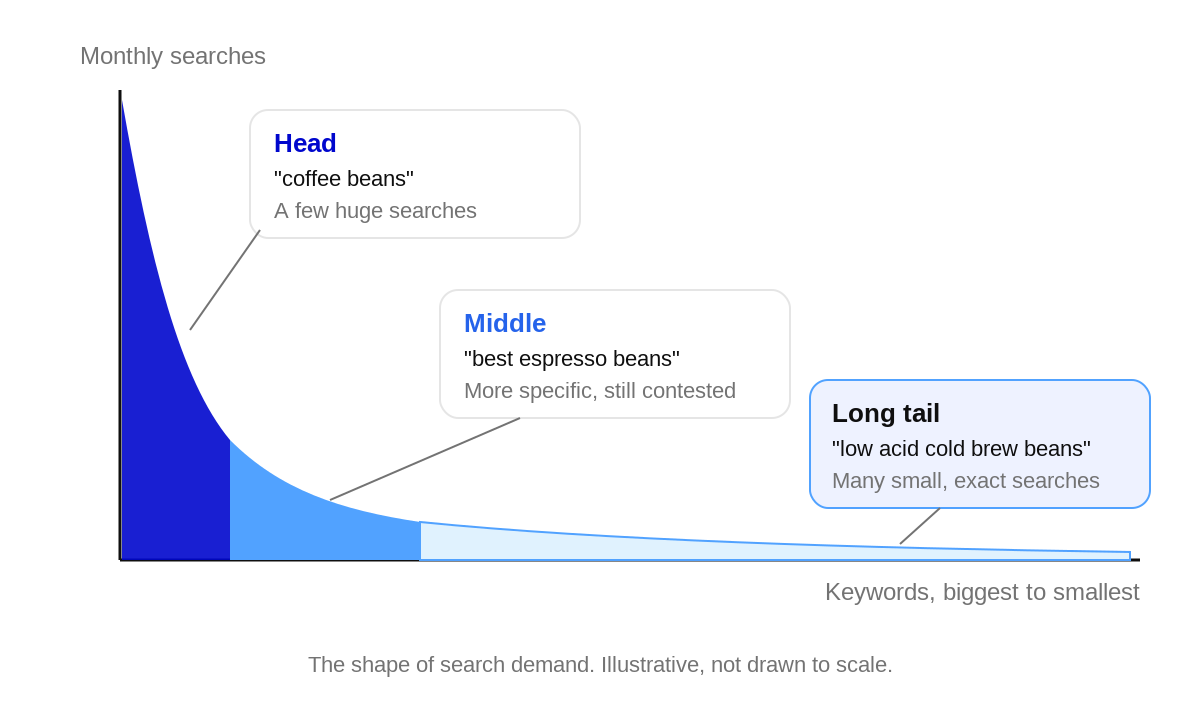
The tail is much bigger than it looks. Ahrefs reports that keywords with fewer than 10 searches a month make up almost 93% of its US keyword database [1]. Google has said that 15% of the searches it sees every day are ones it has never seen before [2]. Most of what people type is small and specific.
Small searches add up to real traffic
One small keyword will never fill your inbox. The reason to bother is that small keywords are easier to win, and you can win a lot of them.
A head term like "coffee beans" is held by big retailers and review sites. A small coffee roaster can write the best page on the internet about beans and still sit on page two. A search like "decaf beans that taste like regular" is different. Fewer sites have written a page that answers it, and the ones that have often answer it in passing.
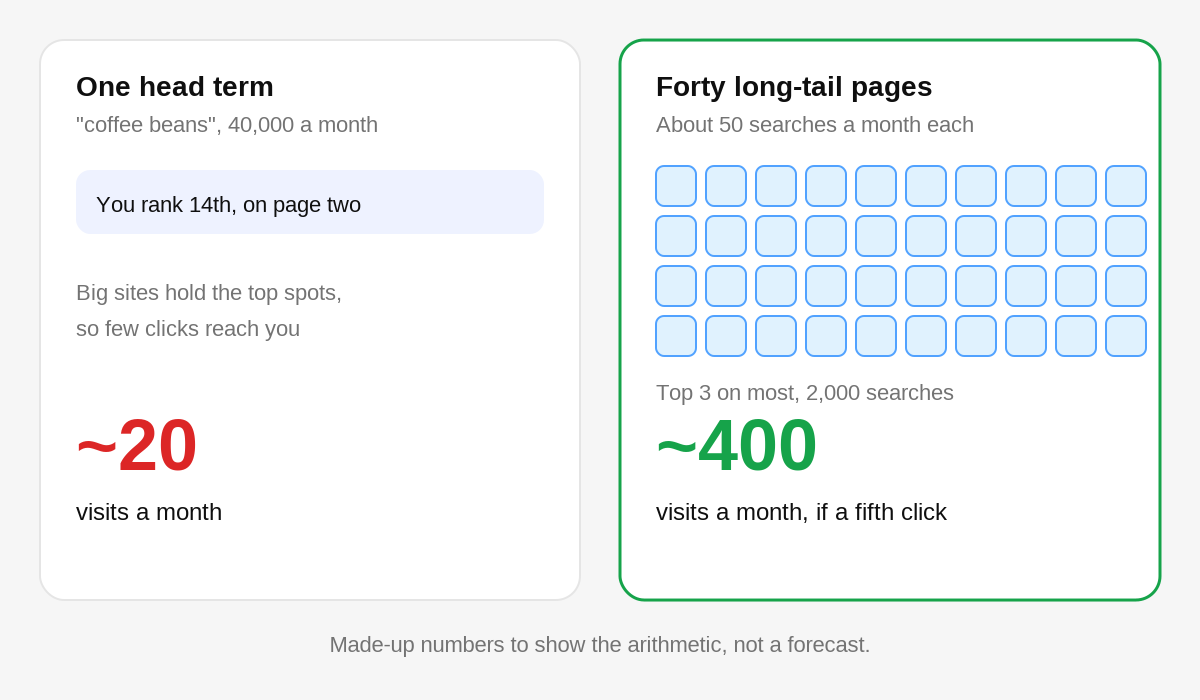
There is a second gain. A specific search carries its own intent. Search intent is the goal behind a search: to learn, to compare, or to buy. Someone who types "coffee beans" might want a definition, a shop or a picture. Someone who types "cold brew beans for french press" owns a French press and wants beans for it. Your page can answer that person exactly, and they are close to buying.
That last point is a reasonable expectation, not a promise. How many extra searches a page picks up depends on the page and the topic.
Where long-tail keywords hide in your results
You do not need a special database to find long-tail keywords. Autocomplete is full of them, because it suggests what real people type. Three parts of an Answer Socrates search are where most of them sit.
| Where to look | What it gives you | Coffee example |
|---|---|---|
| Letters | The seed plus each letter a to z: brands, sizes, places and odd needs no modifier would catch | cold brew coffee acid reflux |
| Prepositions | The seed joined with for, with, without, near, to: who it is for and what they want to avoid | cold brew coffee without bitterness |
| The LONG label | Any keyword of five or more words with no stronger signal | cold brew coffee concentrate ratio to water |
| Long Tail Keyword Generator | 30 AI-written ideas from one seed, sorted by funnel stage | ideas to check, not real searches |
The first three are real searches from autocomplete. The fourth is a brainstorm. Keep that difference in mind; it matters when you judge them.
How to do it in Answer Socrates
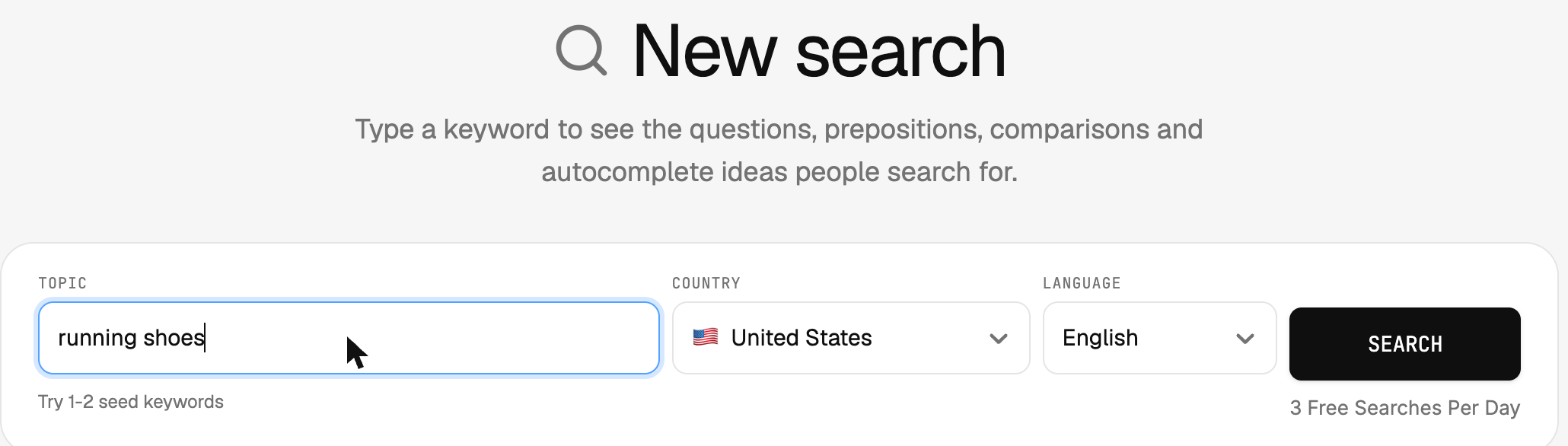
Here is the walk-through on a keyword search. You can use any seed; the screenshots are from a real "running shoes" search in the United States on 21 November 2026.
1. Search a short seed
Go to the Answer Socrates search page, type a short seed and pick your country and language. Use a short seed like "cold brew coffee", not a long phrase. A short seed lets autocomplete do the work of adding the long tail for you.
2. Scan the Letters section
Letters is the seed plus each letter of the alphabet. It is usually the biggest Google group and the best source of long-tail searches, because it catches words nobody would think to add.
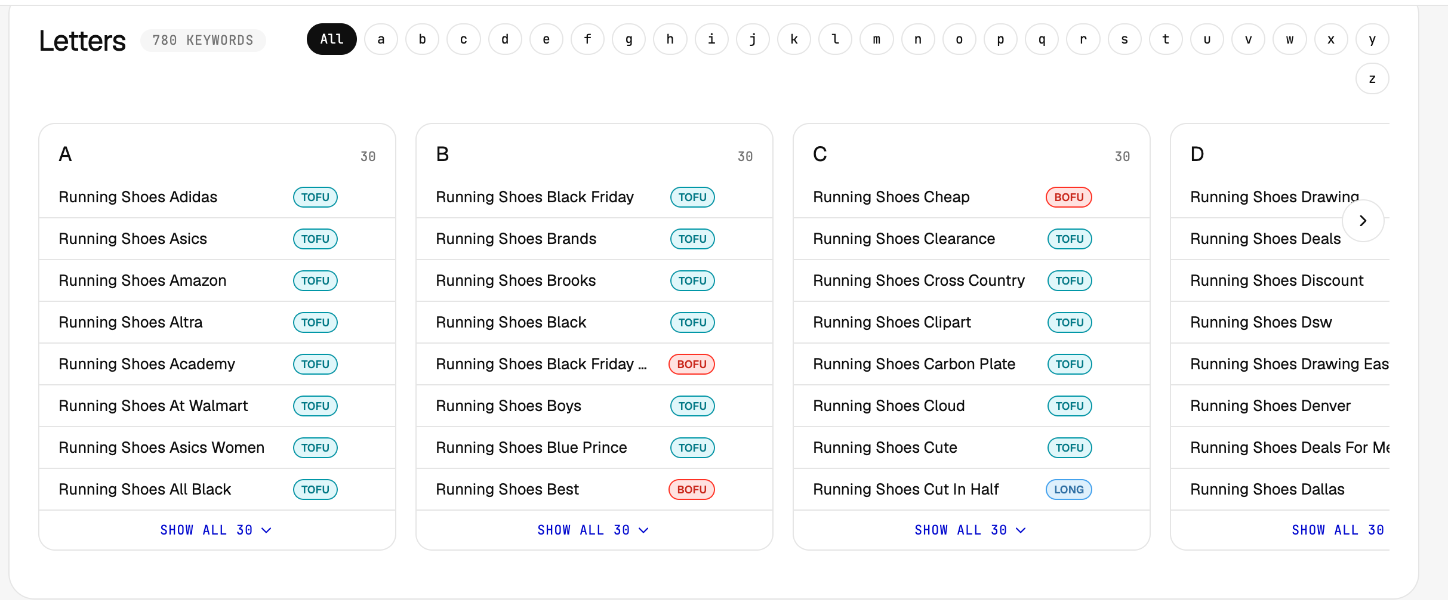
Do not read Letters keyword by keyword. Scan it for repeats. If three cards mention acid, stomach or reflux, that is a long-tail theme worth a page, even if no single search is big.
3. Read the Prepositions section
Prepositions join the seed with words like for, with, without, near and to. These are where searchers describe themselves and their problem.
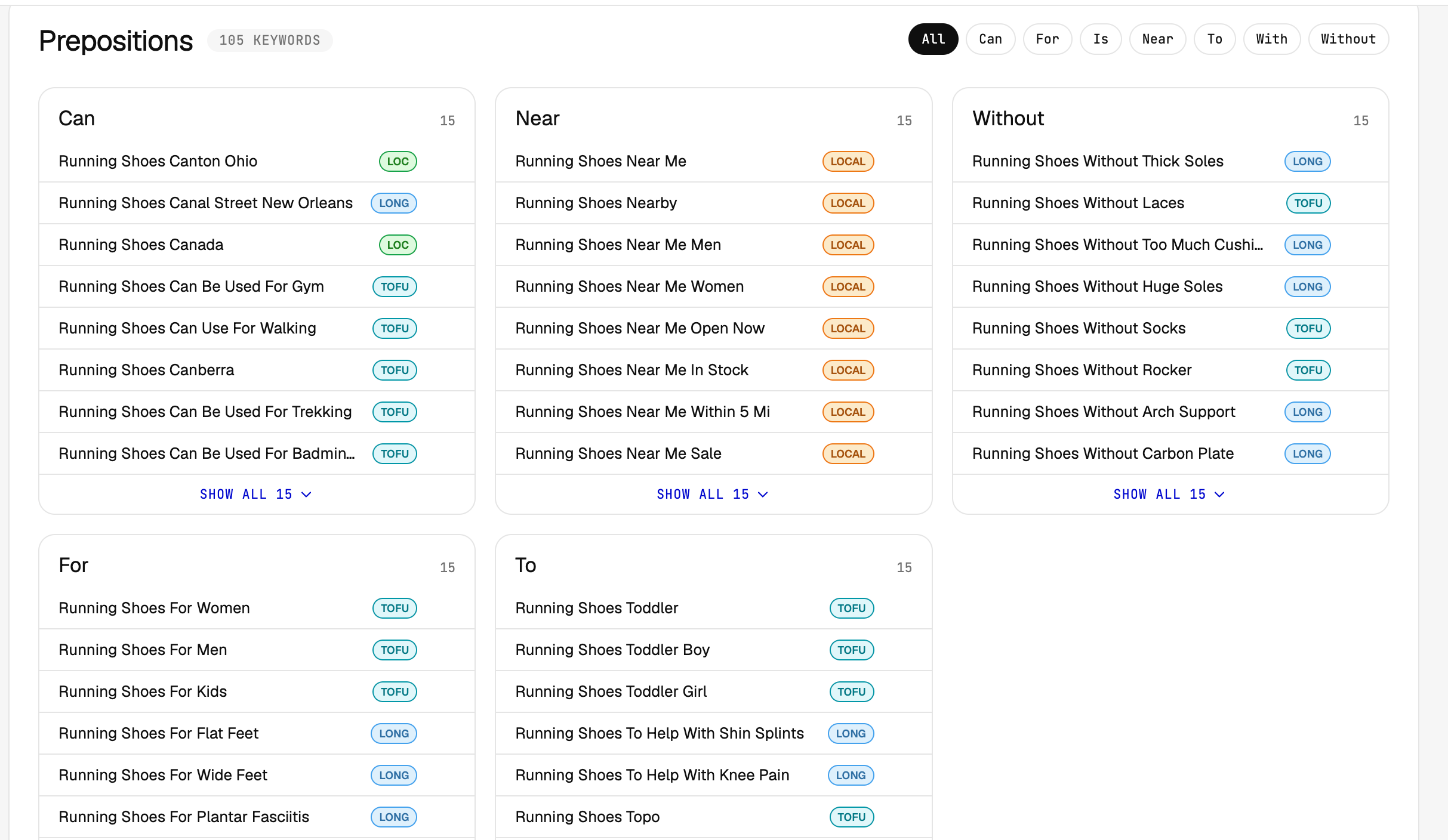
The For card is the richest. "Running shoes for flat feet" and "running shoes for plantar fasciitis" each describe one person with one need. The Without card is a list of objections: what the searcher is trying to avoid.
4. Look for the LONG label
Every keyword in the results has a coloured label that guesses its intent. LONG (short for Long Tail) is the one for this lesson. A keyword gets it when it has five or more words and none of the other rules matched first.
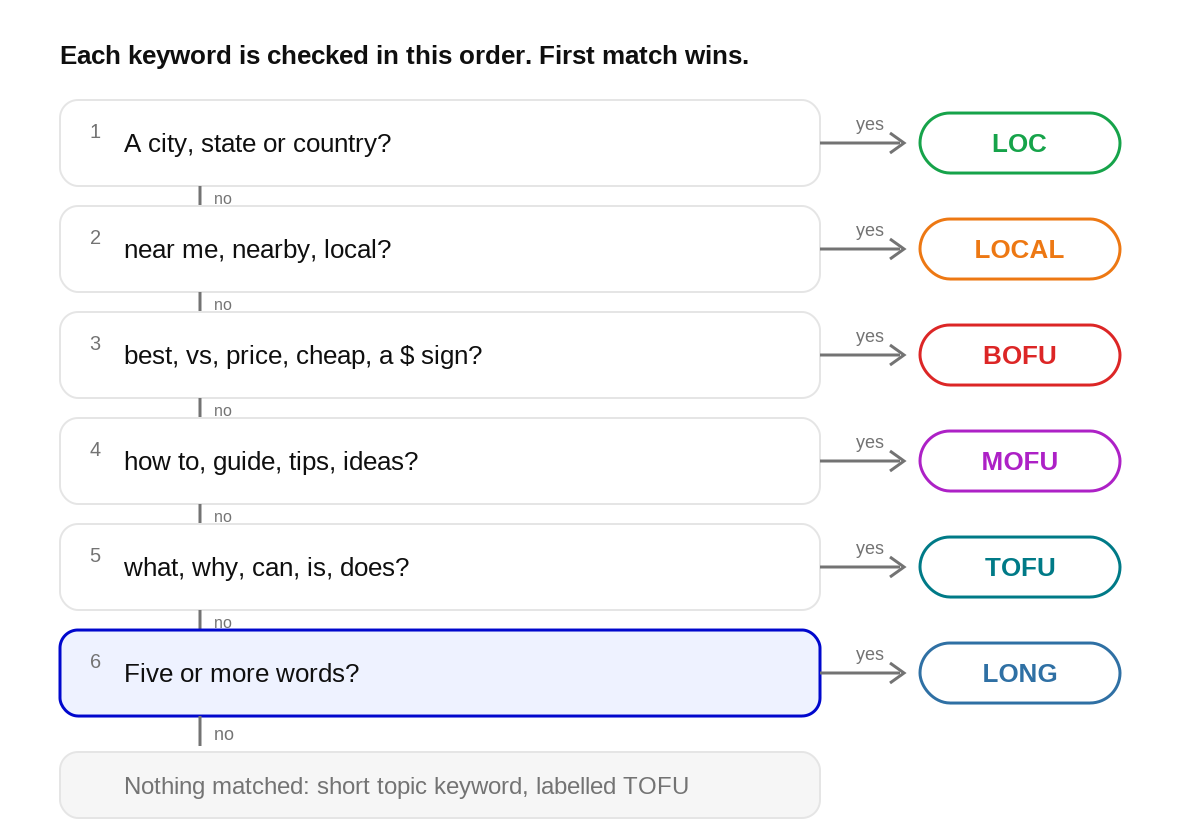
That order has a catch. Most long searches contain a question word or a buying word, so they get those labels instead. "Best low acid coffee beans for cold brew" is long tail by any measure, but it contains "best", so it is labelled BOFU. LONG marks only the leftovers: specific phrases with no other signal, such as "running shoes without arch support".
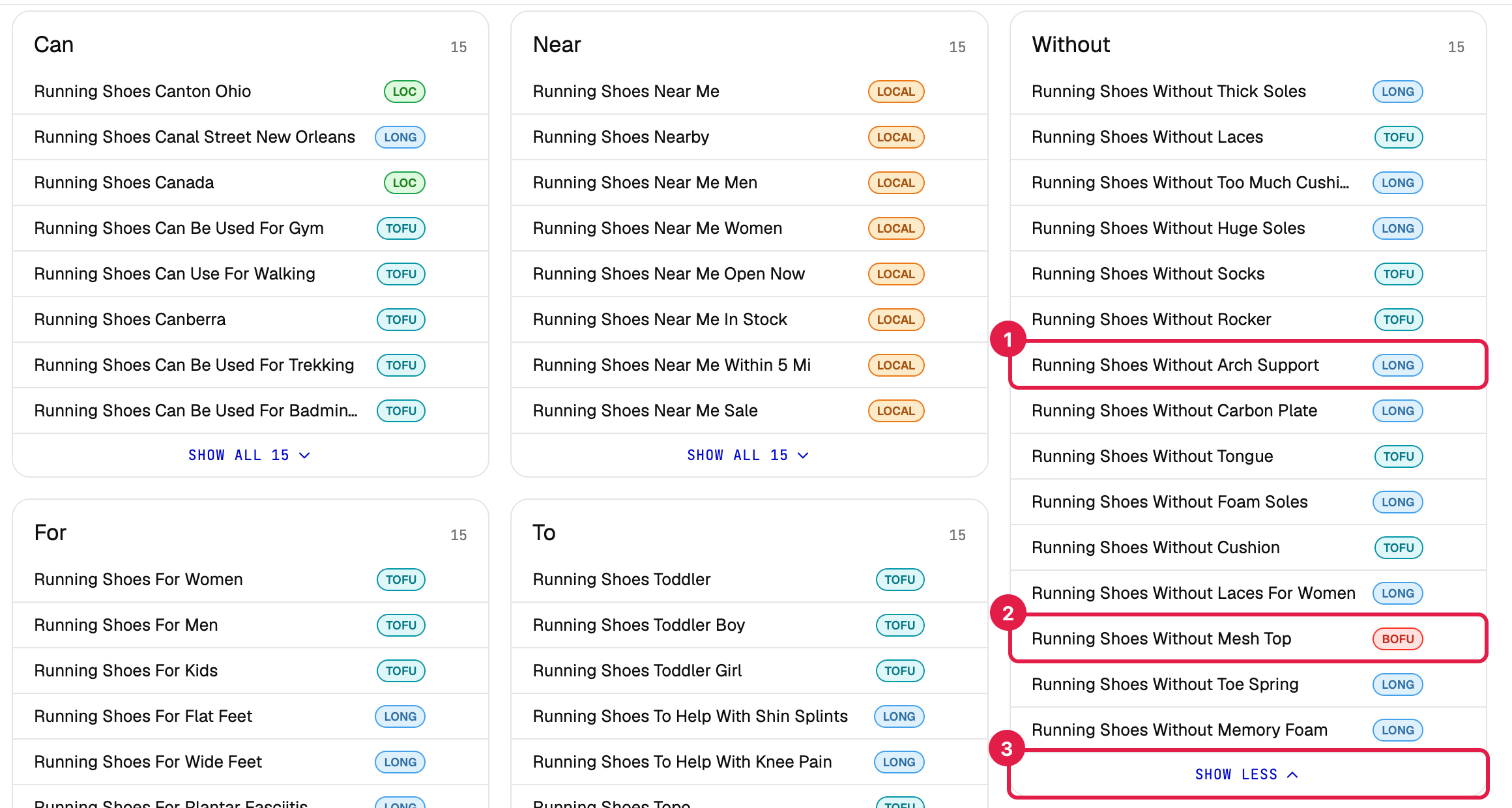
5. Pull the list out and sort it
Click Download CSV in the results header. The file (an Excel workbook, despite the button's name) has a Keyword Label column, so you can filter it to Long Tail in one step. Then add a word-count column in your spreadsheet and sort by it: that catches the long searches that were labelled BOFU, MOFU or TOFU too.
If you are on a paid plan, run Check Metrics first so the workbook carries search volume and CPC. Many long-tail keywords will show a tiny number or none at all. That does not mean nobody searches them. Autocomplete only suggests searches people make; the volume data simply does not reach that far down the tail.
How to judge a long-tail keyword
Not every small search is an easy win. Some are small because nobody cares, and some are already owned by a big site. Run each candidate through five checks.
| Check | Pass | Fail |
|---|---|---|
| Is it a real search? | It came from autocomplete or search data | It only came from an AI brainstorm and nothing confirms it |
| Is the intent clear? | You can say in one sentence what the searcher wants | It could mean two different things |
| Who ranks now? | Forums, old posts, pages that answer it in passing | Big brands with a page built for exactly this |
| Can you answer it best? | You have the product, data or experience | You would be rewriting other pages |
| Does it need its own page? | The answer is long and different from your other pages | It is one paragraph that fits an existing page |
The third check is the one people skip. Search the keyword yourself and look at the first page. If the top results are Reddit threads, Q&A sites or a general article with one line on the topic, the search is open. If they are pages written for exactly that query by sites much bigger than yours, it is not a long-tail win, whatever its volume.
The fifth check stops you writing forty thin pages. Many long-tail keywords belong as a section or an FAQ answer inside a bigger page. One page or many? Reading a keyword cluster covers how to decide.
The Long Tail Keyword Generator, and its limits
The Long Tail Keyword Generator is one of our free tools. You type a seed of up to 50 characters and click Generate Keywords.

An AI model writes 30 long-tail ideas: ten TOFU (top of funnel, people learning), ten MOFU (middle, people comparing options) and ten BOFU (bottom, people ready to buy). Each group has Copy All, each keyword has its own copy button, and Download CSV saves all 30 with their category. The same seed returns the same list for a week, because results are saved.
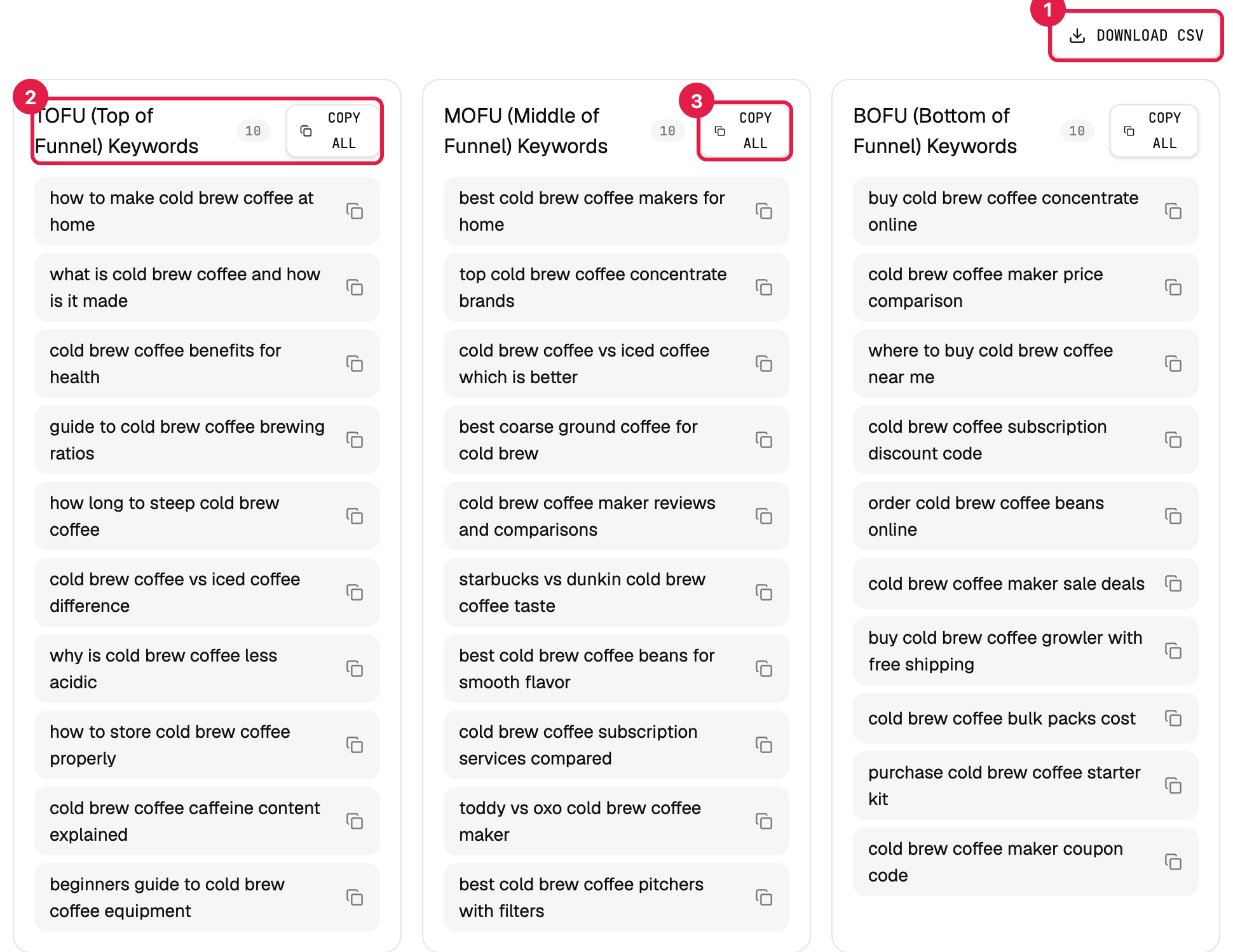
Be clear about what these are. The generator does not look anything up. It writes ideas that sound like searches, with no volume, no source and no check that anyone types them. Note too that the generator sorts by stage its own way, so its MOFU group can include words like "best" and "vs" that the results-page labels call BOFU.
Use it to get past a blank page, or to find angles for a topic too new for autocomplete to know much about. Then confirm the good ideas: run a keyword search on them, or check their volume, before you write anything.
| Use the keyword search when | Use the generator when |
|---|---|
| You want searches people really make | You want quick angles to think about |
| You will check volume and who ranks | You are stuck for ideas on a new topic |
| You are choosing what to publish | You want a funnel-sorted brainstorm in seconds |
A made-up example: a coffee roaster
A made-up example: Hillside Roasters is a small coffee roaster that sells beans online. Its pages for "coffee beans" and "espresso beans" get almost no search traffic, because big retailers hold those results. The owner searches "cold brew coffee" in the United States and works through Letters and Prepositions.
| Long-tail keyword | Where she found it | Her call | Why |
|---|---|---|---|
| cold brew coffee acid reflux | Letters (A) | Write a guide | Her low acid blend is a real answer, and the top results are forum threads |
| cold brew coffee without bitterness | Prepositions (Without) | Write a guide | Bitterness is a grind and steep-time problem her team can explain with tests |
| cold brew beans for french press | Prepositions (For) | Improve a product page | Her cold brew blend page can say it directly, with grind advice |
| cold brew coffee concentrate ratio to water | LONG label | Add a section | One short answer; it belongs in the cold brew guide, not its own page |
| best cold brew coffee maker | Comparisons (BOFU) | Skip | Long, but big review sites own it, and she does not sell makers |
| cold brew coffee subscription for offices | Generator idea | Check first | Sounds good, but it came from the generator; she searches it before deciding |
Six long-tail keywords, two new guides, one better product page, one section and one idea to check. None of them is big. Together they are pages she can win, written for people who are close to buying beans.
The same thing in Ask Socrates
Ask Socrates is the Answer Socrates chat. It runs the same keyword search from a plain request and then works from the results you already have. You need to be signed in. A full keyword pull costs one search credit. If your spending setting is "Asks before spending", the chat shows an approval card first; on an auto setting it runs straight away.
Type a request that names the seed and the market:
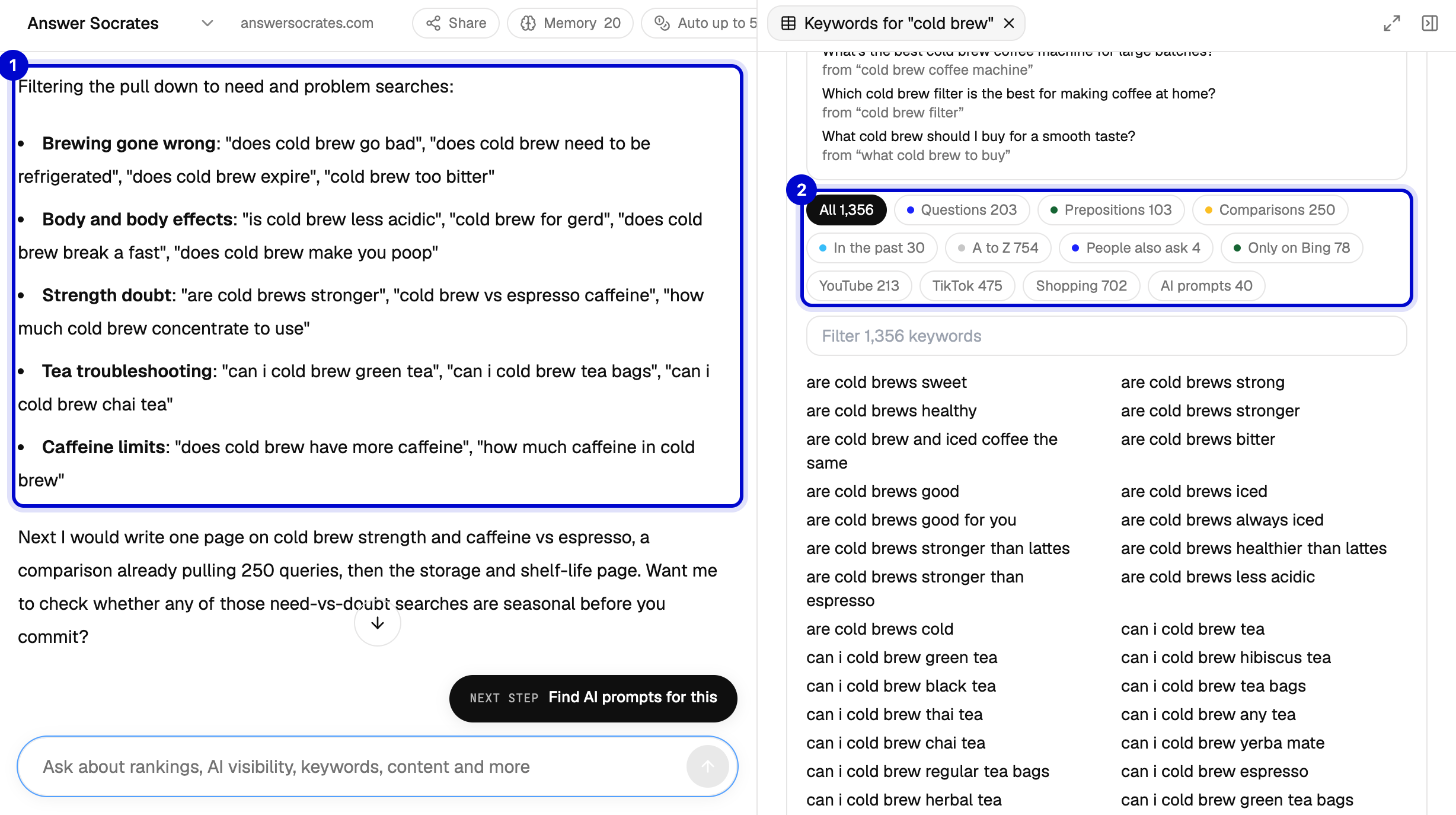
The chat runs the pull, opens the full list in a panel beside it, and answers the follow-up from that list. You can keep narrowing in plain words, such as "drop anything about coffee makers" or "which of these sound like buying searches?". Treat its picks the same way as the LONG label: a fast first sort that you check.
Where to go next
| If you want to... | Read |
|---|---|
| Learn every section of the results first | How to do keyword research: find what people actually ask |
| Go deeper on one long-tail question | Recursive search: going deeper on one question |
| Group your long-tail list into topics | Keyword clustering: turning a list into topics |
| Decide if a keyword needs its own page | One page or many? Reading a keyword cluster |
| Do all of this in a conversation | Keyword research in one chat with Ask Socrates |
Sources
- Long-tail Keywords: What They Are and How to Get Search Traffic From Them, Ahrefs (Tim Soulo), 2026
- Understanding searches better than ever before, Google (The Keyword blog, Pandu Nayak), 2019
