Information gain: adding what other pages lack
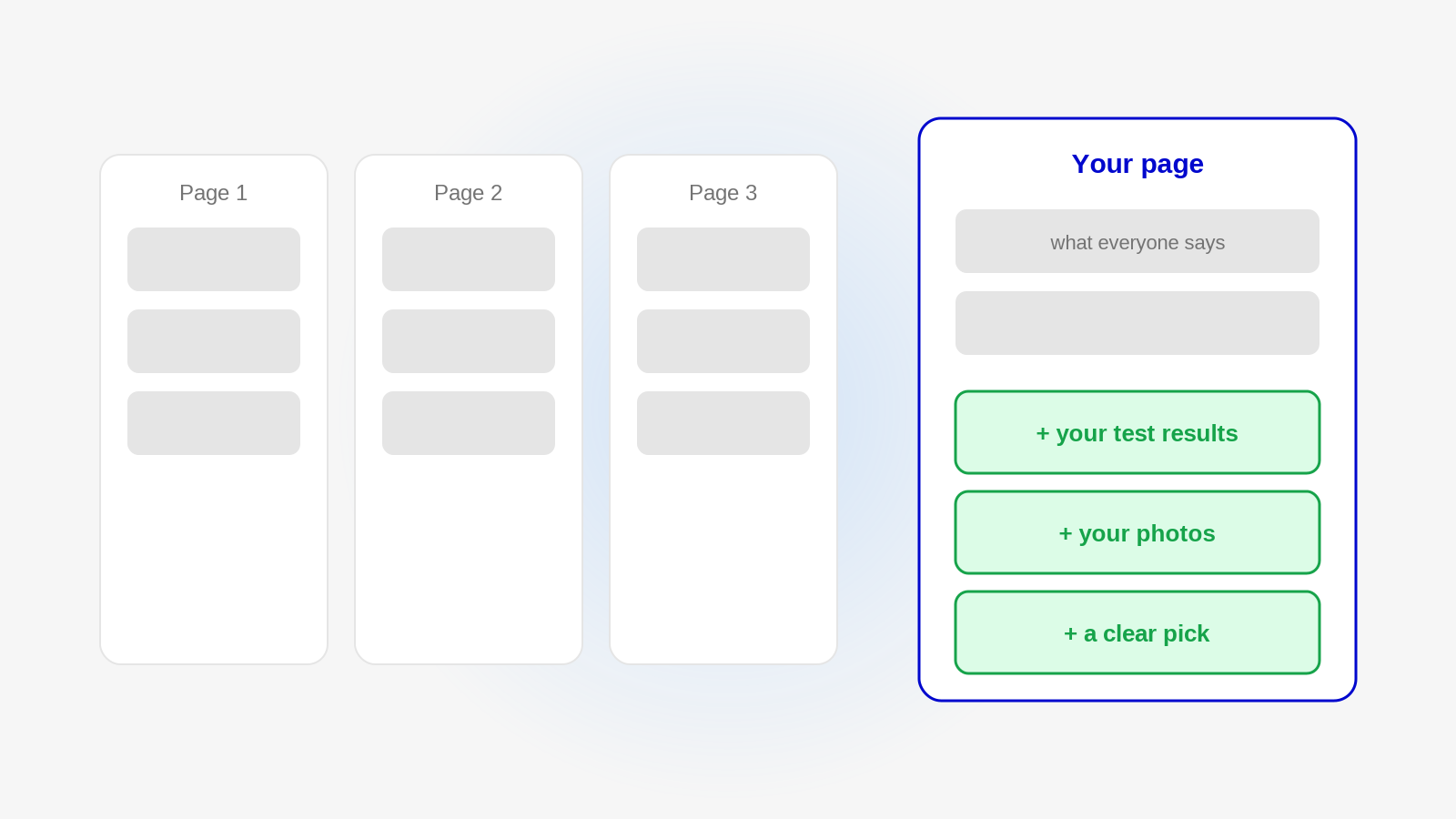
Information gain is what a reader learns from your page that they would not have learned from the pages already ranking. Google's own guidance asks for original information and analysis beyond the obvious, so a page that only repeats the top five gives nobody a reason to choose it.
Key takeaways
- Google's helpful content questions ask for original information, analysis beyond the obvious, and substantial additional value instead of rewriting other sources.
- Google's patent 11,354,342 scores gain against pages one user already viewed, and it does not say Google Search uses it, so treat it as background, not a ranking factor.
- Map the consensus first: list every subtopic the top five pages cover, cover the shared rows briefly, then fill the rows nobody covers.
- Six kinds of gain need no research budget: your own data, a test you ran, your photos, an expert's call, a worked example and a clear pick.
- Content Studio's ranking-page headings and terms panel show the consensus; your gain reaches the draft only through the 800-character notes box or your own edits.
Information gain: what your page adds to the top results
Information gain is what a reader learns from your page that they would not have learned from the pages already ranking. If the top five results for "best running shoes for wide feet" all explain toe boxes and list the same ten shoes, a sixth page that does the same adds nothing. A page that measured the toe box width of each shoe adds something.
Google does not use the phrase in its guidance, but it asks the same question in plain words. Its list of questions for judging your own content includes whether it provides "original information, reporting, research, or analysis", and whether it offers "interesting information that is beyond the obvious" [1]. If your page draws on other sources, Google asks whether it avoids "simply copying or rewriting those sources" [1].
The same idea runs through Google's advice on AI search. In May 2025 Google's John Mueller wrote that site owners should "focus on making unique, non-commodity content" [2]. A commodity page is one that could be swapped for any other result without the reader noticing.
What the information gain patent does and does not say
You will see "the information gain patent" quoted as proof that Google ranks pages by originality. Be careful with that.
The patent is real. Google LLC was granted US patent 11,354,342, "Contextual estimation of link information gain", in June 2022 [3]. It describes scoring a document by how much "additional information" it holds beyond documents the user "previously viewed" [3]. Its background talks about automated assistants (chatbots), and it says search results "may be ranked at least in part" by those scores [3].
Here is what it does not say:
- It does not say Google Search uses it. A patent describes a method a company owns, not one it runs. Google holds many patents that never ship.
- It scores gain against what one user has already seen, not against the web in general.
- It gives no recipe for writing. Nothing in it says "add a table" or "add 20% new content".
Map the consensus first, then look for the gap
You cannot add what is missing until you know what is there. Read the top five results for your keyword and write down, in a sheet, every subtopic each one covers. One row per subtopic, one column per page.
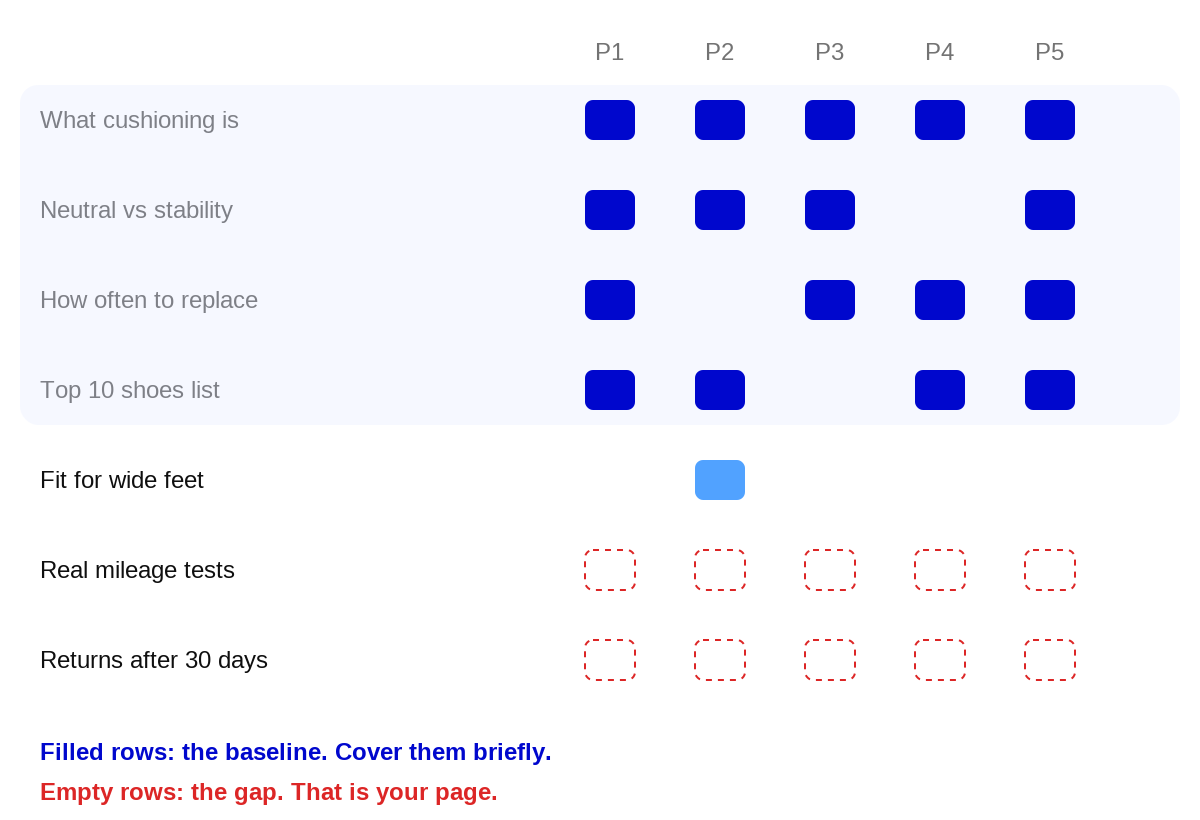
The grid gives you three kinds of row:
| Row type | What it means | What to do |
|---|---|---|
| Filled by most pages | The consensus: what readers expect to see | Cover it, briefly and accurately. Missing it looks thin |
| Filled by one page | A half-explored angle | Go deeper than that page did |
| Filled by none | A gap | Fill it, if you can do it honestly |
The baseline still matters. A page that skips what everyone expects reads as incomplete, and Google also asks whether content gives "a substantial, complete, or comprehensive description of the topic" [1]. Information gain is what you add on top of a complete answer, not a replacement for one.
Six kinds of gain any business can add
You do not need a research budget. Most businesses sit on information the ranking pages cannot have.
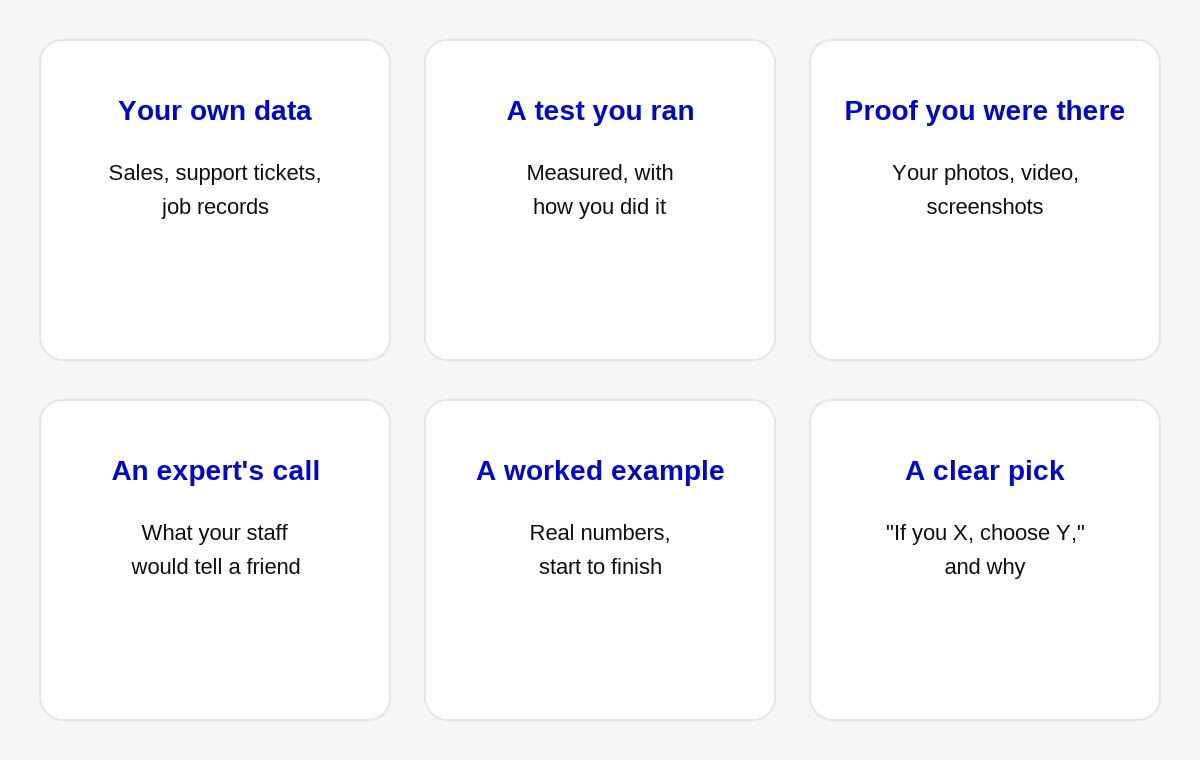
| Kind of gain | Running shoe store example | Plumbing company example |
|---|---|---|
| Your own data | "Of 400 returns last year, 31% were for width" | "Most of our winter call-outs are pressure faults" |
| A test you ran | Toe box widths measured with calipers | Time to repressurise five common boilers |
| Proof you were there | Photos of each shoe on a wide foot | Photos of the gauge and the filling loop |
| An expert's call | What the fitter tells wide-footed customers | What the engineer checks first |
| A worked example | One customer's fitting, size by size | One job, from symptom to fix to invoice |
| A clear pick | "If your feet swell on long runs, choose X" | "If the pressure drops twice in a week, call us" |
Google's guidance on reviews says the same things in its own words: provide "evidence such as visuals, audio, or other links of your own experience", share "quantitative measurements", and explain "what sets something apart from its competitors" [4]. That page is about product reviews, but the advice travels well to any page.
The numbers in the table are made up for the example. Yours have to be real. An invented statistic is not information gain; it is misinformation with a confident tone.
How to do it in Answer Socrates
Answer Socrates helps with two parts: finding gaps worth filling, and seeing the consensus. The gain itself has to come from you.
1. Find questions the top pages skip
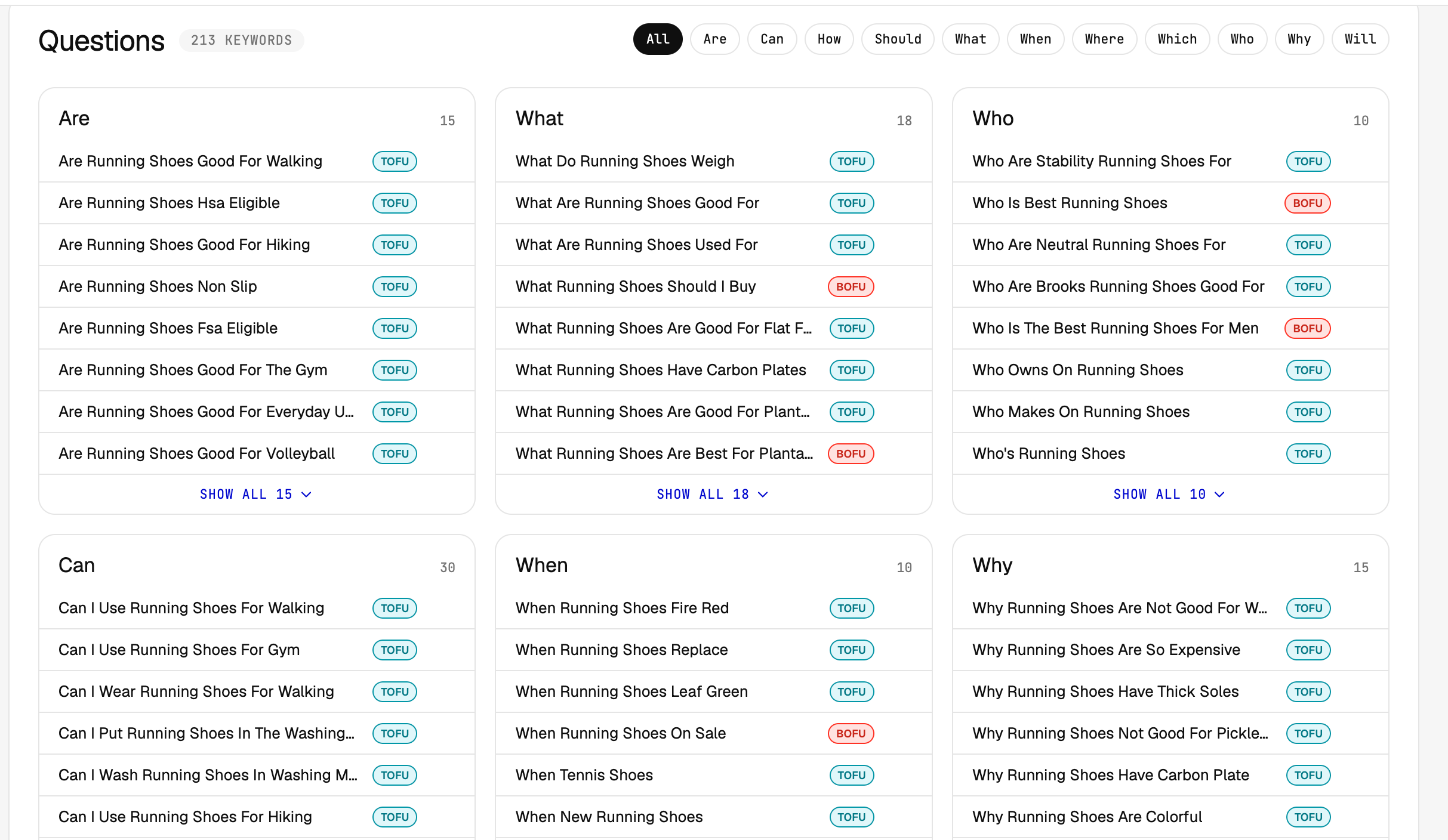
Run a keyword search on your topic and open the Questions section. These are real searches from autocomplete. Pick the questions that sound specific, then check whether the top results answer them properly.
The People Also Asked card on the same results page shows the questions Google itself puts in its People Also Ask box for your seed. Those are questions Google expects searchers to want next, which makes them a good test for your grid: does each top page answer them well?
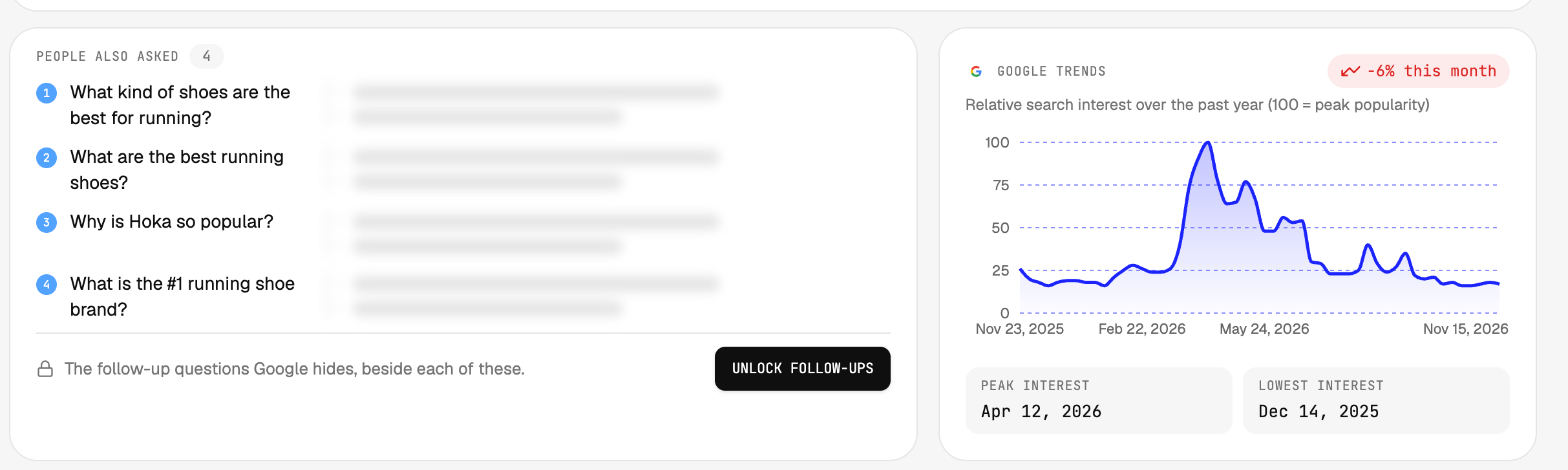
This is the check the callout above asked for. A gap backed by real questions is worth filling. A gap nobody searches for may still be worth a paragraph, but not a page.
2. See the consensus in Content Studio
Start an article in Content Studio and keep three to five ranking pages as sources. On Review the outline, the What the ranking pages cover panel shows their real headings. What they say opens the opening text of a page as the writer saw it. Not in your plan yet lists headings those pages use that your outline does not, shared ones first.
Once the draft is written, the editor keeps the same consensus view in its Live SERP Research panel: how your draft compares with the ranking pages, the heading topics they share, and the searches around the keyword your draft does or does not cover.
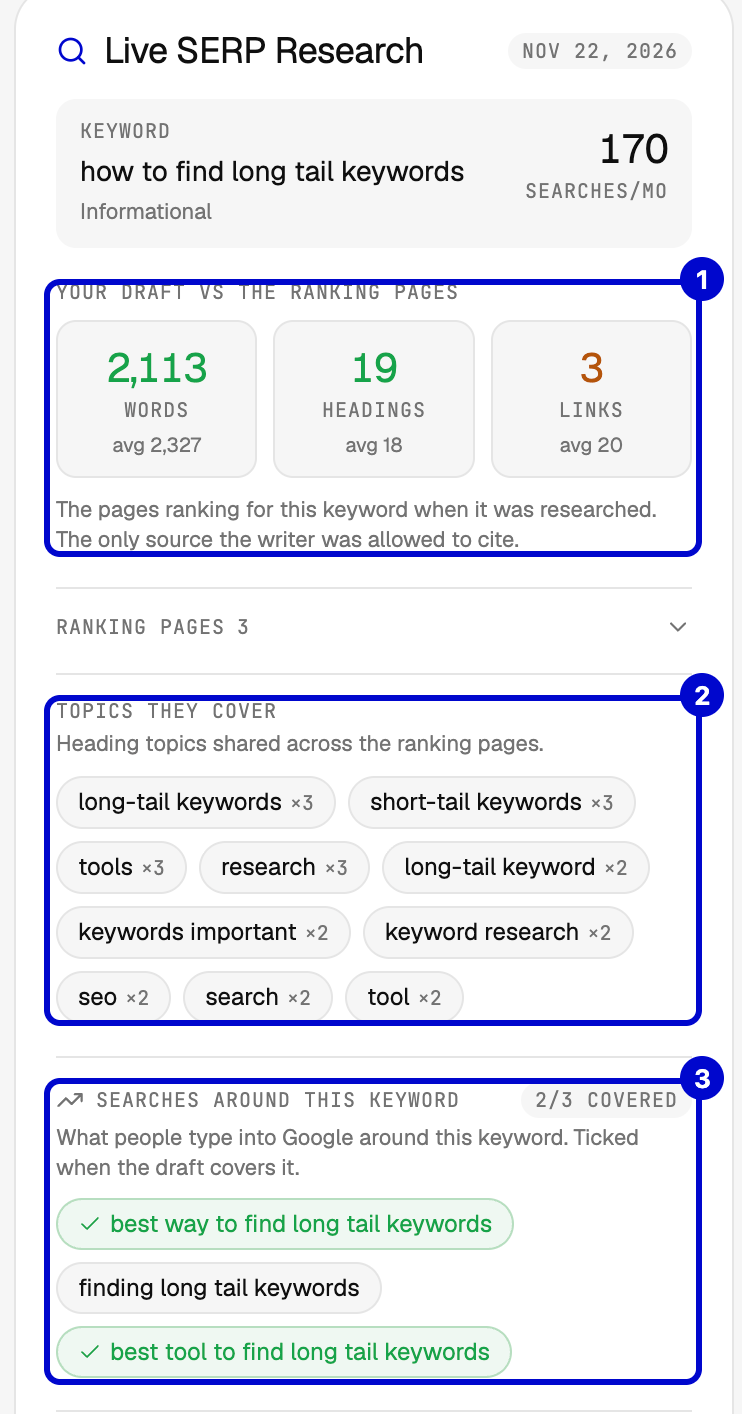
Read this panel as the baseline, not the goal. Adding every heading from "Not in your plan yet" makes your outline match the others more closely. Add the shared ones that readers expect, then put your gain in the Notes for the writer box (up to 800 characters; paste facts, because links are not opened).
3. Keep the writer honest
Content Studio's writer is told that the research notes from your sources are the only source for stats, prices and named claims, so it does not invent numbers. That also means it cannot invent your gain. Your test results, your return rates and your fitter's advice reach the draft only through your notes or your own edits.
4. Read the editor's terms panel the right way
In the editor, the Live SERP Research panel lists terms the ranking pages use, with your count and a suggested range.
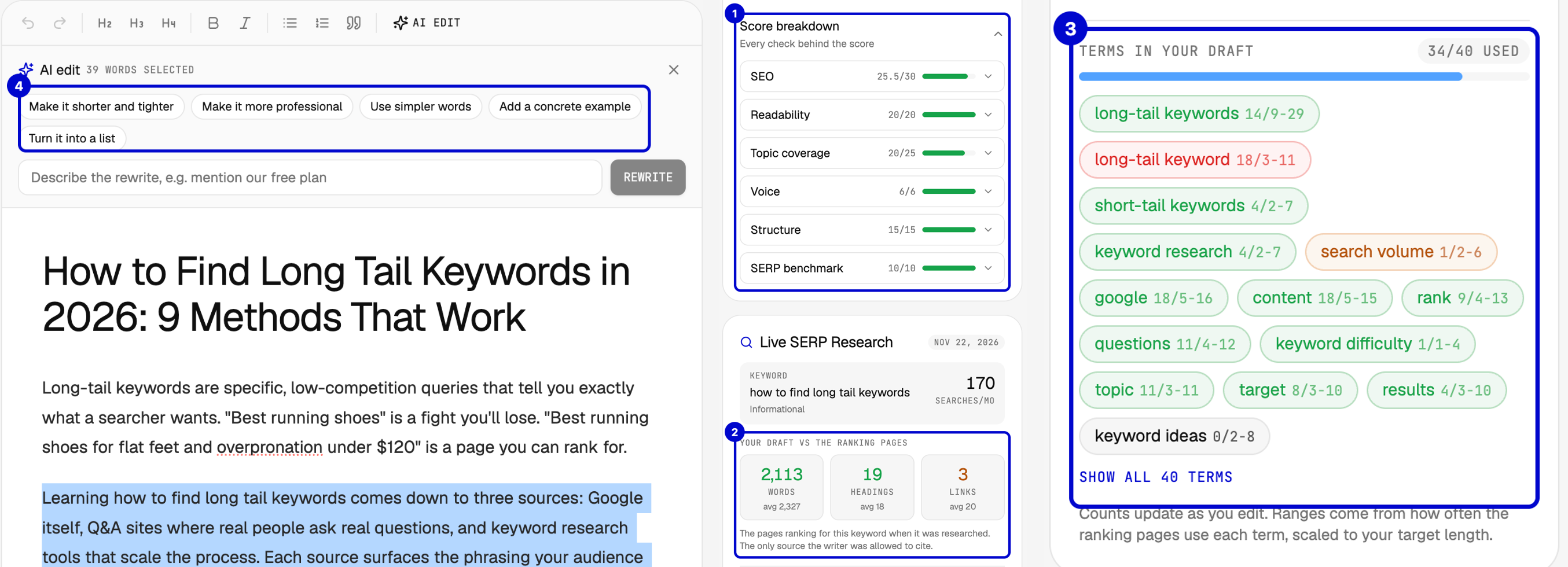
Use it to catch a missing basic, then stop. Chasing every term pushes your page toward the average.
A made-up example: a running shoe store
A made-up example: Stride Lab is a running shoe store with a fitting service. It wants to rank for "best running shoes for wide feet".
- Consensus. The owner reads the top five. All five explain toe boxes, four list roughly the same ten shoes, and none has measured anything.
- Gaps with demand. In the Questions section she finds searches like "are wide running shoes worth it" and "can running shoes stretch". The top pages answer them in a line or not at all.
- Her gain. Her fitters measure every shoe's toe box with calipers. Her returns data shows which shoes come back for width. She has photos of each shoe on a wide foot.
- The brief. In Content Studio she keeps four sources, adds the two shared headings she was missing, and adds a section "We measured 12 shoes". In the notes she pastes the widths and the return figures.
- The edit. She adds the photos and one line from her head fitter: what to try first if your feet swell on long runs.
Her page covers what the others cover, in fewer words. Then it gives a measurement table and a pick that nobody else can give.
The same thing in Ask Socrates
Ask Socrates, the Answer Socrates chat, can read any public page for free. It does not search Google for you here, so give it the addresses of the pages that rank:
The chat reads each page (title, headings and up to the first 6,000 characters of text) and builds the consensus and the gaps in plain words. Then ask it to check the gaps against real searches with a keyword pull, which costs 1 search credit.
Some sites block it. When we asked for the top four guides on "best running shoes for wide feet" by site name, two answered 403 and one guide address was a 404. The chat said so and would not claim what "all four" cover. Paste exact addresses, and have a second choice ready for any page that blocks the read.
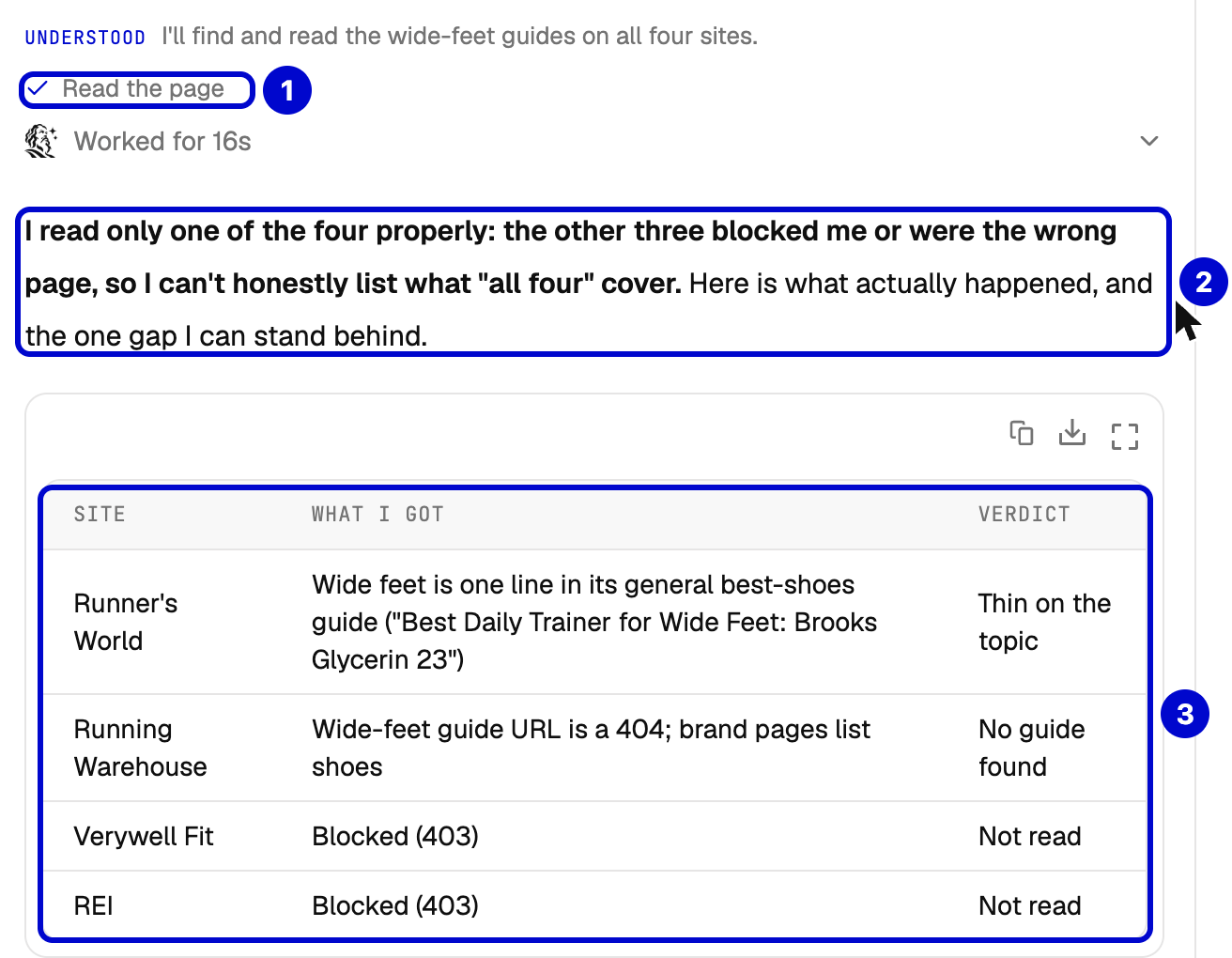
Treat its list of gaps as candidates. Only you know whether you have the data, the photos or the expert to fill each one.
Where to go next
| If you want to... | Read |
|---|---|
| Put your gain into instructions a writer can follow | Content briefs: what to give a writer (or an AI) |
| Choose which pages to give this effort first | From cluster to content plan: what to write first |
| Write the page with sources and an outline | Writing with Content Studio, step by step |
| See why AI answers cite some pages | Why AI cites some pages and not others |
| Find questions the top pages skip | How to do keyword research: find what people actually ask |
Sources
- Creating helpful, reliable, people-first content, Google Search Central, n.d.
- Top ways to ensure your content performs well in Google's AI experiences on Search, Google Search Central Blog (John Mueller), 2025
- US11354342B2: Contextual estimation of link information gain, Google LLC, via Google Patents, 2022
- Write high quality reviews, Google Search Central, n.d.
