Competitors in AI answers: who gets named instead of you
Your competitors in AI answers are the brands AI engines name for the prompts your buyers type, counted as a share of answers across engines and runs. Knowing who they are, and which pages the engines cite next to them, tells you exactly where to earn a place.
Key takeaways
- Compare brands by share of answers across engines and repeat runs: in SparkToro's 2,961-run study the same brand list came back less than 1 time in 100.
- The sources cited next to a rival show where the engines learn your category; Ahrefs found branded web mentions correlate 0.664 with AI Overview visibility, against 0.218 for backlinks.
- A tracker scan's Brand rankings table shows each brand's rank, Share of Voice, Avg Position, Citations and the engines that named it.
- The Citations page's Targets view lists third-party and social pages cited in answers that name your competitors but never you, with Lists only to show best-of lists first.
- In Ask Socrates, "Which topics am I losing to Ember?" compares you with one competitor topic by topic from checks already run, at no cost.
The brands named instead of you are the real lesson
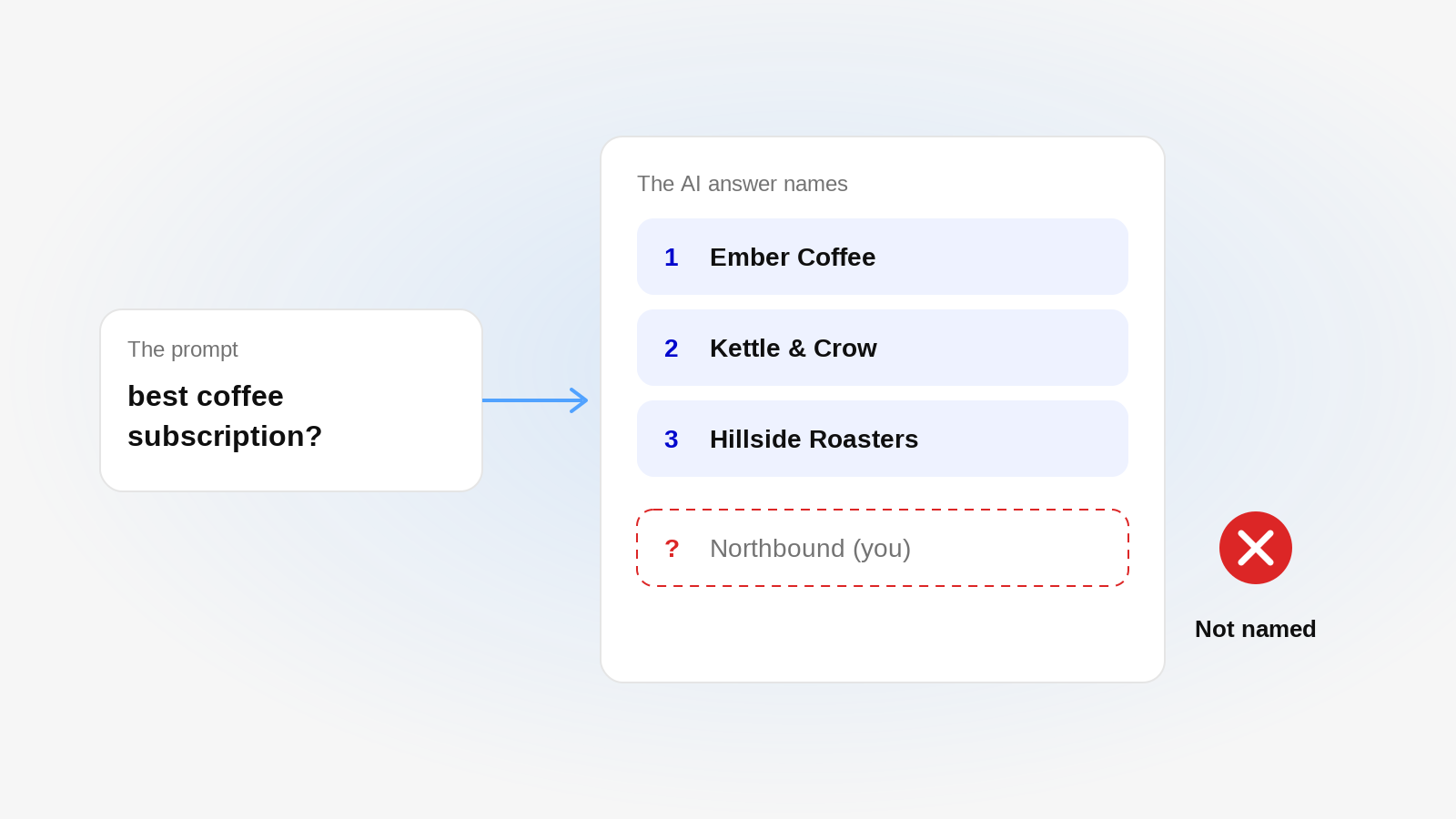
When an AI answer leaves you out, it still names someone. Those brands are the most useful thing in the answer, because they show you what the engine believes about your category: who it trusts, which pages it read, and which reasons it repeats.
An AI competitor is any brand an AI engine names for a prompt your buyers type. It is not always the rival you track in your sales deck. A coffee roaster may lose "best coffee subscription" to a brand it has never heard of, because a review blog the engines read happens to love that brand.
Count share of answers, not one ranking
A single answer cannot tell you who leads. Answers change on every run. In a study by SparkToro and Gumshoe, 600 volunteers ran 12 prompts through ChatGPT, Claude and Google's AI 2,961 times, and the chance of getting the same brand list twice was under 1 in 100 [1]. The same write-up found that how often a brand appears held steadier than where it appears, and calls visibility percentage across many runs "a reasonable metric" [1].
So the comparison that holds up is a count. Ask the same prompts in several engines, more than once each, and count how many answers name each brand.
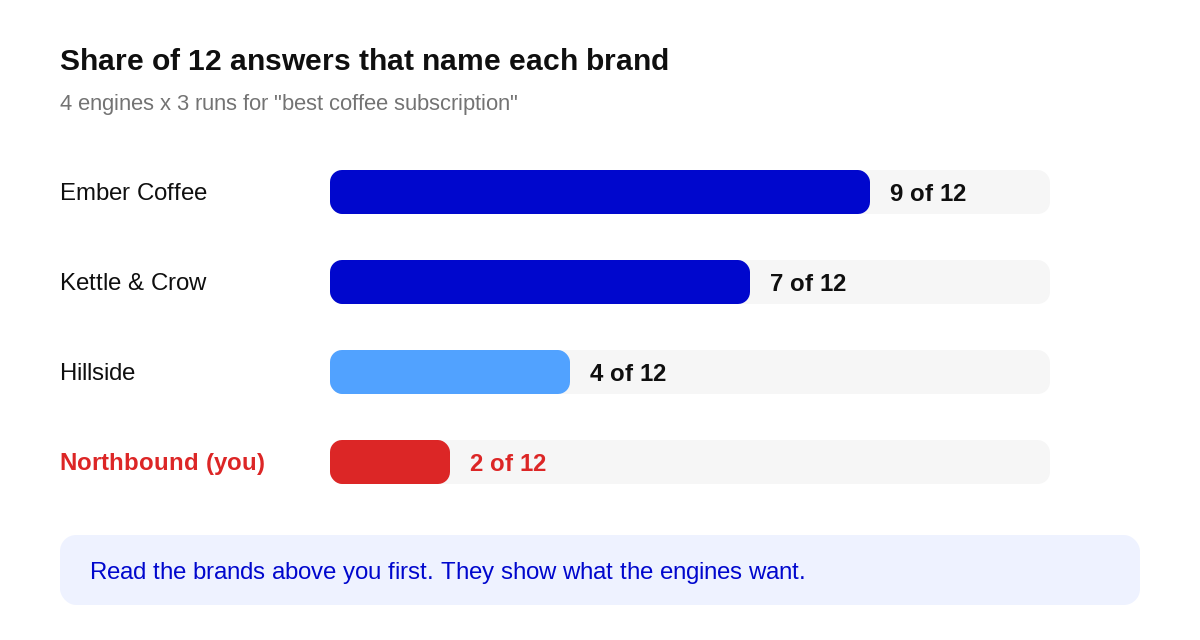
Read the gaps by size:
| Gap between a rival and you | What it means | What to do |
|---|---|---|
| Under 10 points | Noise. One more run could flip it | Run it again before you act |
| 10 to 30 points | A real lead on this prompt | Read the rival's sources and answers |
| Over 30 points | The engines treat the rival as the default | Study this rival first, prompt by prompt |
| Rival named, you never | You are not in the engine's picture of the category | Start with the pages the engines cite |
These bands are a rule of thumb for a check of a dozen or so answers, not a statistical test. With more runs you can trust smaller gaps.
Why engines pick the brands they pick
AI search answers sit on top of web searches. Google says AI Overviews and AI Mode can issue "multiple related searches across subtopics" to build an answer [3]. The brands that win are the ones that show up, and show up well, on the pages those searches return.
That is why the most useful question about a rival is: what is cited next to them?
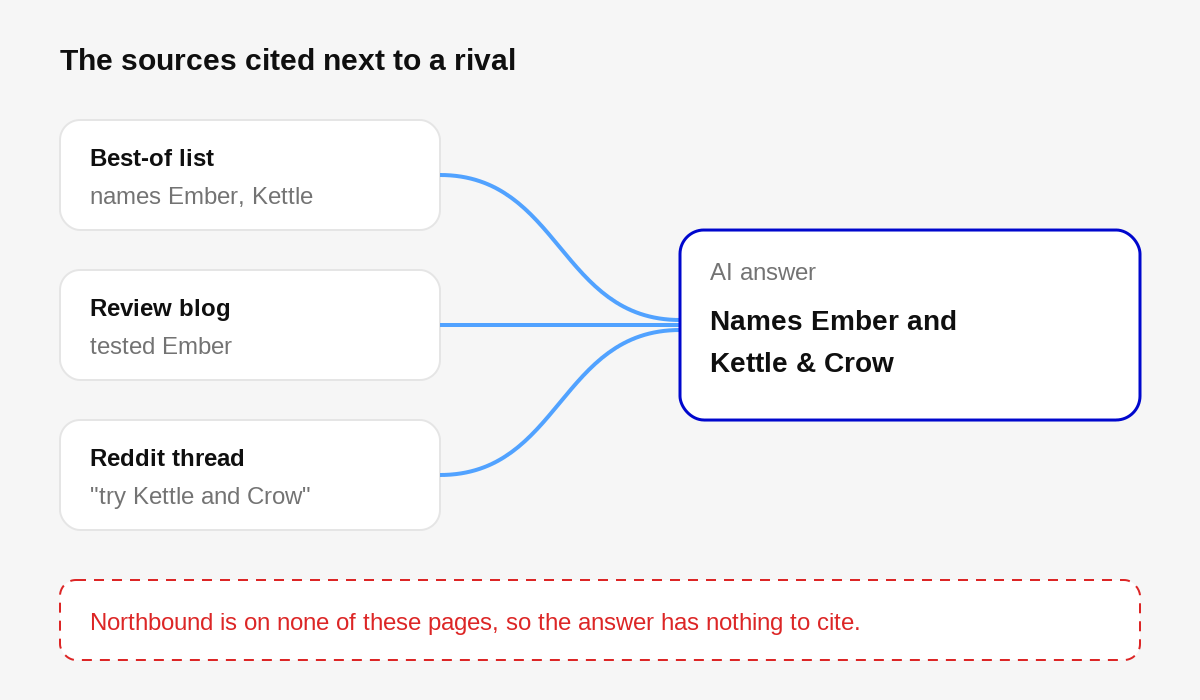
Third-party pages matter more than most people expect. Ahrefs looked at 75,000 brands and found that branded web mentions had the strongest link to being named in AI Overviews, a correlation of 0.664, against 0.218 for backlinks [2]. That is one study and a correlation, not proof of cause. But it fits what you see in a tracker: rivals win on lists, reviews and threads that mention them, not only on their own sites.
For each rival that beats you, write down three things:
- The sources cited beside them. Best-of lists, review blogs, comparison pages, forum threads.
- The reasons the answer gives. "Roasts to order", "free shipping", "best for espresso". The engine is repeating something it read.
- The prompts they win and lose. A rival that wins "best" prompts and loses "cheapest" prompts has a clear position, and you may want a different one.
How to do it in Answer Socrates
The LLM Brand Tracker reads competitors out of every answer for you, so you never type a rival in. Here is the path from one scan to a list of pages to go after.
Step 1. Run scans on your buyer prompts. In the tracker, press New Scan, type a prompt, pick the engines (ChatGPT, Gemini, Claude, Perplexity, Grok and DeepSeek) and press Run Scan. Each engine costs 1 credit. If you have not done this yet, the full walk-through is in Is AI mentioning your brand? How to check.
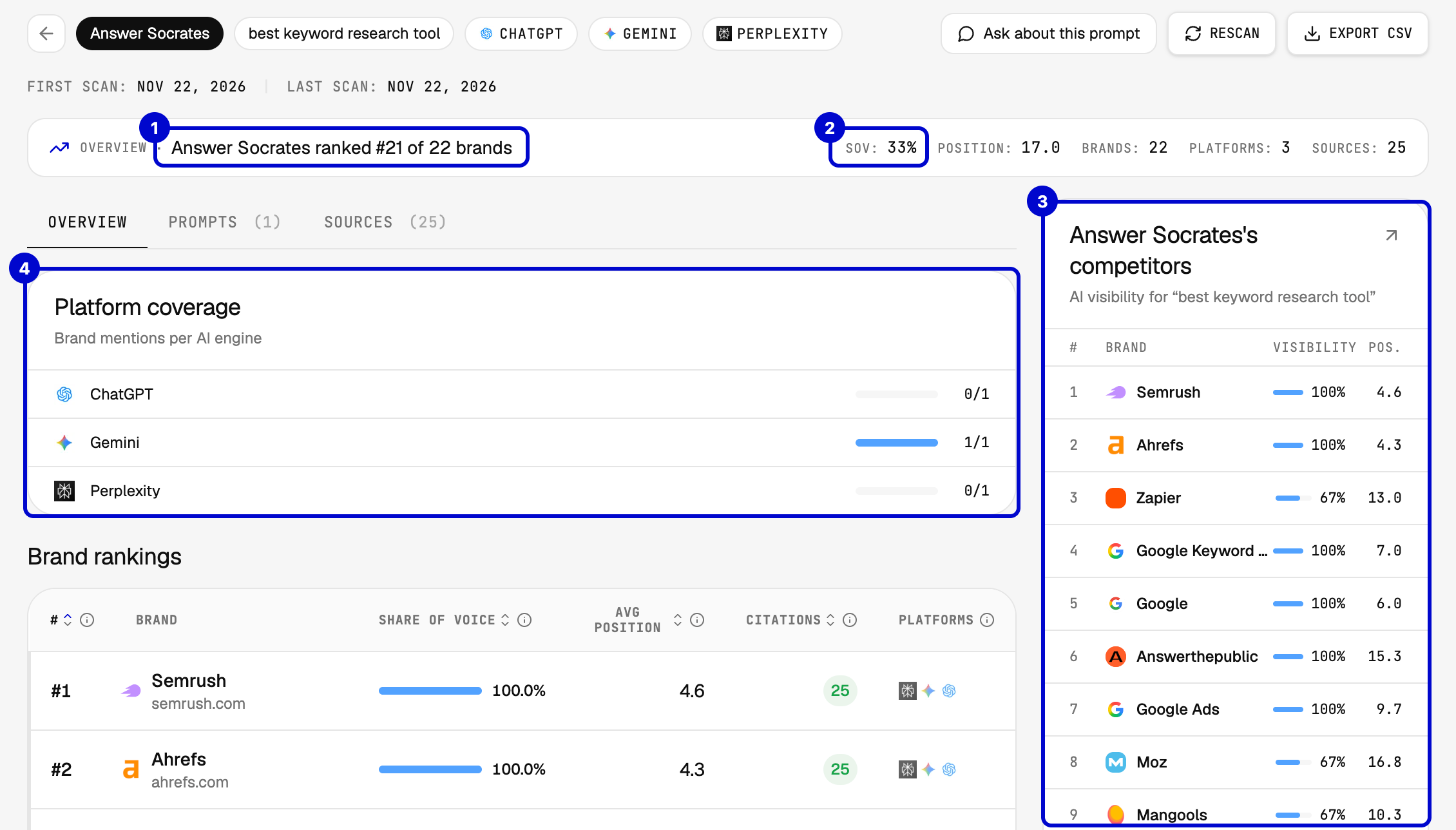
Step 2. Read the scan's competitors. On the result page, the panel on the right lists your competitors for that prompt, each with Visibility and Pos. The Overview tab has Platform coverage (Mentioned or Not mentioned per engine) and a Brand rankings table with these columns:
- #: rank by prominence. Brands named more often and earlier rank higher.
- Share of Voice: the percent of engine answers in this scan that name the brand.
- Avg Position: where the brand tends to come in the answer, roughly its place in the order brands are named. Lower is better.
- Citations: the sources cited in the answers that named the brand. Click the count to see the URLs.
- Platforms: which engines named it.
Step 3. See competitors across all your prompts. Open Dashboard. The Competitors card lists the brands the engines name across your scans, with Voice (their average share of voice), Rank and Seen (how many scans named them). Click a column to sort. This card filters out names that are sources rather than rivals, like encyclopedias and Google itself. Use the Engine, Prompts, Location and date filters to compare, say, ChatGPT alone over 30 days.
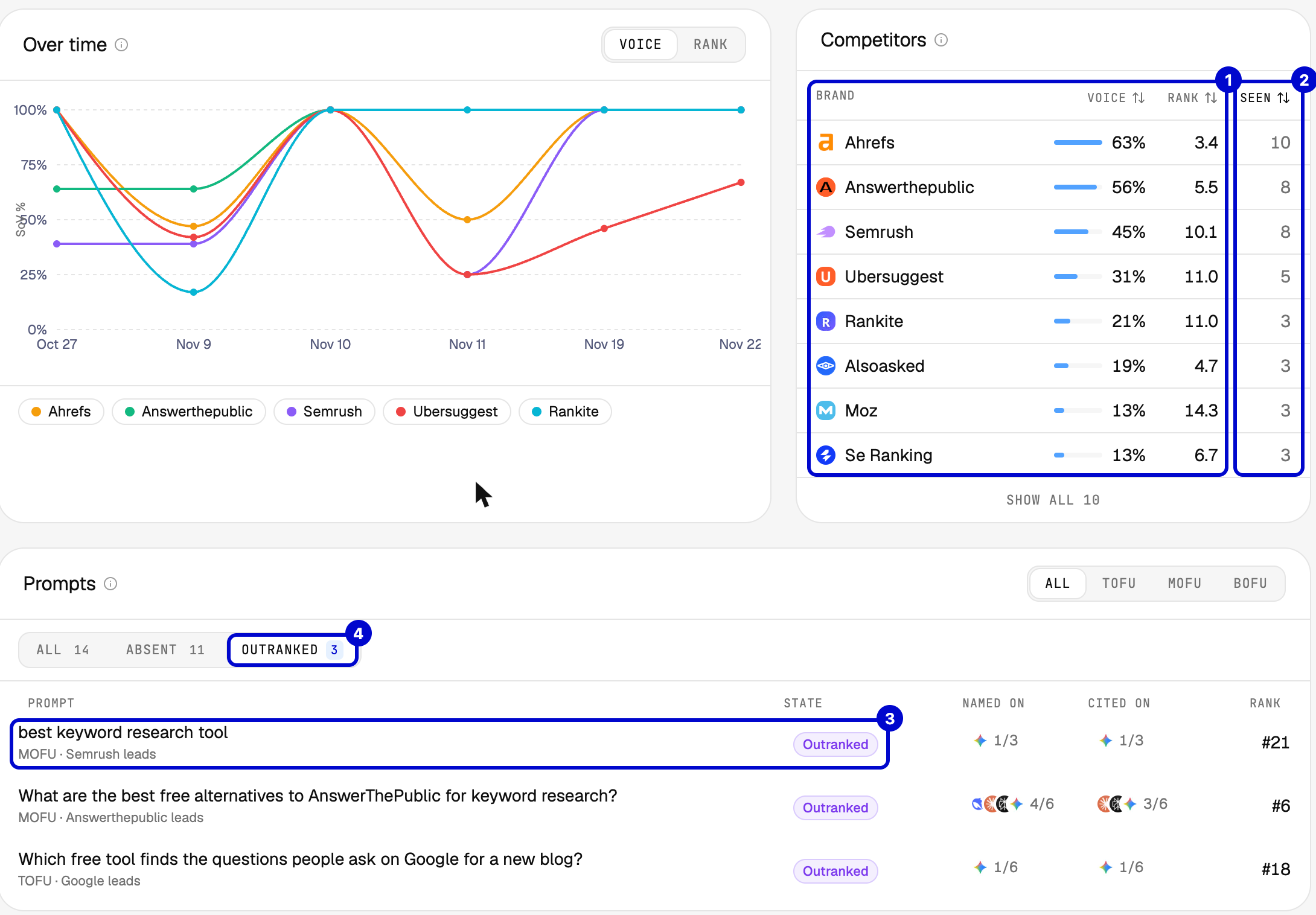
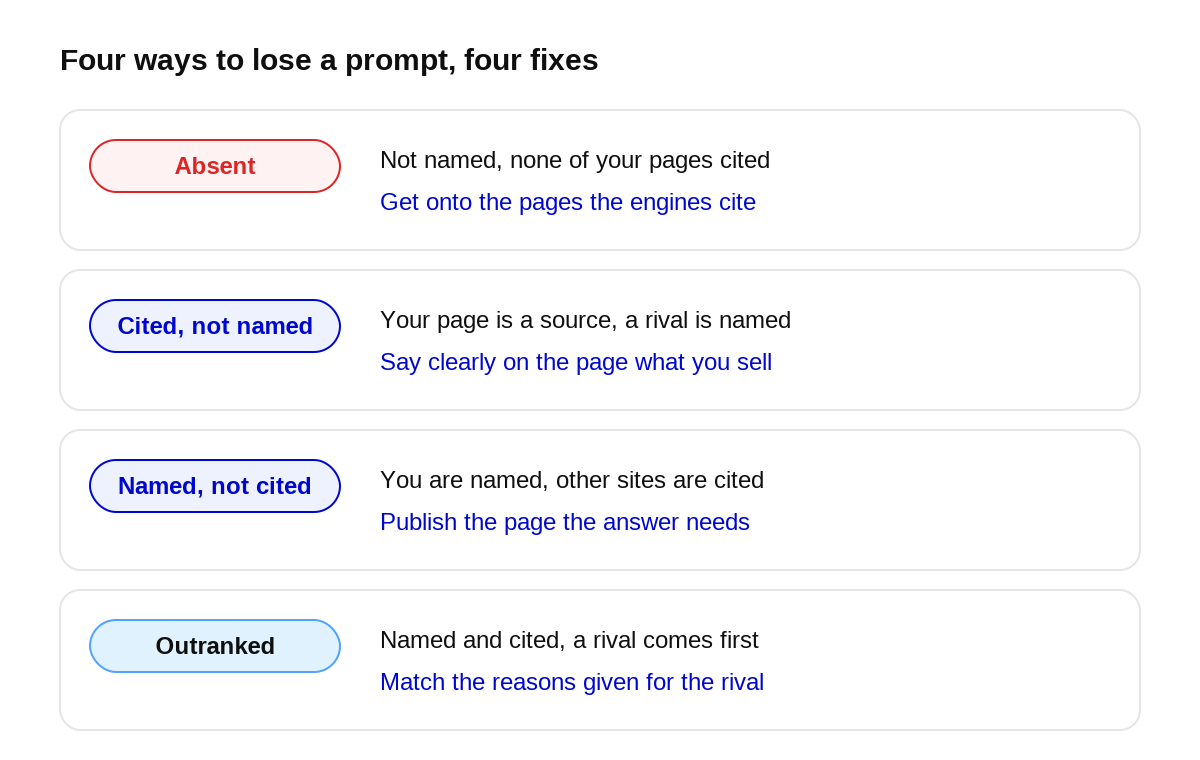
Step 4. Find the prompts you lose. The Prompts card on the Dashboard gives each tracked prompt a state from its latest scan, and names the rival that leads it. The states map straight onto fixes:
Step 5. Open the Targets. In the sidebar, open Citations and switch to Targets. This lists third-party and social pages cited in answers that name your competitors but never you, with the Competitors named on each page, its Share of answers, average Pos. and the Engines that cite it. Switch on Lists only to see best-of lists, roundups and comparisons first. The page's own advice is right: "Lists are the quickest wins: ask to be added."
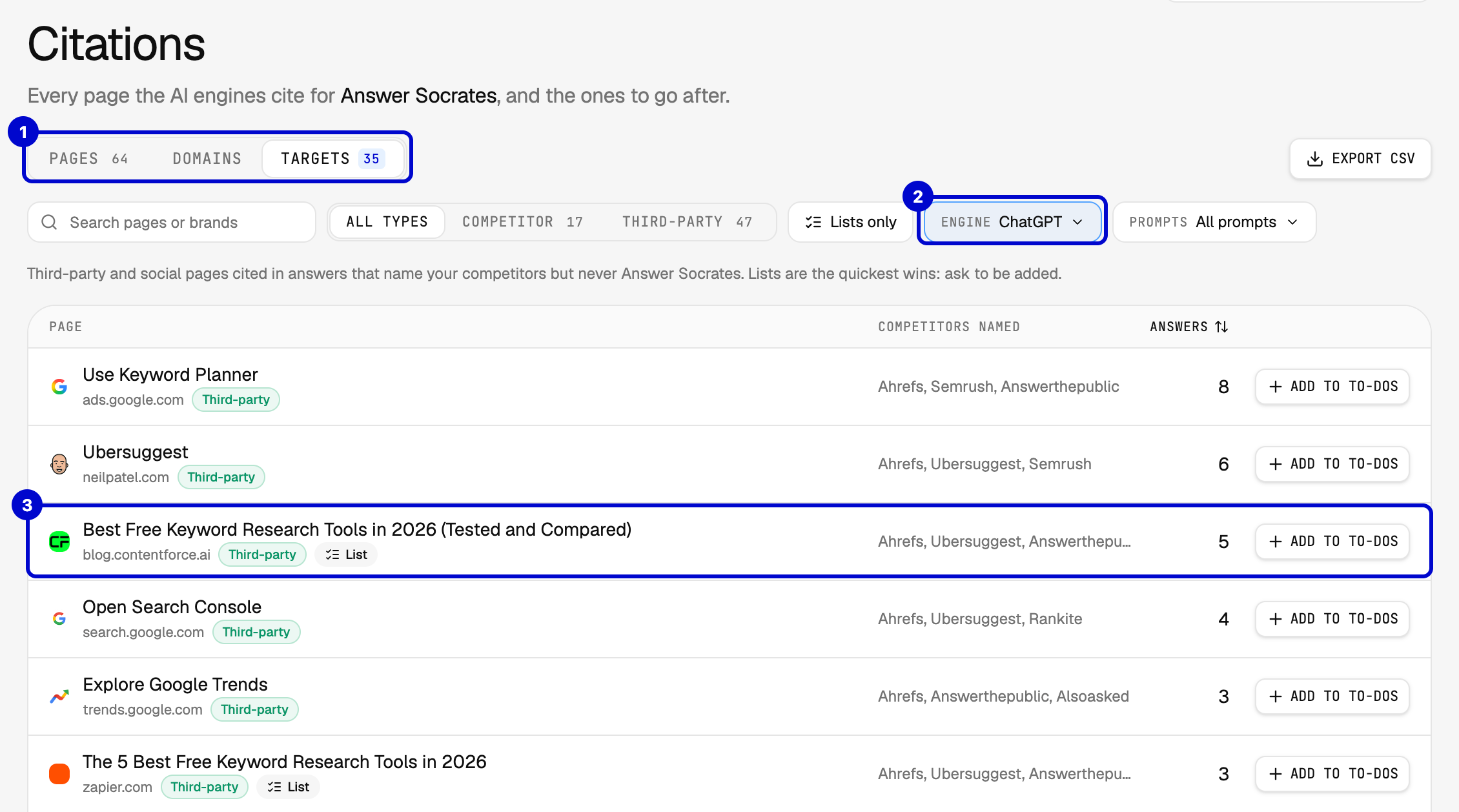
Step 6. Turn targets into work. Open a target and press Add to To-dos. The card it makes says which answers cite the page, which rivals they name, what to ask for and how to check it worked: rescan the same prompts once the page names you. The To-dos board also suggests the best citation targets on its own, in the Suggested column.
Rivals in Link Building and in the chat
Two more places use your competitors, and they work from your project, not from the tracker's answers.
Link Building. Each project's Link Building setup holds up to 5 competitor sites ("2 or 3 sites in your niche that buyers compare you with"). The Listicles tactic then finds lists "in Google and in your competitors' backlinks that name two or more of them but not you", and Link gap finds sites linking to two or more of your competitors but not you. These come from Google results and backlink data, not from AI answers, so they catch lists the engines have not cited yet. A best-of list that names three rivals is worth pitching whichever tool found it. Finding link opportunities covers the tactics.

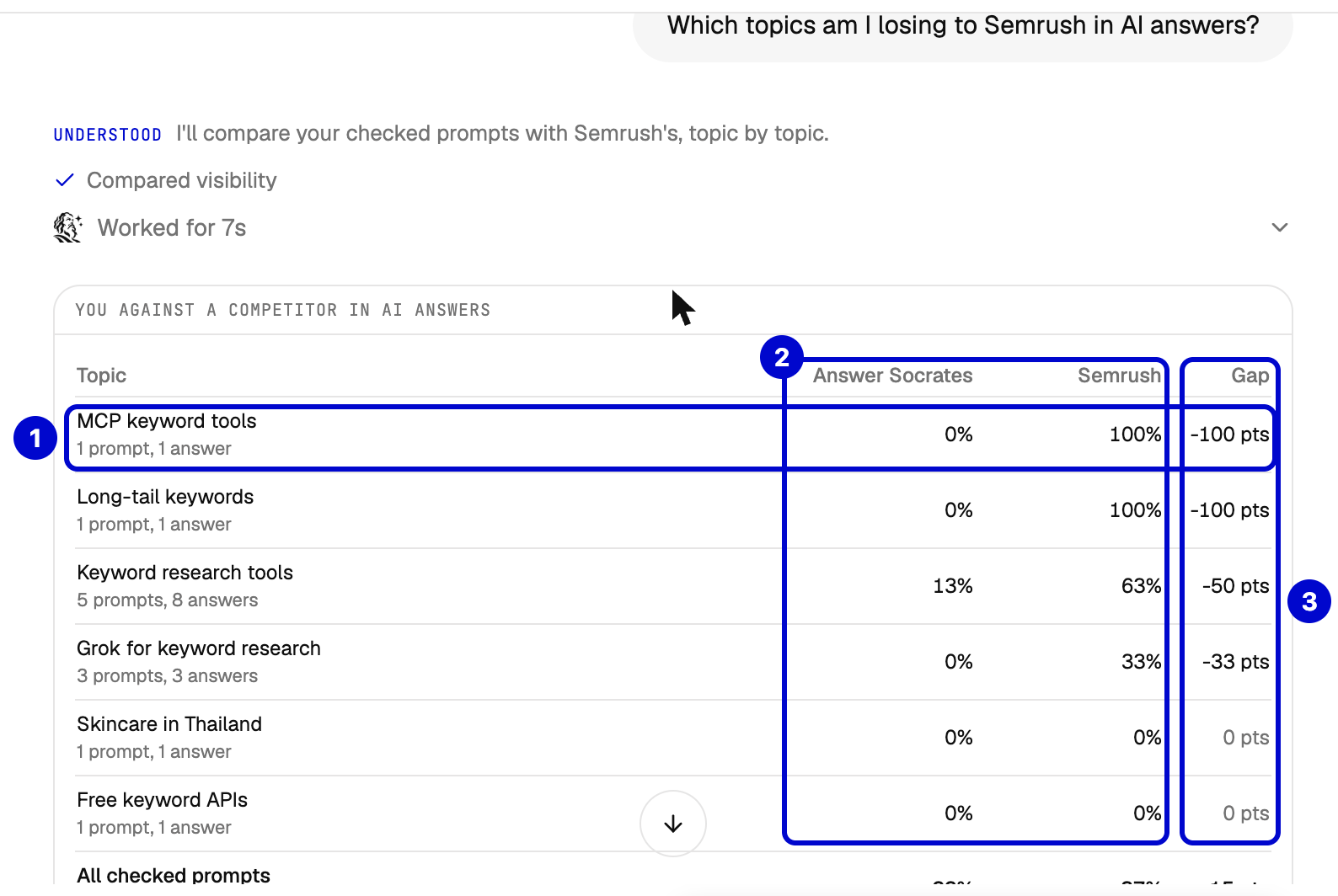
Ask Socrates. Open a project that already has checked prompts and ask:
The chat groups your checked prompts into topics and shows, for each topic, the percent of answers naming you, the percent naming the competitor and the gap in points. It reads checks already on the project, so it is free and runs nothing new. Leave the brand out ("Who beats me in AI answers, by topic?") and it compares you with the competitor named most. If a topic has only a few answers behind it, treat the gap as thin.
A worked example: Northbound vs Ember
A made-up example: Northbound Coffee tracks 8 prompts across ChatGPT, Gemini, Perplexity and Claude. The Dashboard's Competitors card shows Ember with a Voice of 68% and Northbound at 19%. The Prompts card marks 5 of the 8 prompts Absent and 2 Outranked, each with "Ember leads".
Northbound works through it in order:
- Targets, Lists only. Two best-of lists and one review blog are cited in most answers that name Ember. None mentions Northbound. The owner emails each editor once, with a short reason Northbound belongs on the list.
- The Outranked prompts. The answers for "coffee subscription for espresso" praise Ember for "roast date on every bag". Northbound prints roast dates too, but its plans page never says so. That line goes on the page.
- A rescan in four weeks. Same prompts, same engines. Northbound now appears in 2 more answers, through the review blog that added it.
Small wins like this are normal. The engines change their picture of a category one source at a time.
What competitor data cannot tell you
A tracker shows who is named, not why with certainty. Keep these limits in mind:
- Brand names are read by AI. The tracker pulls brand names out of each answer with a model. Odd spellings, a product named without its brand, or two names for one company can split or hide a rival.
- Rank moves more than share. Order changes almost every run [1]. Compare share of answers first and use position only for large gaps.
- Rivals are per prompt. A brand that beats you on "best" prompts may never appear on "how to" prompts. Do not crown one competitor from one prompt.
- Correlation is not a recipe. Being on the pages engines cite tends to go with being named [2], but a single new mention will not flip a 9 to 2 gap.
Where to go next
| If you want to... | Read |
|---|---|
| Run your first check of who gets named | Is AI mentioning your brand? How to check |
| Watch your share against rivals week by week | Tracking AI visibility over time |
| Learn what cited pages have in common | Why AI cites some pages and not others |
| Get onto the lists your rivals are on | Finding link opportunities |
| See whether AI answers send you visits | Measuring traffic from AI search |
Sources
- NEW Research: AIs are highly inconsistent when recommending brands or products, SparkToro, 2026
- An Analysis of AI Overview Brand Visibility Factors (75K Brands Studied), Ahrefs, 2025
- AI features and your website, Google Search Central, 2026
